 Angryturtle
Enterprise Local SEO
Enterprise local SEO for Indian multi-location brands. Bulk GBP management, location data governance, brand consistency at scale and executive reporting. Request a scoping call.
·
A hospital network with 25 branches. A bank with 400 branches and 1,200 ATMs. A QSR chain running 150 outlets across 12 cities. A developer with 30 active project sites in 8 markets. None of these problems get solved by one person operating a tool manually — the coordination requirements outgrow what any individual process can hold reliably, and that's the actual definition of enterprise local SEO. It's an organizational and operational problem before it's a technical one.
Enterprise local SEO is bulk GBP operations across 50 to 5,000-plus locations, an access and governance model that says who can touch what, network-wide reporting built for operations and executive audiences separately, and SLAs that hold the vendor accountable rather than a vague promise of "we'll take care of it." Angryturtle runs this through the same DCG framework — Diagnosis, Cost Optimization, Growth — used across every account, scaled up to a network rollup instead of a single profile.
How we actually run this
Enterprise engagements follow the standard DCG sequence, not a bespoke process invented for large accounts, because the sequence is what actually works — what changes at scale is the unit the work runs on.
Diagnosis takes the same first month it takes anywhere, but the deliverable is a network gap map instead of a single location's: a GBP completeness score for every branch, a geo-grid baseline sized to the highest-value locations rather than run identically across all of them (scanning 500 locations at once produces noise, not a usable signal), a NAP audit against the master location file, and a Rank OS rollup showing which regions and which dimension are dragging the network average down. What you get: the gap map itself, region by region. What we need from you: read access or ownership transfer on the existing GBP accounts, the master location file if one already exists, and a named contact per region who can answer what the audit turns up.
Cost Optimization runs Months 2 and 3, the same window as any DCG account, but fixes apply through bulk API operations rather than location-by-location edits — category corrections, NAP remediation, and attribute updates push out network-wide. A suspension found anywhere in the network jumps the queue immediately, same as it would for a single location. What you get: a corrected master location file and a bulk remediation log per branch. What we need: sign-off authority on brand-standard elements — name, primary category, logo, core description — from whoever actually owns that decision internally, because a bulk push touches every branch at once and an unwind is expensive.
Growth becomes dominant from Month 4, matching the standard DCG trigger point, and from there it's the ongoing operating rhythm described below under governance, Rank OS rollups, and reporting — review velocity, citation expansion, content cadence, and AI Overview readiness, tracked per location and rolled up to region and brand.
Bulk GBP operations at 50 to 5,000-plus locations
At enterprise scale, the platform layer has to automate what's repeatable and leave judgment to people. Simultaneous hours updates roll out across every branch at once — festival special hours deployed to 500 locations in a single push rather than one at a time. Description updates apply in bulk when brand messaging changes. New attributes get added across the network the moment Google releases them for your category. Photo campaigns deploy brand-standard imagery to every location simultaneously. Posts publish with location-specific variables inserted automatically — branch name, city, local offer — from a single template.
What doesn't get automated: review responses, because they need a human voice and brand tone even with AI drafting the first pass; content decisions about which post type suits which location type; compliance review of regulated content before it publishes; and suspension root-cause analysis, which needs expert judgment every time. The write-back layer — publishing live to Google across name, hours, categories, service areas, photos, and posts — carries the bulk mechanics. People carry the decisions.
Governance and who can touch what
Enterprise local SEO needs explicit rules about access. The Angryturtle management account holds full admin rights and is the only entity that edits live profiles. HQ marketing sees all location data and reporting and can submit content requests. Regional managers see their own region and submit region-specific requests. Location managers see only their own listing's data and can't edit profiles directly.
Brand-standard elements — name, primary category, logo, cover photo, core description — stay locked to central management with no local override. Local content, meaning local photos, local posts, and local special hours, runs through a submit-review-publish workflow, reviewed within 48 hours and either published or returned with guidance. Regulated industries add a compliance review step before anything publishes, and every piece of published content is logged with a timestamp, reviewer, and approval status.
Location data and NAP at real scale
Past 100 locations, NAP drift is close to inevitable without a system underneath it. We maintain a master location file — name, address, phone, hours, categories for every branch — as the canonical reference, and both GBP data and directory citations get validated against it. A monthly automated scan across every profile and priority citation flags any discrepancy for remediation, and fixes apply through bulk API operations rather than location-by-location manual work. For enterprises already running a location data system — Salesforce, an internal database, a legacy Yext deployment — we work from a data feed export to keep GBP synchronized with your own source of truth.
Rank OS and demand clusters across the whole network
Every location still carries its own Rank OS score across the same five weighted dimensions — Relevance, Review Health, Freshness, Entity Authority, AIO Readiness — because a branch in Pune and a branch in Kolkata genuinely have different data, not because the platform pretends they're identical. What changes at enterprise scale is the rollup: scores aggregate to city, region, and brand views so an executive team can see network-wide trends without losing the ability to drill into a single underperforming branch.
Demand clusters work the same way — each location's keyword clusters are computed from its own first-party GBP data, tracked for whether they're scaling, broadening, concentrating, or decaying, with opportunity sizing pulled from Ads Keyword Planner data. A national retail chain doesn't get one keyword strategy forced onto every store; each store's cluster reflects its own actual search behavior.
What moves, and when
Profile accuracy and category fixes move fastest across a network. Once the master location file is corrected and bulk API operations push a fix live, Relevance and Entity Authority scores shift within the same reporting cycle, usually 30 to 60 days across the whole network rather than location by location. Suspension resolution jumps ahead of everything else the moment it's found, anywhere in the network.
Review velocity and citation coverage take longer, because they compound instead of snapping into place. Growth-stage review and citation gains tend to show measurable effect within 60 to 90 days of consistent execution per location, and at network scale that shows up unevenly — a region with strong staff adoption of the WhatsApp request flow moves faster than one where adoption lags behind.
Geo-grid share of local voice, and competitive commercial phrases specifically, take the longest of all — usually a quarter or two behind the review and citation gains that feed them, longer again in the most contested metro categories. None of this is guaranteed. Anyone promising a specific rank position or a fixed timeline in writing is selling certainty that nobody in this industry actually controls — Google's ranking algorithm isn't public, and your position depends on what every competitor in that market does too, not only on what we do on your account.
Store locator and location-page architecture
Enterprise local SEO extends past the GBP layer into the website's own location infrastructure. A functioning store locator needs server-side rendering so Google can actually crawl every location's data, a unique indexable URL per location, a full NAP block matching the GBP exactly, an embedded map, and content that isn't a copy-paste template repeated across every page — a unique intro paragraph with real city or area context, location-specific services where relevant, local team information if the brand allows it, and schema-marked reviews. Angryturtle advises on this architecture and manages the citation layer underneath it, though the locator build itself sits outside our scope — we're not a website builder, and we say so plainly rather than overselling.
Reporting for two audiences at once
Operations teams need location-level detail — which branches are gaining, which have review velocity below threshold, which carry citation errors, which sit at suspension risk — because that granularity drives weekly decisions. Executive audiences need brand-level aggregates — quarter-on-quarter rank improvement, network-wide review count and rating, the percentage of locations sitting top-3 for primary keywords, regional comparisons — because that's what informs quarterly strategy.
Weekly, an automated digest flags exceptions only, one line per location. Monthly, a full location-level report rolls up to city, region, and brand views. Quarterly, an executive pack adds trend analysis and competitive benchmarking. Ask Virtual CMO sits underneath all of it for anyone who wants to ask a direct question grounded in the actual data rather than wait for the next scheduled report.
None of this asks you to take our word for it. The Rank OS score, the dimension breakdown, and the geo-grid SoLV numbers are visible inside the platform as they update, not only inside a monthly PDF, and the underlying action log — every edit, every citation fix, every post — is timestamped and exportable. If a number in a report doesn't match what you see in your own GBP dashboard, raise it; don't assume the report is right by default. See DCG reporting and Rank OS for how this reporting layer works on any account, enterprise or otherwise.
Agency OS: the multi-tenant layer behind large accounts
Enterprise and agency accounts run on Agency OS, our multi-tenant architecture with role-based access — Agency Admin, SEO specialist, Project Manager, and Client roles, each seeing exactly what they should. Usage is metered through Turtle Credits rather than flat per-seat pricing, client portals give each brand or franchise partner their own branded view, and a 22-endpoint API lets enterprise teams integrate Rank OS data into their own internal systems instead of only viewing it inside our dashboard. SSO is available on the Enterprise plan for teams with existing identity infrastructure.
Security, approvals, and franchise workflows
Franchise governance follows the same pattern throughout: HQ sets brand standards, franchisees contribute local content through the structured workflow described above, and Angryturtle manages execution and compliance in between. No franchisee edits core profile elements without HQ approval. Access runs through Google Business Profile manager accounts rather than shared passwords, and it can be revoked at any point through Google's own account controls. Nothing is stored outside defined systems, and every content action is logged and client-visible. Enterprise SLAs commit to suspension escalation within 4 hours, review response within 24, monthly reports by the 5th, and critical GBP error correction within 24 hours.
A large brand's procurement team usually asks the same handful of questions before signing: where the data lives, who at Angryturtle can see it, what happens to access on contract termination, and whether the account is tied to one person. Data lives inside GBP manager accounts and our own platform, not on local machines or shared spreadsheets. Access is role-based and logged, as above. On termination, GBP manager access is revoked through Google's own controls, and any exported reports or data feeds remain the client's property. And the account runs on a pod model, not a single point of failure — covered in the FAQ below.
What Enterprise doesn't cover
This is GBP, citation, and review infrastructure at scale — not website development, not link building, and not a guarantee of real-time data. Google's own reporting lags roughly a month, and profile edits can take hours to reflect live even once pushed through the API. Enterprise clients hear this in the scoping call, not discover it three months in.
Where this is the wrong spend
A brand under 20 locations doesn't need Enterprise, unless the category is genuinely complex or regulated. The bulk tooling, the governance layer, and the multi-tenant reporting solve a coordination problem that only exists once a network is large or fragmented enough that no single person can hold it in their head — smaller brands get more for less on Managed Local SEO or the Agency plan.
It's also the wrong spend for a brand that can't get internal sign-off moving quickly. Bulk operations touch every location at once, and if a category or description change needs six weeks of committee review before anyone approves it, the platform's speed advantage sits idle waiting on process rather than technology. And if the real bottleneck is the store locator or the website's own on-page SEO rather than the GBP and citation layer, that's a different scope — see what Enterprise doesn't cover, above.
Anyone shopping specifically for a guaranteed rank position, a guaranteed suspension-free network, or a fixed enquiry-uplift figure should look elsewhere. That's not a number any vendor honestly controls, at any scale, and a proposal that promises one is worth being suspicious of.
Frequently asked questions
What's the minimum location count for the Enterprise plan? Formally 20-plus, though complexity matters as much as raw count — a heavily regulated sector with 15 locations can be a better Enterprise fit than a simple retail category with 25.
How do you onboard 50 new locations at once? Through bulk onboarding: parallel GBP creation and verification, bulk citation building off the master location file, and simultaneous review pipeline activation. Early engagement, three to four weeks before launch, is required to hit that timeline reliably.
Do you work with our existing location data system? Yes. If you're running Salesforce, SAP, or a proprietary location database, we work from a data feed export and manage the synchronization from our side.
Can different stakeholders get different reporting frequencies? Yes — weekly digests for operations, monthly detailed reports for marketing, quarterly executive packs for leadership are all standard on Enterprise.
What happens if our account manager changes? The pod model means the account isn't tied to a single person. Institutional knowledge — client history, strategy notes, the approvals log — stays with the pod, and transitions run over a two-week handover.
How does the DCG framework change at enterprise scale? The three stages, Diagnosis, Cost Optimization, Growth, stay identical, but each one adds a network rollup: a network gap map instead of one location's, bulk API fixes instead of edits done one at a time, and region and brand-level Growth tracking instead of a single profile's numbers.
When do we start seeing network-wide movement, and how is it reported? Category and profile-accuracy fixes usually show up across the network within 30 to 60 days of Cost Optimization starting. Review velocity and citation gains follow over the next 60 to 90 days, and geo-grid share of local voice trails that by a quarter or two. All of it is visible inside the platform as it happens, not only inside the monthly report.
How do we start? Request an enterprise scoping call →. We'll assess location count, category complexity, compliance needs, and data infrastructure before building a custom proposal.
Which demand is growing, and which is decaying
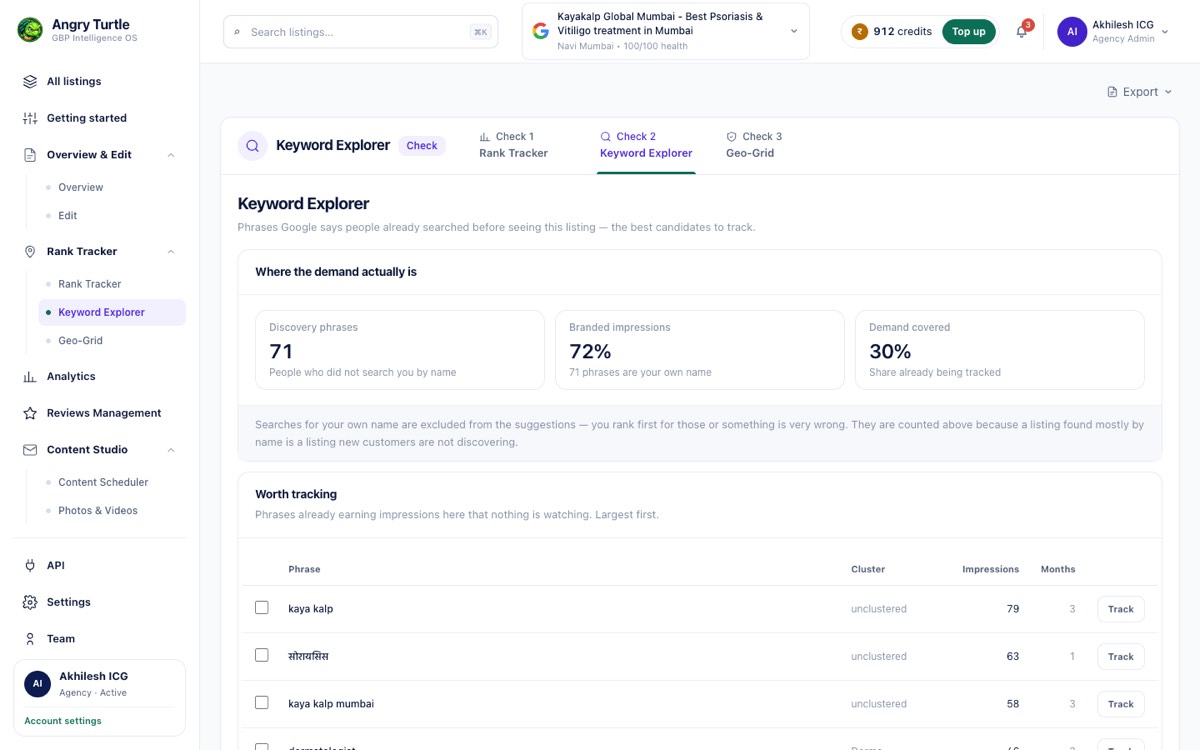
Search terms group into industry-aware demand clusters, each with a momentum read — scaling, broadening, concentrating or decaying — computed from your own Business Profile data rather than a generic keyword tool.
Ready to have this run for you?
Book a free audit — we'll show you where you stand in 48 hours.