 Angryturtle
White-Label Local SEO
White-label local SEO for Indian agencies. We fulfil GBP management, citations, reviews and reporting under your brand. Partner pricing, full confidentiality. Become a partner today.
·
Agencies that already have client relationships often don't have the in-house team to execute local SEO properly, and building one is slow, expensive, and hard to keep staffed. White-label local SEO — white label GBP SEO specifically, since Google Business Profile work is most of what agencies resell — is the workaround: Angryturtle fulfils the full scope under your brand, and your client never sees our name.
What "invisible delivery team" actually means here
GBP management, citation building, review management, geo-grid rank tracking, and monthly reporting all get delivered with your agency's name, your logo, and your report design attached. There's no Angryturtle watermark anywhere a client would see it. This lets agencies sell local SEO without hiring for it, keep the client relationship while removing execution risk, and earn a margin on delivery without adding headcount.
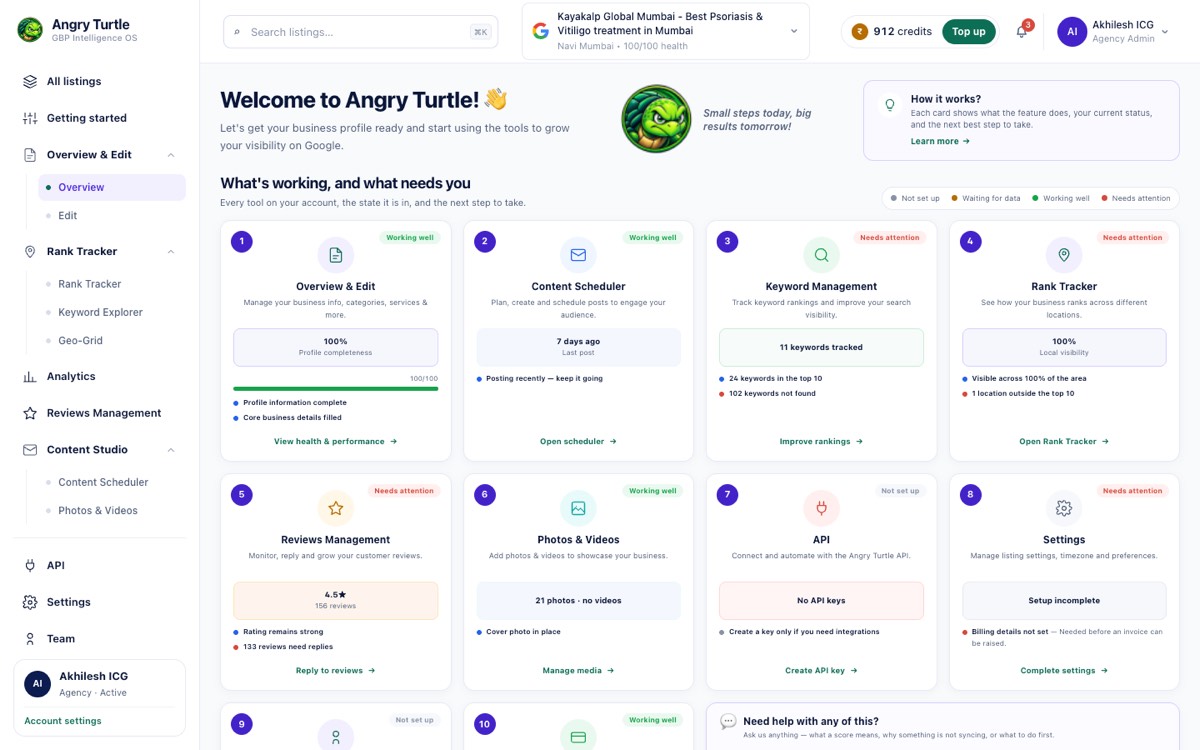
The mechanics run on Agency OS, our multi-tenant platform built specifically for this arrangement — role-based access for Agency Admin, SEO, PM, and Client seats, metered Turtle Credits instead of flat per-seat pricing, and branded client portals so your customers log into something that looks like your product, not ours.
White label GBP SEO versus simple reselling
Reselling and white-labelling get used interchangeably, and they aren't the same commitment. A reseller arrangement is mostly a billing relationship: you mark up someone else's service and pass it through, and the end client may well know a third party is doing the work, because nobody's hiding it. White label GBP SEO is a step further — the client-facing identity, not just the invoice, has to be yours. That means the GBP manager-of-record access sits under your agency's name, the reports carry your logo and no trace of ours, and if a client ever looks up who's managing their profile, brand is what they find.
The operational cost of that difference falls on us, not you, which is the point of paying for it. We build the report templates to match your brand rather than sending you a generic PDF to relabel. We route platform notifications and portal logins through your branded environment rather than a shared one with our name on it. And we hold to a stricter confidentiality standard than a typical reseller agreement requires, because a reseller leak is embarrassing; a white-label leak breaks the entire premise of what you're paying for.
What actually happens when something breaks
The honest failure mode in white-label delivery isn't the work itself going wrong — it's a coordination gap when it does. Say a client's GBP gets suspended on a Tuesday, three days before a scheduled client call. Under our SLA, suspension escalation happens within 4 hours of detection, but the client relationship is still yours, so the actual sequence matters: we detect and start the reinstatement process, and you get notified immediately through the Partner Slack channel so you can decide what, if anything, to tell the client before it's fixed rather than after.
Where this goes wrong for agencies new to white-label is assuming "fulfilled under your brand" means "you never need to know what's happening." It doesn't. You still own the client conversation, which means you need visibility into what we're doing and why, fast enough to answer a client's question before they ask it twice. Agencies that treat the Partner Slack channel and monthly call as optional tend to get caught flat when a client raises something we already resolved three days earlier — not because the work was late, but because nobody told the agency it happened.
The same logic applies to routine changes. If we correct a NAP error or update a category on a client's profile as part of ongoing optimisation, that's logged in the monthly action log you receive — but if a client notices the change themselves and asks about it before your next report lands, you're the one fielding that question. Agencies that do this well build a light weekly skim of the action log into their own process rather than waiting for the monthly cycle to surface it.
Every deliverable, white-labelled
GBP work runs under your agency's GBP manager access, so your clients see your agency as the manager of record. Citation submissions across 20+ platforms via the citation engine — JustDial, Sulekha, IndiaMART, Practo, 99acres, MagicBricks, and the wider Indian directory set — go out as your agency's fulfilment. Review request flows run under your client's own WhatsApp Business credentials, and AI-drafted responses through Reviews AI publish in client brand voice through your process, not ours.
Reports run in your template with geo-grid rank maps, GBP insights, review velocity, citation completeness scores, and the GBP action log — described as your agency's work, because functionally it is your delivery to the client. Competitive rank comparisons come from the same Pin Checker data your platform account would show if you were running it yourself.
Why agencies outsource GBP management instead of hiring for it
Hiring a full-time local SEO specialist in a metro market runs somewhere in the ₹30,000–60,000 monthly range before benefits, and one hire rarely covers GBP work, citation building, and review response across a dozen client accounts without slipping on at least one of those. That's the real math behind why agencies outsource GBP management rather than build the function in-house: the partner rate on white label GBP SEO at volume tends to land below the fully-loaded cost of even a single junior specialist, and it scales with client count instead of requiring a second hire at client thirteen.
The tradeoff isn't free. An agency that outsources gives up direct day-to-day control of execution timing in exchange for capacity it doesn't have to manage, train, or replace when someone quits mid-quarter. For an agency with under ten clients needing local SEO, that trade almost always favors outsourcing GBP management rather than hiring. Past thirty or forty clients, the calculus can flip toward an in-house team paired with our platform in self-serve mode instead. It's worth reading about the underlying multi-location SEO mechanics before deciding which side of that line your book of business sits on.
A worked scenario: a 6-person Mumbai agency taking on its first 12 white-label clients
Take an agency running paid ads and social for a dozen SMB clients in Mumbai, none of whom currently get any GBP or local SEO attention beyond what the client owner does themselves. The agency wants to add local SEO as a line item without hiring an SEO specialist, and needs pricing that still leaves margin at a client-facing rate SMBs in that market will actually pay.
The workable path here isn't onboarding all 12 clients on day one. It's picking 2 or 3 clients with the clearest existing gap — say a GBP with under 40% profile completeness and no review activity in months — running the four-week onboarding sequence on those first, and using that as the proof point before rolling the rest in over the following two months. At the volume tier for 5 to 20 locations, the agency buys at the standard partner rate and sets its own client-facing price with a 30 to 50 percent margin; at 12 clients the agency isn't yet at the 21-location discount tier, so the math should be run on standard rates rather than assuming a volume break that hasn't been earned yet.
A second scenario: a 3-person Bengaluru agency's first quarter on white label GBP SEO
A small Bengaluru agency running website builds and PPC for local businesses gets asked by an existing client, a chain of three yoga studios, whether they also handle "the Google listing thing." They don't, and they don't want to hire for a service they're not sure will stick as a line item.
They sign on as a white-label partner at the three-location minimum, using the client's three studios as the pilot. Month one is the audit. All three profiles have inconsistent hours, one has a stale phone number carried over from a studio that closed eighteen months earlier, and none have posted anything in over six weeks. Month two starts execution: hours corrected, categories tightened, review request flows set up through WhatsApp. By month three, the agency has a branded report to hand the client showing geo-grid movement across all three studios, powered by the same Rank OS score every plan runs on, and can quote a going rate for the next client without guessing at delivery cost, because it's already the partner rate plus their margin.
What made this work wasn't the size of the client. Three modest studio locations, no dramatic budget. It was the agency treating the pilot as a real trial rather than a favor to an existing client, complete with the same onboarding sequence and reporting cadence a fifth client would get.
Reporting options and what's inside them
Three format options exist: a PDF built to your agency template with data populated by us, a Rank OS dashboard carrying your agency's logo so clients log into something branded as yours, or a Looker Studio report where we maintain the data connections and you own the visual layer. Whichever format, the underlying data is identical — geo-grid rank maps for tracked keywords, calls and direction requests, review velocity and rating trend, citation completeness, the monthly action log, and competitive comparison. Reports land with you, not your client, by the 5th of each month, and you control the send timeline. We don't communicate with your clients directly unless you explicitly ask us to.
Pricing and margin
White-label partners buy at wholesale rates and set their own margin — there's no fixed markup we require. Agency Partner pricing starts from ₹6,999 per location per month, with setup fees waived at volume. A typical structure has the partner buying at that base rate and billing the client at the base rate plus a 30 to 50 percent margin, recurring monthly with no fulfilment overhead on your side. Volume tiers step down the partner rate as total managed locations grow: standard rate from 5 to 20 locations, a 10 percent discount from 21 to 50, 15 percent from 51 to 100, and custom pricing above that. See pricing for the full plan comparison, or contact us for current partner rates →. We bill the agency monthly in rupees; what you charge your own clients is entirely your commercial relationship, and we have no visibility into it.
Bringing a new client onto the programme
Week one is data collection — client GBP credentials, business details including NAP, categories, and target cities, review generation preferences, and your report template. Week two runs the full audit across GBP, citations, and a geo-grid baseline, with any client-facing questions routed through you as the account owner. Week three starts execution: first GBP optimization actions, first citation builds, review pipeline setup. Week four delivers the first report in your template for you to review, brand, and send onward. From there it's the same monthly cycle, with reports landing by the 5th and a dedicated Partner Slack channel available for strategy support on your account team's side.
Communication and SLAs for partners
Every agency gets a dedicated Partner Manager and a Slack channel for day-to-day queries and new-client onboarding, plus a monthly 30-minute partner call to review performance across every white-label client and align on priorities. Review responses go out within 48 hours of publication, 24 on the Growth tier. Suspension escalation happens within 4 hours of detection. Monthly reports reach you by the 5th. Critical GBP error correction lands within 24 hours, and partner queries get a response within one business day via Slack, four hours if flagged urgent.
What happens when an SLA gets missed and the end client escalates
Take a case where a partner's client notices a wrong phone number on their GBP, flags it to the partner agency, and the correction — for whatever reason, a queue backlog, a missed Slack message — doesn't land inside the 24-hour critical-error window. The client escalates to the agency, frustrated, wanting to know why something that sounds trivial is taking days.
The partner's real exposure here isn't the missed window itself; single misses happen in any operational relationship. It's whether the agency has anything concrete to tell the client in that moment. Agencies that handle this well go back to us immediately through the urgent Slack flag rather than waiting for the next scheduled call, get a real timestamp on when the fix will land, and pass that timestamp straight to the client instead of a vague "we're looking into it." Agencies that handle it badly try to resolve it themselves first and only escalate once the client is already upset, which turns a minor delay into a trust problem entirely of the agency's own making.
The relationship survives a missed SLA. It doesn't survive the client feeling like the agency didn't know what was happening with its own vendor. That's the actual argument for treating the Partner Slack channel as a live operational tool rather than a once-a-month check-in — the four-hour urgent-response commitment only protects the client relationship if the agency actually uses it the moment something's wrong, not after the client has already asked twice.
What to check before signing on as a white-label partner
Before committing client volume, an agency should actually look at three things rather than take the pitch at face value. First, whether your own reporting cadence matches ours — if you promise clients weekly updates but our cycle is monthly, that mismatch is yours to solve, not something to discover after the first client complains. Second, how your current client contracts are worded around subcontracted delivery; some client agreements require disclosure of third-party fulfilment even under a white-label arrangement, and that's a legal question for your own counsel, not something the platform resolves for you. Third, whether the industries you're bringing in are ones we serve — healthcare, lifesciences, real estate, hospitality, education, franchise, retail, and BFSI — since compliance-heavy categories carry review and content restrictions that need to be understood before a client signs, not after.
Who shouldn't use white-label local SEO
An agency selling to clients who explicitly want to know exactly who touches their Google profile — some legal, financial, or healthcare clients require this as part of their own compliance posture — is a poor fit for white-label specifically, though a disclosed managed local SEO engagement run under our own name works fine for that same client. An agency with fewer than three total locations to place doesn't clear the partner minimum in a way that's worth the account-management overhead on either side. And an agency looking for a purely passive revenue line, with zero ongoing involvement, will find the Partner Slack channel and monthly call more demanding than expected. Outsourcing execution isn't the same as outsourcing the relationship.
Confidentiality and data handling
We don't contact your clients directly and we don't pitch Angryturtle services to them. We don't disclose our role as fulfilment partner outside the agency relationship without your written permission. Client GBP credentials are stored securely and used only for the agreed scope, location data isn't shared with any third party, and on termination, all client credentials are deleted from our systems within 14 days. A data processing agreement is available for agencies with GDPR or Indian data protection obligations to satisfy.
What white-label doesn't include
This is GBP, citation, and review execution under your brand — not backlink building, not website development, and not a guarantee of real-time data on the reports you send your clients. Google's own reporting lags roughly a month, which is worth setting expectations around with your own clients before they ask why last week's review doesn't show up yet.
It also doesn't fit every agency shape. An agency with one or two clients rarely clears the three-location minimum in a way that makes the partner relationship worth the coordination overhead on either side — for that volume, a direct managed local SEO engagement run in the agency's own name, disclosed openly to the client, is usually the simpler path. And it doesn't remove the need for an actual point of contact on your side; white-label reduces execution work, not account management. An agency expecting to hand a client over and never think about local SEO again for that client will find the Partner Slack channel and monthly call more demanding than expected, because staying informed is still part of the job even when the work itself sits with us.
Frequently asked questions
Can we white-label for clients in any industry? Yes, across all eight industries Angryturtle serves — healthcare, lifesciences, real estate, hospitality, education, franchise, retail, and BFSI. Compliance-heavy sectors like healthcare and BFSI follow the same guardrails whether the client is direct or white-label.
Will Angryturtle ever contact our clients directly? No, unless you explicitly ask for a joint onboarding call or similar. Default is that every client communication routes through your agency.
What if a client asks who actually builds the reports? That's your call entirely. Some agencies are transparent about using a specialist fulfilment partner; others keep it in-house-presented. We work with whichever stance you take.
Can we set our own report template? Yes — send a PPT, Canva, Google Slides, or defined PDF format and we populate the data fields. A white-labelable default exists if you don't have one yet.
Is there a minimum commitment? Three months, minimum three client locations, matching our standard managed minimum and giving enough runway to show results on your first clients.
How is this different from your enterprise plan? Enterprise is built for a single large brand managing its own network. White-label is built for an agency reselling the service across multiple, separate client accounts — the platform layer (Agency OS) underneath is shared, but the client-facing structure is different. Managing multiple locations covers the operational overlap between the two models.
What if we want to outsource GBP management but keep everything else in-house? That's most of our white-label book, actually. Agencies routinely keep content, paid media, and web development in-house and outsource GBP management, citations, and review flows specifically, because that's the piece with the steepest specialist learning curve and the least brand-differentiation value in doing it yourself.
Where do we go to actually start the conversation? Contact us or look at what other agencies are running through the programme before filling in the partner enquiry form.
How do we become a partner? Fill in the partner enquiry form →. We respond within one business day with partner rates and a programme overview.
A score you can argue with, not a black box
Rank OS gives every profile a 0–100 score built from five weighted dimensions — Relevance, Review Health, Freshness, Entity Authority and AIO Readiness — and the weights are tunable. Underneath it sits a ranked list of the fixes that move the number, each with the point lift it unlocks.
Ready to have this run for you?
Book a free audit — we'll show you where you stand in 48 hours.