 Angryturtle
AEO Services
Angryturtle's AEO services help Indian businesses get cited by Google AI Overviews, ChatGPT, Perplexity, and Gemini. Managed done-for-you AI search visibility. Book a free AI readiness audit.
·
Being ranked and being cited are not the same thing anymore. A business can sit at position one in the local pack and still not exist inside the sentence an AI Overview writes when someone asks "best orthodontist in Indiranagar." That sentence names two or three businesses, not ten. Angryturtle's AEO services are built to get you named in it — as a self-serve platform you run yourself, or as a managed service where our team does the work.
Answer Engine Optimization (AEO) is the practice of structuring a business's Google Business Profile, website, citations, and review profile so that Google AI Overviews, ChatGPT, Perplexity, and Gemini can identify the business confidently enough to cite it. Classic SEO optimises for rank position. AEO optimises for whether the AI engine trusts the entity enough to say its name.
Why this is a GBP problem before it's a content problem
Most agencies sell AEO as a content and schema service — blog posts, FAQ pages, structured data. That's real work and Angryturtle does it. But for local businesses, the highest-confidence entity data an AI system has access to isn't your website. It's your Google Business Profile: verified, structured, and readable without a crawl. Get the GBP wrong — vague category, no services listed, a description that reads like a brochure — and no amount of blog content downstream fixes it.
This is why Angryturtle's AEO service starts inside Rank OS, our scoring engine, rather than with a content calendar. Rank OS produces a single 0–100 score from five weighted dimensions: relevance (categories, services, and cluster coverage against local peers), review health, freshness, entity authority (NAP consistency and citation coverage), and AIO Readiness — whether the profile reads as a citable answer to Google Maps' AI, AI Overviews, and ChatGPT. AIO Readiness carries a 15-point weight in the default model, and because the weights are config-tunable rather than fixed, an agency running Rank OS for a chain of clinics can weight AIO Readiness higher for a client chasing AI visibility specifically. Nothing here is a black box you're asked to trust. Background on the model is in the Rank OS glossary entry and the AEO readiness definition.
How we actually run this
AEO work runs on the same DCG framework — Diagnosis, Cost Optimization, Growth — used across every service Angryturtle offers, mapped here to the three things that actually decide whether an AI system cites you.
Diagnosis means entity accuracy first: the Rank OS AIO Readiness score and the Ask Maps question-by-question audit, run against your GBP, website, and citation footprint, typically inside the first month alongside the rest of a standard DCG diagnosis. You get a gap list naming the specific questions your profile can't answer yet, not a percentage score with no explanation attached. We need read access to your GBP and website, and a plain answer to which AI engines you actually care about — Google AI Overviews, ChatGPT, Perplexity, and Gemini aren't equally important to every business, and treating them as interchangeable wastes the diagnosis.
Cost Optimization here is schema and content structure: fixing entity inconsistencies across directories, implementing LocalBusiness, FAQPage, HowTo, and Speakable schema where it's missing, and rebuilding service pages with a direct-answer opening instead of a marketing lead-in. This runs over the following month or two, the same Months 2 to 3 window as standard DCG cost optimization, because schema and page restructuring take real implementation time and aren't a single sitting's work.
Growth, from Month 4 on, is citation monitoring: ongoing answer-targeted content built from demand clusters below, and, where the query-level data supports it, tracking how often you're actually cited across the engines named at Diagnosis. This is the stage where the honest limits matter most, covered further down this page.
Ask Maps: the question bank behind the score
The AIO Readiness dimension isn't a guess. It's backed by Ask Maps, a per-listing question bank that checks, question by question, whether a profile is a strong citable answer when Google Maps' AI, AI Overviews, or ChatGPT are asked about it. You seed and edit the question set for your category and city, run the visibility check, and see which questions your profile answers well and which ones it doesn't. A dermatology clinic might answer "do you treat acne scars" cleanly but have nothing extractable for "do you offer teleconsultation" — Ask Maps surfaces that gap by name, not as a generic score.
That's the difference between Angryturtle and a tool that just reports a percentage: Ask Maps tells you which specific answer is missing, and the fix flows straight into the GBP editor.
From diagnosis to a pushed edit
A diagnosis is only useful if something happens after it. Angryturtle's GBP editor gives a visual preview of how a change will look on Google, over a full editor for name, description, phone, website, address, hours (including holiday hours), categories via a live Google category picker, and service areas — and the change pushes straight to Google. Photos, posts, products, and review replies publish live the same way. Most competing tools in this category are read-only, or write back to some fields and not others; this is the piece Angryturtle treats as its core bet, and it's the one most often missing elsewhere. It's also why an AEO fix here isn't a recommendation you take away and implement somewhere else — the fix is executed in the same place it was diagnosed, though edits still take a few hours to reflect on Google's side, because that's Google's timeline, not ours.
What actually gets fixed, in order
Once the Rank OS score and Ask Maps gaps are in hand, the work sorts into six areas.
Entity and authority. Your business described the same way everywhere — GBP, website, JustDial, Practo, IndiaMART, Sulekha — with sameAs links tying them together in schema. Inconsistent entity data is the single most common reason a profile that looks fine to a human reads as unreliable to an AI system cross-checking sources. Our citation and NAP tooling tracks this across 20-plus platforms.
Structured content. Service pages get a direct-answer opening instead of a marketing lead-in, FAQ sections in question format, and LocalBusiness, FAQPage, HowTo, and Speakable schema where it applies. An llms.txt file is set up so AI crawlers know which pages matter most. Related reading: schema markup for AI search and entity SEO and the knowledge graph.
Answer-targeted content. Ongoing content aimed at the specific questions AI engines are being asked for your category in your city — not generic blog posts, but pieces built answer-first and schema-marked from the start, informed by demand clusters rather than guesswork (more on that below).
Citation and mention building. Presence on the sources AI systems actually draw from for Indian queries: association directories, vertical platforms, and general citation sources, tracked through the citation engine plus NAP consistency checks, duplicate detection, and a missing-citations map.
Reviews, read two ways. Angryturtle drafts AI-assisted review replies with a personalised greeting and your brand signature, one-click publish to Google. It also runs the Brand Identity vs Image comparison — your canonical story, what you say you are, against what your reviews actually say customers experience — and flags the gap with specific actions to close it. If your "why choose us" copy talks about speed and your reviews keep mentioning long waits, that gap shows up here before it shows up in a lost AI citation.
Measurement. Where the query-level data supports it, we track how often you're cited across the AI engines you care about — see Share of AI voice tracking for what that measurement actually involves and what it doesn't yet claim.
Demand clusters: knowing which questions matter before you write anything
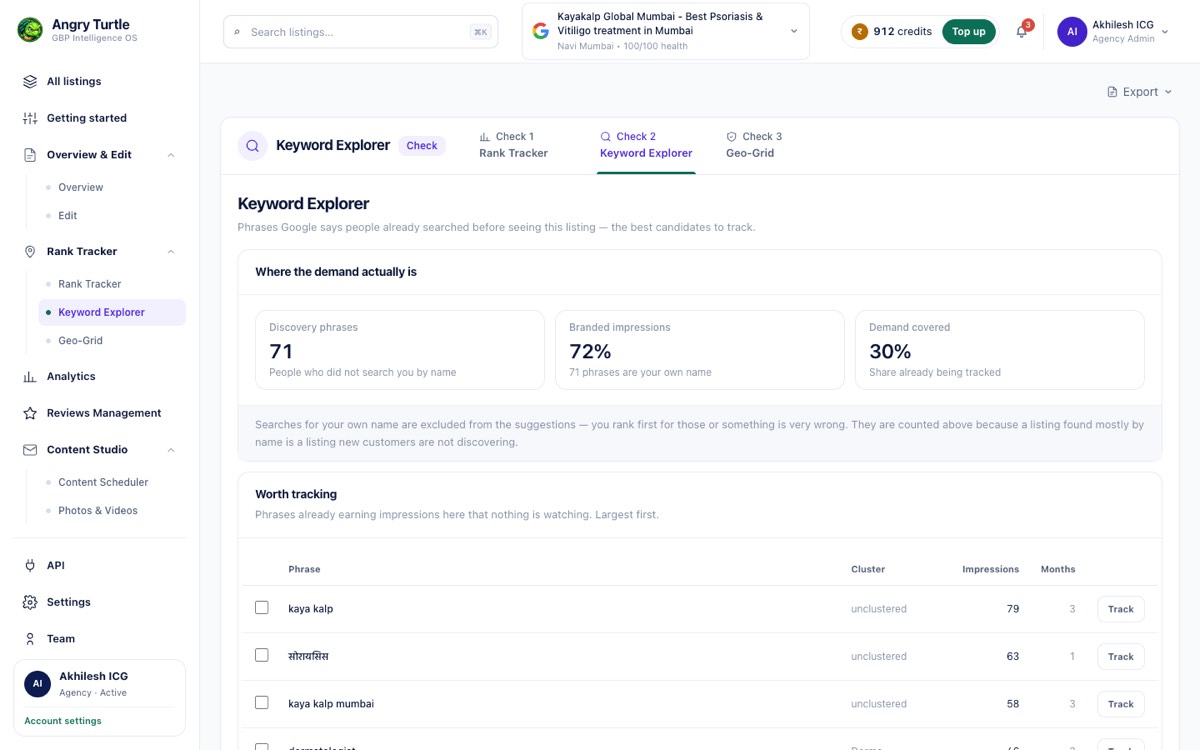
Content built for AI citation only works if it answers a question people are actually asking. Angryturtle's demand clusters group your category's search behaviour into industry-aware keyword clusters, each with a momentum reading — scaling, broadening, concentrating, or decaying — computed from your own GBP performance data, plus a potential score sized against Google Ads Keyword Planner volumes. A cluster that's scaling and under-covered is where the next piece of answer-targeted content should go; a cluster that's decaying is not where you spend a content budget, no matter how well it ranked last year. This is also where seasonal Indian demand shows up early — a wedding-season cluster for a jeweller, or an admissions-season cluster for a coaching institute, moves before the obvious signals do.
AEO across the industries we serve
The mechanics above apply differently by vertical. Healthcare businesses lean on Practo alongside GBP, with compliance-aware content and medical schema — see Healthcare and Healthcare AI search. Lifesciences and B2B brands lean on IndiaMART and technical entity-building rather than review velocity — Lifesciences. Real estate developers need project-level entity clarity for micro-market queries — Real estate. Hospitality, education, franchise, retail, and BFSI each carry their own citation sources and constraints, covered on their respective industries pages, and the country-specific patterns across all of them are pulled together in the AEO India playbook.
Ask Virtual CMO
Once the score, the gaps, and the fixes are live, the recurring question from a business owner is usually "so what do I do next month." Ask Virtual CMO is a Gemini-powered chat grounded in your specific listing's Rank OS score, reviews, and competitor set — not a generic AI chatbot bolted onto the dashboard. Ask it why your Rank OS dropped four points and it can point at the specific dimension and the specific review or citation change behind it. It's built in strict JSON mode against your data and is designed to flag when it doesn't have enough grounding to answer, rather than guessing.
What moves, and when
Entity accuracy is the fastest fix. Once NAP is corrected across directories and sameAs links are in place, that's a same-cycle change — usually 30 to 60 days, the same Cost Optimization window as any DCG account. Schema implementation and service-page restructuring follow the same window, since both are build work rather than something that compounds gradually.
Citation visibility is the part that's genuinely less settled, and it's more honest to say that plainly than to promise a number. Classic rank tracking has 15-plus years of tooling behind it and a stable, agreed definition of what "position 3" means. Whether ChatGPT or an AI Overview cites you for a given query this week versus next isn't nearly as stable — the same prompt can return different sources on different days, the underlying models get updated without notice, and nobody outside Google, OpenAI, or Anthropic can see inside that decision. The entity and content fixes above are the same mechanisms every credible source on AI citation points to, and Share of AI voice tracking is built to show the trend over months rather than a single day's snapshot — but on a surface this new, one snapshot moving up or down means less than the same movement would on a mature rank tracker. See measuring AI search visibility for a fuller look at why the tooling across this whole industry, not just ours, is still settling. Anyone promising a specific citation count or a guaranteed AI Overview appearance is promising something outside anyone's control.
What we report, and how you check it
Monthly, you see your Rank OS AIO Readiness score and its dimension breakdown, the Ask Maps question coverage for your category, and, where the data supports tracking it, a citation log naming which AI engines returned your business for which queries and when the check ran. Where the query-level data doesn't yet support reliable tracking for a given engine or query type, we say so rather than reporting a number we can't stand behind. See DCG reporting and Rank OS for how the reporting layer works generally.
You don't have to take our word for any of it. Ask Maps results appear in the dashboard as soon as a check runs, the GBP editor's change log is timestamped and exportable, and you can independently ask ChatGPT or Perplexity the same questions we track and compare what comes back. If a report says you're cited somewhere and you can't reproduce it yourself, raise it — don't assume the report is right by default.
What AEO does not do
AEO is not website SEO. Angryturtle doesn't crawl or rank your site pages for organic search — it checks your website's NAP against your GBP, but on-page and backlink SEO sit outside this scope, and if that's what you need, say so up front. It's not a backlink service; citations here mean NAP listings, not links. It doesn't gate or filter reviews — that's against Google's policy and we won't do it. AI-drafted content, review replies, and audit findings should be reviewed before they're published, especially anything going live on a real client profile; Gemini in JSON mode is grounded against your data, but a human still checks the output. Google's own performance data also lags by roughly a month and GBP edits take hours, not seconds, to reflect — that's Google's infrastructure, not a limitation Angryturtle can remove. And no one — not Angryturtle, not any AEO vendor — can guarantee a citation. Google, OpenAI, and Anthropic control what their models cite. What we can commit to is the entity, content, schema, and review work that makes citation possible, and honest reporting on whether it's moving.
This also isn't the right spend for a business with fewer than about 10 real reviews and no review-response process running yet. AEO amplifies distribution once the underlying entity data is sound; getting review health to a baseline is Cost Optimization work that needs to happen first, on this page or on managed local SEO generally, before an AI-citation layer has anything solid to build on.
Self-serve, managed, or both
Everything described above exists as a self-serve platform: Rank OS, Ask Maps, the GBP editor, citation tools, and Ask Virtual CMO are usable directly, whether you're a solo operator running one or two profiles or an agency managing a client book through the agency operating system. It's also available as a managed service where Angryturtle's team runs the diagnosis and executes the fixes for you. Agencies get a white-label option, multi-tenant roles, and a portfolio view across every client listing; enterprises get unlimited profiles, volume pricing, and SSO. Neither path is the "real" product — both run on the same engine, and plenty of clients start self-serve and move to managed once the gap list gets long enough that they'd rather hand it off.
Pricing follows the same shape as the rest of Angryturtle: a Solo tier for one or two profiles, an Agency tier that scales with pooled credits and unlimited seats, and Enterprise pricing for chains and multi-brand portfolios. AEO work — the content, schema, and citation layer specifically — is priced as an addition to core local SEO management for existing clients, or as its own standalone scope for businesses not yet on a retainer.
See pricing or book an AI search readiness audit to see where your specific listing stands before committing to either.
FAQ
Is AEO different from SEO? Yes, though they overlap. SEO earns a rank position in organic results. AEO earns a named citation inside an AI-generated answer. The local SEO foundation — GBP, citations, reviews — feeds both, which is why Angryturtle treats AEO as an extension of local SEO rather than a separate discipline.
How is AIO Readiness actually measured, not just described? Through Ask Maps: a per-listing question bank that checks whether your profile answers the specific questions AI systems are asked about your category and city. The result feeds the AIO Readiness dimension of your Rank OS score, which carries a 15-point weight by default and can be re-weighted.
Can you guarantee an AI Overview or ChatGPT citation? No. Citation decisions belong to Google, OpenAI, and Anthropic's models, not to any vendor. We commit to the entity, schema, content, and review execution that makes citation eligible, and we report the movement honestly rather than promising an outcome we don't control.
Do you edit our Google Business Profile directly, or just tell us what to change? Both are available. The platform includes a full write-back editor — changes push straight to Google rather than sitting in a recommendation document. If you'd rather implement changes yourself, the audit and Ask Maps findings work as a standalone gap list too.
Does this replace our website SEO or backlink work? No. AEO here is local and GBP-centred. It checks your website's NAP consistency against your GBP but doesn't crawl or rank your site pages, and it isn't a backlink service. If you need website SEO alongside this, that's a separate scope.
How do demand clusters change what content actually gets written? They stop content decisions from being a guess. A cluster reading as scaling and under-covered gets priority; one that's decaying doesn't, even if it performed well previously. The clusters are industry-aware, so a jeweller and a diagnostics lab are matched against completely different question sets.
How does DCG map onto AEO work specifically? Diagnosis means entity accuracy — the Rank OS AIO Readiness score and the Ask Maps gap list. Cost Optimization means schema and content structure — fixing entity inconsistencies and implementing schema where it's missing. Growth means citation monitoring — ongoing answer-targeted content and, where the data supports it, tracking actual citations across the AI engines you care about.
Why is AEO's timeline less predictable than classic SEO's? Classic rank tracking has a stable, well-understood definition and years of tooling behind it. Whether an AI engine cites a specific source for a specific query can change day to day as models get updated, and nobody outside the AI vendors controls that. The entity and content fixes are stable and worth doing regardless — the citation outcome layered on top is the part still settling as an industry.
What's the smallest way to start? The AI search readiness audit is the entry point — it scores where you stand today on Ask Maps and Rank OS before you commit to either the self-serve platform or a managed engagement.
Which demand is growing, and which is decaying
Search terms group into industry-aware demand clusters, each with a momentum read — scaling, broadening, concentrating or decaying — computed from your own Business Profile data rather than a generic keyword tool.
Ready to have this run for you?
Book a free audit — we'll show you where you stand in 48 hours.