 Angryturtle
Run every client's local SEO from one white-label OS.
Agency OS turns Angryturtle into your own platform. It's multi-tenant and white-label — your logo, no Angryturtle branding for clients — with roles for Agency Admin, SEO, Project Manager and Client. Metered Turtle Credits track usage per listing, client portals and monthly client emails keep everyone informed, and the "All Listings" portfolio view lets you triage your whole book by health and trend. White-label reports and a 22-endpoint Agency OS API make it yours end to end.
In brief
Yes. It's multi-tenant with your own logo and branding — clients see your brand, not Angryturtle. Client portals, monthly client emails and reports all carry your identity.
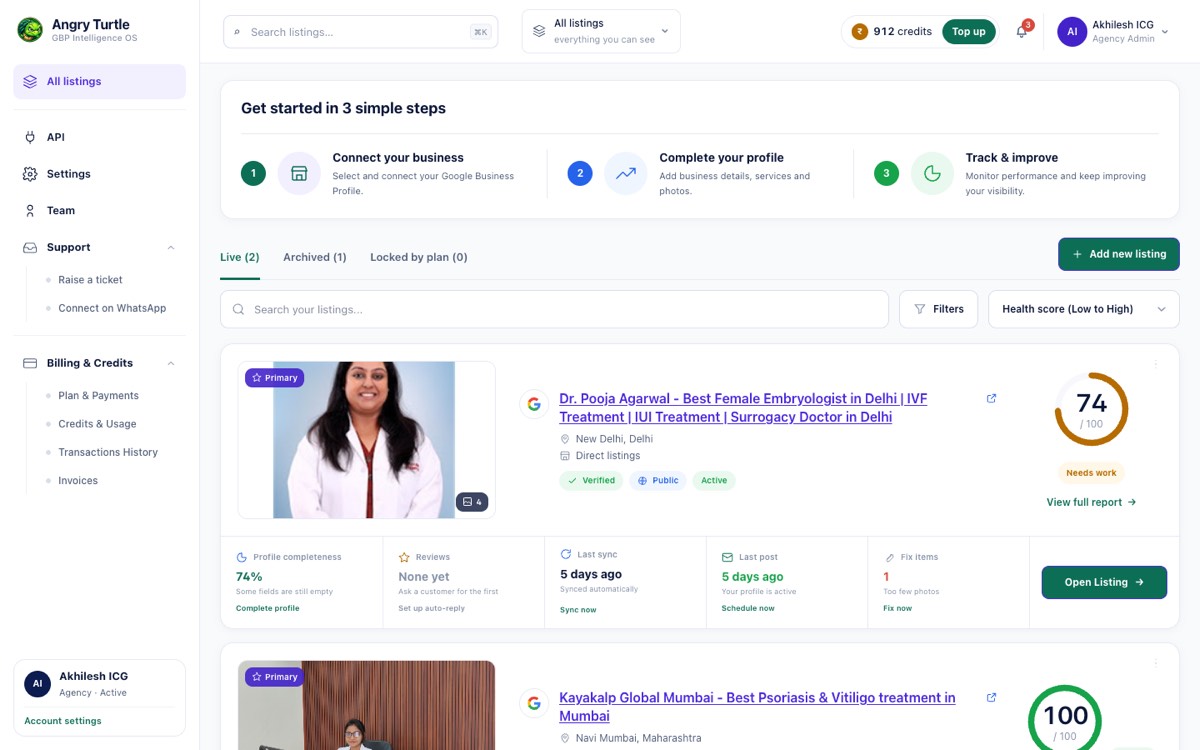
Agency OS — from the live Angryturtle console.
How Agency OS works.
Brand it
Add your logo and white-label the platform, portals and reports.
Set roles
Assign Agency Admin, SEO, Project Manager and Client access, with metered Turtle Credits.
Run the book
Triage every listing from "All Listings", ship white-label reports and connect the API.
What's inside.
The building blocks that make this module work.
Who it's for.
Resellers running 10+ client listings under their own brand.
Agencies triaging which client's health score dropped this week.
Teams wiring Angryturtle into their own stack via the API.
Fourteen clients, fourteen logins, one Monday
An agency running local SEO for fourteen clinics and diagnostic centres across Hyderabad and Secunderabad used to start every Monday the same way: open fourteen tabs, log into fourteen Google accounts one at a time, and manually note which listing looked off before deciding where to spend the week. Nothing about that process is efficient, but it's the default for any agency that grew client by client without a platform underneath it, and it scales badly the moment a fourteenth client becomes a twentieth. Agency OS exists for the exact moment an agency realises spreadsheets and fourteen tabs aren't a system, they're a habit that's about to break.
What "white-label" actually has to mean to be worth anything
White-label gets used loosely in this category, so it's worth being specific: it means a client logging into their own portal sees the agency's logo and branding, not Angryturtle's, on the reports, the monthly client emails, and the portal itself. An agency reselling this under its own name to a client who's never heard of Angryturtle is the intended use case, not an edge case, and the four roles — Agency Admin, SEO, Project Manager, Client — exist so a client can log in and see their own listings without ever seeing another client's data or the agency's internal notes.
Reading the portfolio view the way it's meant to be read
The instinct with any dashboard listing every client is to scan top to bottom in whatever order they load. The "All Listings" view is built to be sorted instead — by Rank OS health score, by views trend, by review frequency, by which Ops Manager owns the account — and the useful Monday-morning habit is sorting by health-score change over the last week, not reading the whole list in order. A client whose score dropped eight points since last check deserves attention before a client sitting steady at a high score, even if the steady client happens to be the bigger account. Ignoring the sort and reading top-to-bottom is how a real problem sits unnoticed for two weeks behind eleven clients who didn't need attention that day.
A second decision: which clients get the senior team's time
Beyond triage, agencies running a large book eventually have to decide where to put their best people, not just their attention. The portfolio view filtered by trend rather than raw score is the more honest way to make that call — a client sitting at a mediocre but stable score for six months straight needs less senior attention than a client whose score is trending down even from a higher starting point, because the second one is actively losing ground and the first one has simply plateaued. Agencies that staff by account size alone, rather than by trend, tend to over-invest in their biggest accounts regardless of whether those accounts actually need the help that quarter.
A worked week: the Hyderabad agency, six months in
By month six, the same fourteen-client agency had the portfolio view sorted by weekly health-score change every Monday, and one Tuesday a diagnostic centre in Secunderabad dropped nine points overnight — not from anything the agency had done, but from a duplicate listing that had appeared and split its review count in half. Caught same-day through the sorted view, cleaned up through the citation tools, back to its prior score within the week. Caught the old way, buried in a fourteen-tab scroll, that same problem would plausibly have run for a month before a client called asking why their number of reviews looked wrong. The credits used for the fix drew from a shared pool across the team rather than needing a separate top-up, and the client-facing monthly email documented the fix automatically rather than needing someone to remember to mention it.
Where this doesn't help
Agency OS runs the local SEO and GBP side of a client's business — it doesn't replace an agency's own billing, invoicing, or CRM system, and teams expecting a single tool to also handle client contracts and payment collection will be disappointed. Turtle Credits meter the SearchApi and AI work the platform does, not the agency's own labour, so a credit-efficient month doesn't automatically mean a profitable one if the agency's own time on strategy calls and onboarding isn't tracked somewhere else. Pricing here starts from ₹3,499 a month for the Agency plan, and the managed Agency Partner tier for agencies that want work done rather than a tool to run themselves starts from ₹6,999 — real numbers, worth checking against current plan details on pricing rather than treated as fixed forever. And the 22-endpoint API is genuinely useful for agencies wiring this into their own stack, but it assumes a developer on the team or on retainer; it isn't a no-code integration for an agency without any technical capacity at all.
What it connects to
Every client listing inside Agency OS still runs on the same Rank OS score, the same Insights & Performance metrics, the same Geo-Grid rank maps and the same Competitor Intelligence benchmarking as a solo account — Agency OS is the layer on top that lets one team run all of it across many clients rather than a different product underneath. The white-label reports pull directly from those same numbers, so a client-facing PDF and the agency's own internal portfolio view are always looking at the same underlying data, just presented differently depending on who's looking. Multi-location clients specifically benefit from how the portfolio view maps onto multi-location SEO work generally, and for agencies serving a specific vertical at scale, the industries hub and pages like franchise local SEO map onto how the portfolio view can be filtered and reported by segment. Agencies working with larger chains eventually also look at what's covered on the enterprise page, since the two audiences — agencies and enterprise brands — often end up needing the same portfolio-level tooling for different reasons.
Agency OS — questions, answered
The rest of the platform.
Rank OS Scoring
One transparent 0–100 score, split into the 5 weighted levers that move the map pack — with the top 3 fixes ranked by expected point lift.
Explore Rank OS ScoringGeo-Grid Rank Maps
A colour-coded grid showing your true rank at every point around your business — with a pin checker for any pincode and a rank tracker for every keyword.
Explore Geo-Grid Rank MapsAI Reviews + Virtual CMO
On-brand, one-click AI replies to every review — plus a Virtual CMO grounded in your own data, and a Brand Identity-vs-Image gap read that shows how customers really perceive you.
Explore AI Reviews + Virtual CMONAP & Citation Intelligence
A live directory-presence matrix of every listing that has your business wrong — with duplicate detection, missing-citation gaps and a prioritised fix list.
Explore NAP & Citation IntelligenceOne-Click Google Posting
Write once and publish an offer, event or update across all your listings on a schedule — a freshness signal that feeds your Rank OS score.
Explore One-Click Google PostingCompetitor Intelligence
A standardised view of your top-5 local rivals — ratings, review volume and the Us-vs-Competitor citation landscape — with the gaps you need to close.
Explore Competitor IntelligenceInsights & Performance
Real GBP metrics — views, calls, directions, clicks — split by branded vs discovery, over any date range.
Explore Insights & PerformanceDemand Clusters & Momentum
Industry-aware keyword clusters with a momentum read and demand sizing, built from your own GBP data.
Explore Demand Clusters & MomentumAsk Maps / AIO Readiness
A per-listing question bank and visibility checks that show if your profile is a citable AI answer.
Explore Ask Maps / AIO ReadinessEdit Location (Write-Back to Google)
A full GBP editor with a live "how it looks on Google" preview — every change pushes straight to Google.
Explore Edit Location (Write-Back to Google)Brand Identity vs Image
Your canonical brand story set against how reviews say customers really see you — plus the gap and the fix.
Explore Brand Identity vs Image