 Angryturtle
AI Overview Optimization
How to optimize your business for Google AI Overviews in India. Angryturtle's managed service covers GBP, reviews, schema, and content to earn AI Overview citations. Book a free audit.
·
Google's AI Overview reads your Google Business Profile before it reads your website. That single fact changes almost everything about how AI Overview optimization should actually be done, and it's the part most guides on this topic skip past on their way to talking about schema markup. GBP data is structured, verified, and directly accessible to Google's systems without a crawl step — it is the highest-confidence source Google has about who you are and what you do. A business with a vague GBP category and no services listed is handing Google's AI low-confidence data, and no amount of website content fixes that on its own.
Angryturtle's approach to AI Overview optimization starts there, then works outward to schema, content structure, and citation consistency.
What Google AI Overviews actually pull from
Google AI Overviews are AI-generated answers that appear above the local pack and organic results for queries where Google judges a synthesised answer adds value — "which IVF clinic in Bengaluru has the best success rate" (see how this plays out for healthcare specifically), "best physiotherapist near me for sports injuries," "difference between CBSE and ICSE schools in Delhi" (a pattern covered further on education AI search). Four sources feed the answer: your GBP's structured fields, your website's crawled content, your review signals, and your citation network across directories like JustDial, Practo, and IndiaMART — the citation aggregators most relevant to Indian queries. Schema markup sits underneath all four, making the underlying data machine-readable rather than adding a fifth source of its own.
Review signals deserve a plainer note than most AEO content gives them. Recency and volume both function as trust signals for AI Overview citation, but there is no published threshold from Google and no independent study establishes one — treat review count as a gradient that makes a profile progressively more citable, not a gate that flips at a specific number. Anyone quoting you an exact review count as a guarantee is quoting a number that doesn't exist in any Google documentation.
Ask Maps: checking citability question by question, not guessing at it
Instead of inferring your AI Overview readiness from a generic checklist, Angryturtle runs Ask Maps — a per-listing question bank that tests whether your profile is a strong, citable answer for the specific questions Google Maps' AI, AI Overviews, and ChatGPT are likely to be asked about your category and city. You seed and edit the questions, run the visibility check, and see exactly which ones your profile answers well. A clinic might read as strongly citable for "do you treat acne scars" and have nothing extractable for "is teleconsultation available" — that's a concrete gap, not an abstract score, and it points straight at what to fix in the GBP editor.
Ask Maps feeds directly into the AIO Readiness dimension of Rank OS — background on the model is in the Rank OS glossary entry — Angryturtle's 0–100 scoring model built from five weighted dimensions: relevance, review health, freshness, entity authority, and AIO Readiness at a 15-point default weight. The weights are transparent and config-tunable rather than fixed, so a business chasing AI Overview visibility specifically can weight that dimension higher and see exactly what moving it would do to the overall score.
The fields that actually move AI Overview citation
Primary category carries the most weight. "Dermatologist" maps precisely to "dermatologist near me" queries; "Doctor" is too broad to match a specialty query with confidence, no matter how complete the rest of the profile is — see GBP categories for how Google structures this taxonomy. After category, the services section functions as a set of extractable, matchable attributes — a clinic that lists "Laser Hair Removal" as an individual service is in the matching set for that exact query; one that buries it inside a generic "skin treatments" line item is not.
The description matters for how it opens, not how long it is. A direct-answer capsule in the first sentence — what the business is, where it is, what it does — is extractable. A paragraph that opens with "Welcome to our world-class skincare journey" is not, regardless of what comes after it. Attributes function as filters: "Online appointments: yes" makes a profile eligible for "book dermatologist online" queries in a way that an unfilled attribute simply doesn't. And GBP Q&A content, while it's being deprecated as a standalone feature and should be treated as legacy going forward, still contributes indexed, question-format content where it remains active.
Turning the gap list into a live change
Knowing the fix and making it are two different problems, and this is where most AI Overview optimization advice stops short. Angryturtle's GBP editor shows a visual preview of how a change will render on Google, layered over a full editor for name, description, phone, website, address, hours, categories through a live Google category picker, and service areas — and the change pushes straight to Google rather than sitting in a document waiting for someone else to implement it. Photos, posts, products, and review replies publish live the same way. It typically takes a few hours for Google to reflect an edit, not seconds — that's Google's infrastructure, and it's worth knowing going in rather than treating a same-day check as evidence something failed.
Schema and structured content as reinforcement, not the whole job
Schema markup — LocalBusiness or the relevant subtype, FAQPage on FAQ sections, Speakable on answer capsules, HowTo where genuinely applicable — makes your website's data machine-readable and reinforces what your GBP already states, provided the two agree. When schema data and GBP data disagree (a different business name format, a different phone number), that inconsistency reduces AI extraction confidence rather than adding two independent sources of confirmation. Structured content follows the same logic: FAQ sections in direct question-and-answer format, service pages that lead with a factual capsule instead of marketing copy, and content built around what Google's AI actually needs to extract rather than what reads well to a human skimming a homepage. More detail on the markup side is in schema for AI search and entity SEO and the knowledge graph.
Demand clusters: which questions to write for
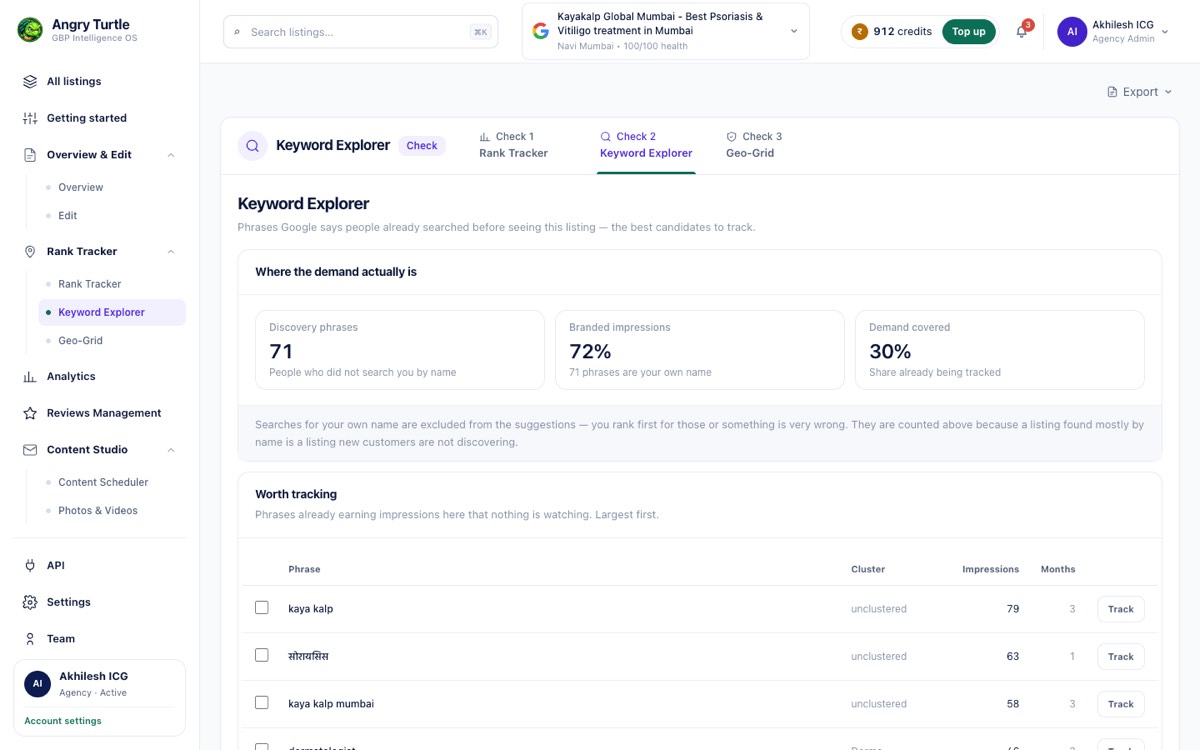
Structured content only helps if it answers a question people are actually asking. Angryturtle's demand clusters group your category's queries into industry-aware clusters with a momentum reading — scaling, broadening, concentrating, or decaying — derived from your own GBP performance data, plus a potential size pulled from Google Ads Keyword Planner. A cluster reading as scaling and under-covered is where new content should go before a cluster that's already saturated or declining, and Indian seasonal patterns — festival demand spikes, admission cycles, monsoon health queries — show up in the momentum reading before they'd be obvious from a plain traffic chart.
Reviews, freshness, and the identity-image check
Review reply automation and content freshness maintenance both feed AI Overview citation indirectly: AI systems favour entities that read as active and current. AI-drafted review replies, personalised and one-click published, keep response rates up without demanding constant manual attention, though a human glance before publishing is still worth doing, especially for sensitive replies. Freshness also comes from GBP posts, photo uploads, and Q&A updates — a profile that goes quiet for three weeks starts to decay in the freshness dimension of Rank OS, independent of anything else about it. Angryturtle also runs a Brand Identity vs Brand Image comparison — what your marketing claims against what your reviews actually describe — which surfaces a perception gap that, left alone, tends to show up eventually as inconsistent or contradicted claims in the content an AI system extracts.
Measuring whether any of this is working
Manual query monitoring — checking whether an AI Overview appears and whether you're cited in it, on a defined set of target queries — remains the most reliable available method. Google Search Console's AI Overview reporting, where present in the interface, and AI-referred session tracking in GA4 both add supporting signal. Automated, real-time AI Overview citation tracking at scale isn't broadly available yet through any vendor, Angryturtle included; treat any tool claiming otherwise with some skepticism. What Angryturtle does track, and reports honestly rather than benchmarks against invented industry averages, is covered on the Share of AI voice tracking page and in measuring AI search visibility.
Ask Virtual CMO
Once the score and the fixes are in motion, the recurring question is what to prioritise next. Ask Virtual CMO is a Gemini-powered chat grounded specifically in your listing's Rank OS score, reviews, and competitor data, run in strict JSON mode so it's answering from your actual numbers rather than a generic AI-search script. It's built to flag when it doesn't have enough grounding to answer a question confidently, rather than filling the gap with something plausible-sounding.
What this can't do
This is local and GBP optimization, not website SEO — Angryturtle checks your site's NAP against your GBP but doesn't crawl or rank your website's pages independently, and if you need organic website SEO or link building, that's a separate scope. Schema and structured content increase eligibility for AI Overview extraction; they don't guarantee it, and no honest vendor will tell you otherwise. Google's own reporting lags roughly a month for performance history, and GBP edits take hours to reflect, which is worth planning around rather than treating as a tool malfunction.
FAQ
Do AI Overviews appear for "near me" searches in India? Increasingly, yes — for queries like "best dentist near me" or "hospital near me," proximity, review signals, and GBP completeness together determine whether a business is cited, though there's no fixed threshold Google has published for any of these factors. See near-me searches for more on how these queries behave.
Why does a competitor appear in AI Overviews and I don't? The most common causes are a more specific GBP category on their side, stronger or more recent review signals, or structured FAQ and answer-format content on their website that yours doesn't have. Ask Maps checks each of these directly against your specific listing rather than leaving it to guesswork.
Does schema guarantee AI Overview appearance? No. Schema increases extraction eligibility by making your data machine-readable, but citation still depends on relative entity authority, content quality, and query match. It's necessary groundwork, not a guarantee.
Can a new business appear in AI Overviews? Yes, particularly for definitional or informational queries. Recommendation-style "best" queries tend to favour entities with a longer, more established review and content history, but there's no fixed age or review count that excludes a new business outright.
Are AI Overviews available in Hindi and other Indian languages? Yes, and coverage continues to expand across regional-language search. Businesses with Hindi-language GBP descriptions and vernacular content have a structural head start for citation on vernacular queries — see the AI overviews and local business piece for more on this specifically.
How do I actually check where I stand right now? Book a free AI search readiness audit — it runs Ask Maps against your specific listing and returns your current Rank OS and AIO Readiness scores rather than a generic checklist.
Which demand is growing, and which is decaying
Search terms group into industry-aware demand clusters, each with a momentum read — scaling, broadening, concentrating or decaying — computed from your own Business Profile data rather than a generic keyword tool.
Ready to have this run for you?
Book a free audit — we'll show you where you stand in 48 hours.