 Angryturtle
Google Business Profile management, done for you.
Profile optimisation, weekly posts, review management, citation fixes and monthly geo-grid reporting — managed every month, priced in ₹.
·
GBP management means someone runs the operational cadence behind your Google Business Profile every week and every month: posts, review requests, photo uploads, Q&A moderation, and suspension monitoring, with changes published live to Google rather than sitting in a report. Angryturtle structures that work using DCG (Diagnosis, Cost, Growth), the same framework behind every managed and self-serve engagement on this platform. What follows covers how that runs, month to month, and what changes when something like a suspension or a duplicate listing shows up.
Why GBP management is a live system, not a setup task
Your Google Business Profile decides whether you show up in the local pack, what a customer sees before they ever open your website, and whether Google's AI systems treat you as a trustworthy source in your category. It is not something you configure once. Google routinely overwrites profile fields from third-party data sources, customer-suggested edits get auto-applied without your approval, photos disappear, categories drift, and an unmoderated Q&A section fills up with stale or wrong answers. Left alone, a profile degrades quietly, and rank follows it down.
Here's the part most competitors in this category can't say honestly: Angryturtle's GBP management service writes every change live to Google through the Business Profile API — name, description, phone, address, hours, special hours, categories, service areas, photos, posts, products, and review replies. That's not a dashboard you interpret and then manually replicate on Google's own site. It publishes. Most tools in this space are read-only or partially editable at best. This single capability is why teams that have tried BrightLocal, Yext, or a spreadsheet-and-manual-edits process switch to Angryturtle and don't switch back.
Every profile element, managed monthly
The scope covers business name, primary and secondary category, attributes, a description kept current and keyword-relevant, hours including special hours for holidays, the services and products catalogue, ongoing photo and video uploads, Q&A moderation and proactive seeding, booking links, and GBP messaging setup. Weekly Google Posts go out — offers, updates, events, product highlights. Reviews get generated through WhatsApp, SMS, and QR flows, and every review receives a response within 48 hours (24 on the Growth tier), drafted by an AI layer trained on your brand voice and checked by a human before publishing on most plans. Suspension monitoring runs daily with instant escalation the moment a flag appears.
None of this is software you log into and use once a quarter. It's ongoing execution, and it's why the word "managed" earns its place in the name.
How we actually run this
GBP management runs on the same DCG sequence, Diagnosis, Cost, Growth, that structures every engagement on this platform. See the DCG framework for the full methodology; this section is what it looks like applied to one profile.
Diagnosis happens in the first month: a full GBP audit against the five Rank OS dimensions, a geo-grid baseline, and a NAP check across the directories that matter for your category. You get a prioritised gap map, not a narrative report. We need read access to the profile, or an ownership transfer, before any of it can start. Full detail on what this stage checks is at DCG Diagnosis.
Cost work follows, usually through months two and three: the wrong category gets corrected, NAP errors get fixed across priority directories, and any active suspension gets resolved before anything else. This is the phase where errors that have been sitting for months finally get closed. It's rarely glamorous.
Growth continues from month four onward for as long as the engagement runs. Review velocity climbs on a schedule, the GBP post calendar stays live, citation coverage expands to Tier 2 and Tier 3 directories, and AI Overview readiness gets tracked alongside all of it. See DCG Growth for the four levers this stage runs on, and a worked example of the full sequence if you want to see Diagnosis catching a wrong category before Growth work would have compounded on top of it for months.
Underneath all three stages, the weekly and monthly rhythm doesn't change. Photos get checked and uploaded weekly. Posts publish on a two-to-four-a-month cadence depending on plan tier. Reviews get a response within 48 hours of posting, 24 on Growth. Suspension monitoring runs daily across every managed profile. If a flag appears, the timeline compresses: escalation within 4 business hours, a root-cause read on whether it's a soft or hard suspension, appeal documentation inside 24 hours. A duplicate listing or a hijacked profile gets the same urgency, because both erase your Maps visibility just as completely as a formal suspension does. None of that waits for the next monthly cycle.
Choosing a GBP management agency in India: what actually differs between vendors
Searching for a GBP management agency in India turns up dozens of generalist digital agencies that added "Google Business Profile" to a services list without building anything specific for it. A few things actually separate a vendor worth paying from one that isn't. Does the agency write changes live to Google, or does it hand you a report and expect you to make the edit yourself? Is the scoring behind their recommendations disclosed, or a black box you're asked to trust? Do they run India-specific citation directories — JustDial, Practo, IndiaMART, Sulekha, 99acres, MagicBricks — or a citation list built for a US market and lightly localized?
A GBP management agency in India also needs to handle verification realistically. Google's verification process here runs slower and less predictably than in the US or UK, postcard delays and phone verification mismatches are common, and an agency without domestic experience will treat a two-week verification hold as an emergency rather than the normal course of business. Angryturtle's team runs these workflows daily across 319 managed GBPs across 8 industries and knows which delays are routine and which ones need an actual escalation.
The Rank OS score behind every action
Every profile carries a transparent Rank OS score out of 100, built from five weighted dimensions: Relevance at 25 points, Review Health at 25, Freshness at 20, Entity Authority at 15, and AIO Readiness at 15. The weighting is disclosed and can be tuned per account — a category where reviews decide everything can weight Review Health higher than the default. Each dimension links to a concrete action list with an expected point gain, so the monthly work log isn't a vague set of tasks. It's "update service categories, +3 points" or "publish two posts this week, +2 points on Freshness."
That transparency is deliberate. Yext and Whitespark both publish some version of a completeness score. Neither shows you the underlying weights, and neither lets you adjust them. Ours does both, which means the monthly action list is traceable back to a real number instead of a consultant's judgment call.
What moves, and when
Category and NAP fixes show up first, usually within four to eight weeks, because Google can reflect a corrected category or a fixed phone number faster than it can reflect a changed reputation. Review velocity and geo-grid share of local voice take longer: a consistent request flow tends to show measurable movement within 60 to 90 days of consistent execution, per DCG Growth, and geo-grid rank changes typically lag a quarter or two behind that because rank tracks the underlying signal with a delay. Competitive, high-commercial-intent phrases, the ones a rival is also fighting hard for, take the longest of the three and can run three to six months of consistent work before a real shift shows.
None of this is promised on a date. Google's algorithm, not any agency or platform, decides final rank, and anyone guaranteeing a specific position on a specific timeline is selling you something they don't actually control. What DCG guarantees is sequence and visibility into which dimension is moving and which isn't, not an outcome. See DCG reporting for how that gets tracked month to month.
Monthly workflow and SLAs
Week one covers the audit and any required edits, plus new photo uploads. Week two is content: two Google Posts published, Q&A moderated, review requests sent to eligible customers. Week three is outreach — review follow-up, a citation check for new errors, competitor rank monitoring. Week four closes with the geo-grid rank report, review velocity summary, updated action log, and the monthly report itself, with a strategy call booked off the back of it.
Review responses go out within 48 hours of publication, 24 on Growth. Suspension escalation happens within 4 business hours of detection. Monthly reports land by the 5th of the following month. Profile edits requested outside the normal cycle are completed within 2 business days.
Managing GBP at multiple locations
One profile is simple. Fifty is a different job entirely. Angryturtle's bulk layer, built on the GBP API, runs the same monthly workflow across 5 clinic branches or 300 franchise units without any drop in quality per location — hours, attributes, and descriptions update across all locations at once, each branch can still run its own localized posts and offers, and role-based access means HQ sees the full network while a branch manager sees only their own listing. See enterprise and multi-location plans →
A worked scenario: a 4-branch Ahmedabad retail chain evaluating GBP management services
A textile retail chain with four branches across Ahmedabad has always handled its own GBP listings, one staff member per branch updating hours and photos whenever they remember to. Two branches show up reliably in the local pack for their categories; two barely show up at all, and nobody at the company can say why the gap exists.
An audit surfaces the actual cause: the two underperforming branches have overlapping service-area definitions that were confusing Google about which physical location to rank for which search, one has a secondary category that doesn't match what the branch actually sells, and neither has posted anything in four months. None of this required new investment or a store renovation — it required someone who could read what the Rank OS score was actually flagging and fix it at the API level across all four branches at once, rather than one overworked staff member per store making occasional manual edits. Within the first full monthly cycle, both underperforming branches had corrected categories, cleaned service-area boundaries, and a caught-up posting cadence; the geo-grid report in month two is what actually shows whether that translated into local-pack visibility, not a promise made in month one.
Review generation and response
Review velocity is one of the clearest local ranking signals there is, and it's also the most persuasive thing a stranger sees before deciding to call you. A business gaining reviews steadily tends to outrank and outconvert one sitting on a larger but static total.
Generation runs through WhatsApp sequences (the highest response rate in India by a wide margin), SMS triggers post-visit, QR cards for in-location prompts, and email for e-commerce or appointment-based businesses. Every review, positive or negative, gets a response — drafted in your brand voice, reviewed before publishing on most plans and auto-published on Growth and above. Negative reviews get a de-escalation response first, then a private resolution path. In regulated sectors — healthcare, BFSI, pharma — every response runs inside compliance guardrails: no clinical claims, no financial advice, nothing that risks a violation.
Posts, offers, and the product catalogue
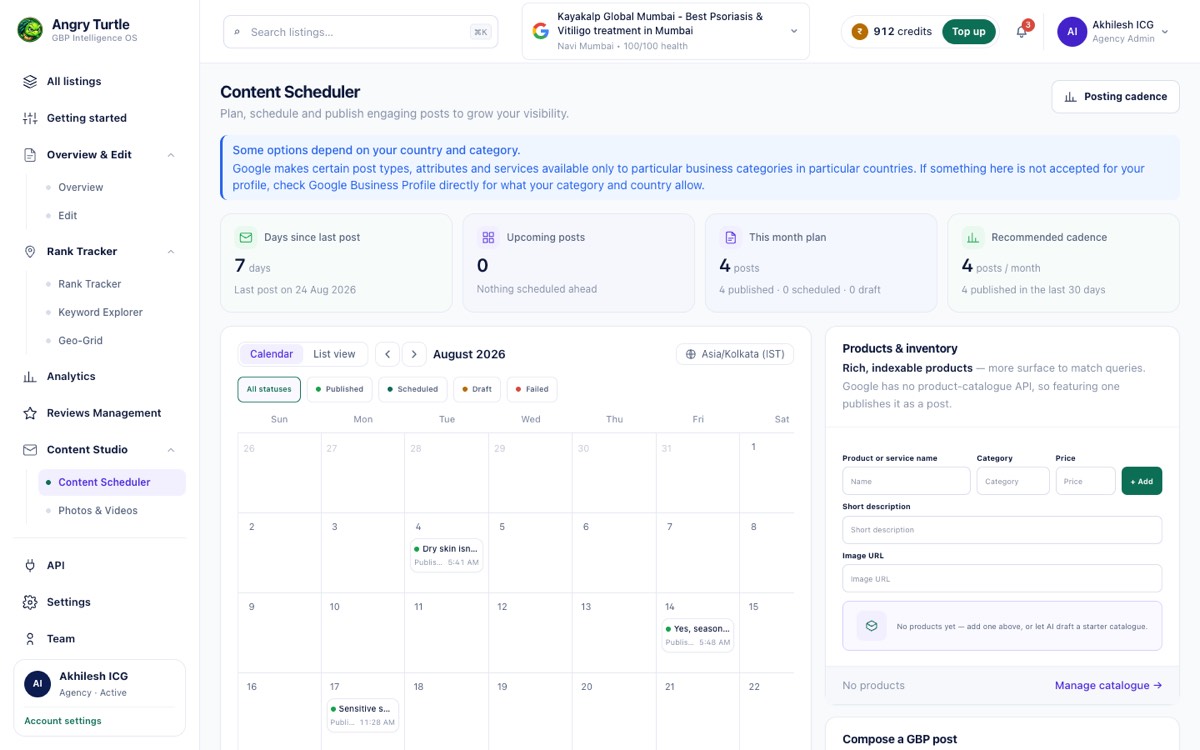
Google Posts remain one of the most underused GBP features among Indian businesses, and they carry real weight — a recency signal, extra keyword surface, and a direct conversion path through offer codes or event registrations, all inside the panel a customer sees before reaching your website. We publish two to four posts per location monthly depending on plan tier, spanning What's New, Offers, Events, and Products, with festival and seasonal campaigns planned proactively around Diwali, Holi, financial year-end, admission season, and the monsoon. The products and services catalogue gets set up once with descriptions and prices, then updated monthly as your offerings change. See Google Posts as a product →
Suspension monitoring and reinstatement
A suspended GBP vanishes from Maps entirely — no calls, no directions, no visibility. For a clinic depending on booking flow or a restaurant on walk-ins, even a two-day suspension is real lost revenue. Daily monitoring across every client profile catches suspension signals early. If one hits, you're notified within 4 business hours, we run a root-cause read on whether it's a soft or hard suspension and what likely triggered it, appeal documentation goes in within 24 hours, and we track the case through Google's support channels until it resolves. GBP Reinstatement Service → covers this as a standalone offering too, for profiles not otherwise under managed contract.
How to verify what we report
Every monthly report ties back to the same Rank OS score used to run Diagnosis and Cost work in the first place, broken down by dimension rather than collapsed into one number, so you can see whether the thing that moved is the thing that was actually broken. DCG reporting covers how that dimension-level tracking works across all three stages.
You don't have to take the report's word for any of it. The geo-grid rank map is checkable against Pin Checker directly, GBP Insights numbers match what's visible in your own Google Business Profile dashboard, and the action log lists every edit made that month with a timestamp — a claimed fix is something you can go verify on the live profile, not something you have to trust because it's written down. What the report itself contains is below.
Reporting that supports a decision, not a PDF
The monthly report is built to be used, not filed. The geo-grid rank report shows your position for every target keyword at every mapped point across your service area — where you're in the top three, where you're sitting at four through ten, and exactly where a competitor is blocking you. GBP insights cover calls, direction requests, website clicks, photo views, and search impressions trended over six months. A review velocity dashboard tracks new reviews, cumulative total, average rating, response rate, and sentiment split. A citation score shows active citations, new builds, and errors corrected. And the action log lists every change made that month with the reason behind it.
For a deeper read on any of it, Ask Virtual CMO answers direct questions grounded in your own Rank OS data and named competitors rather than generic local-SEO advice.
Where GBP management services stop
GBP management doesn't touch your website. If your site is slow, poorly structured, or missing basic on-page content, that's a separate problem a GBP-focused service was never scoped to fix. It isn't backlink building — citations are NAP listings, not links, and shouldn't be sold as the same thing. It isn't real-time; Google's own performance data lags roughly a month, and profile edits typically take a few hours to reflect on Maps even once submitted. And GBP Q&A specifically is a feature Google itself is winding down, so treat any heavy investment there as legacy maintenance rather than a growth lever.
It also isn't a fit for a business with a single location and genuinely no local competition worth tracking — that's closer to a self-serve or DIY case, covered on the done-for-you versus DIY comparison, than a managed engagement.
Plans and pricing
GBP management is priced per location, per month, in rupees. The tiers run from a free two-profile trial through Solo for single-location businesses, Agency for teams managing multiple clients or branches, and a custom Enterprise plan with SSO for large networks. Agencies reselling this under their own brand should look at white-label local SEO instead of the direct tiers below. Full pricing breakdown →
Frequently asked questions
What does "managed" GBP mean versus just using Google's own tools? Google gives you the platform; it doesn't run itself. Managed means a team executes the posts, responses, citation fixes, and attribute updates every month, and those changes publish live back to Google rather than sitting in a report you'd have to act on manually.
How often do you post on GBP? Twice a month minimum on Essentials, up to four times on Growth, plus event posts as needed. Posting recency is a real signal, not decoration.
Do you manage reviews on Practo, JustDial, and other Indian platforms? Google reviews are covered on every plan. Practo and JustDial review management can be added as a scope item — ask about it during your audit call.
What happens if Google edits our profile automatically? It happens more than most businesses realize — Google applies suggested edits from third-party sources or user submissions, sometimes wrongly. We audit weekly and revert unauthorized changes so you don't quietly lose ground to Google's own automation.
Can you manage a service-area business with no storefront? Yes. Service-area business GBP setup is its own approach — service-area definition, keyword-to-area mapping, and review generation without requiring a physical visit.
How do you handle multi-practitioner profiles, like clinics with several doctors? We manage both the primary business profile and individual practitioner listings, keeping NAP consistent and making sure they don't cannibalize each other.
How is a GBP management agency in India different from a global one operating here? Mostly in the details that don't show up on a features page: verification timelines, WhatsApp as the dominant review channel instead of email, and citation coverage across JustDial, Practo, IndiaMART, and Sulekha rather than directories built for a different market and lightly adapted.
How does the DCG framework apply to a single GBP? Diagnosis runs in month one, correcting the profile's category and NAP errors runs through Cost Optimization in months two and three, and Growth, review velocity, citation expansion, and post cadence, compounds from month four onward. See the DCG framework for the stage-by-stage detail.
How soon will I see my profile's rank move? Category and NAP corrections tend to show up within four to eight weeks. Review velocity and geo-grid share of local voice usually need 60 to 90 days of consistent execution before movement is visible, and competitive commercial keywords can take three to six months. Nobody can guarantee a specific position or timeline, including us.
What's the minimum commitment? Three months. The first month is mostly audit and remediation; real movement tends to start in months two and three, and a single month isn't enough runway to judge impact fairly.
How do I get started? Book a free GBP management proposal call →. We'll audit your current profile, run a geo-grid snapshot, and come back with a scope inside 48 hours.
Write it, schedule it, and it publishes to Google
Posts, photos, products and review replies are composed here and publish live to the Google profile — timezone-correct to the listing. Most tools in this category are read-only or stop at a recommendation.
Ready to have this run for you?
Book a free audit — we'll show you where you stand in 48 hours.