 Angryturtle
Reply to every review. Grow from every one.
Review Health is a quarter of your Rank OS score, so reviews are both a ranking and a trust signal. Angryturtle drafts a personalised, on-brand reply for every review — greeting plus brand signature — ready to publish to Google in one click after you review it. The Virtual CMO, a Gemini chat grounded in this listing's own reviews, Rank OS and competitors, then reads the whole corpus into a prioritised action plan and shows the gap between your Brand Identity and the Brand Image customers describe.
In brief
Yes. Every reply is AI-drafted and grounded in the real review, but you approve or edit it before it publishes to Google. The AI is built to be honest and flag gaps rather than fabricate, and we recommend a human check on anything pushed to a live profile.
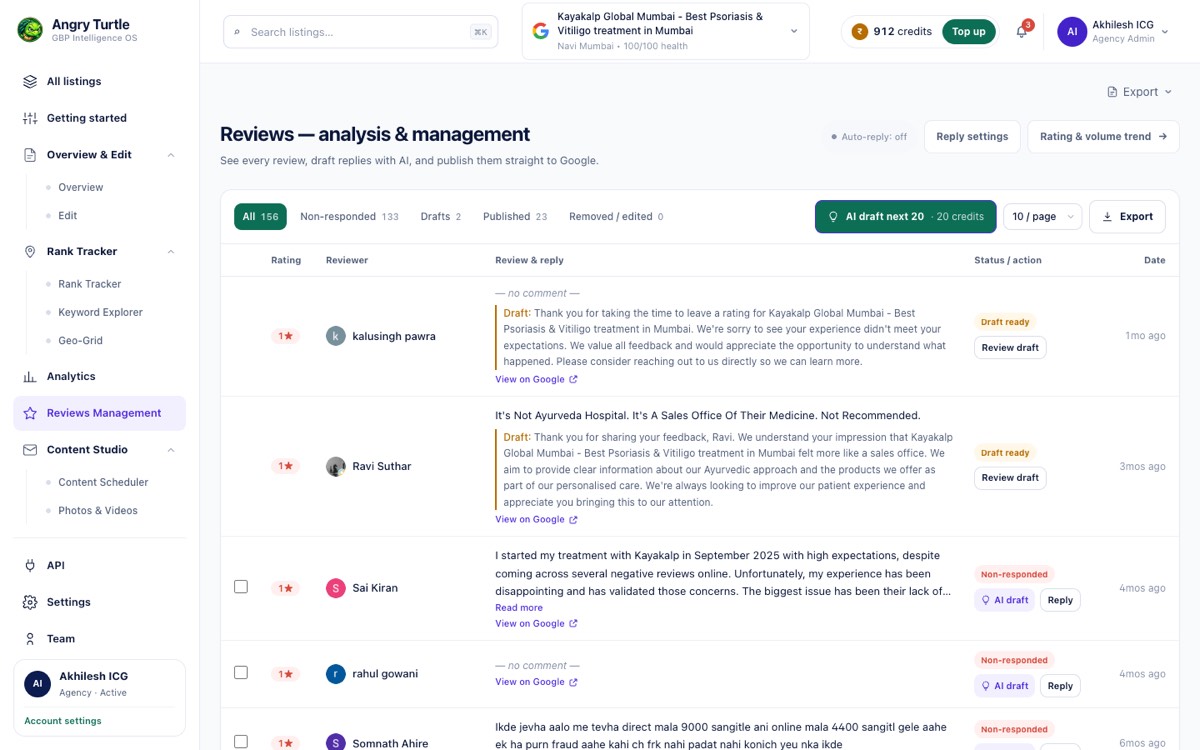
AI Reviews + Virtual CMO — from the live Angryturtle console.
How AI Reviews + Virtual CMO works.
Draft
AI writes an on-brand reply for every new review — greeting plus signature.
Review
You approve or edit, then publish to Google in one click — grounded AI, always human-checked.
Grow
The Virtual CMO reads sentiment and the Identity-vs-Image gap into a prioritised plan.
What's inside.
The building blocks that make this module work.
Who it's for.
Clinics, salons and retail outlets replying on-brand at volume.
Multi-location brands keeping one voice across every listing.
Owners who want reviews to drive decisions, not just sit there.
Replying to reviews is not optional, and it isn't fast either
A salon in Anna Nagar, Chennai, gets maybe four or five new Google reviews a week during a good month. That doesn't sound like much until the owner realises none of the last forty have a reply, because replying well takes longer than it looks — matching tone to a genuinely angry customer is different from thanking someone for a five-star note, and doing both properly after a twelve-hour day at the chair isn't happening. Review Health carries a quarter of the Rank OS score, so this isn't a nice-to-have sitting next to the real work. It is the real work, just deferred long enough that it starts costing something.
AI-drafted replies exist to remove the part of this that's actually tedious — the drafting — while keeping the part that matters, which is a human deciding whether what got written is right before it goes anywhere near Google.
What a good draft looks like, and what to change before publishing
A solid draft reads like the business, not like a template with the name swapped in. It opens with something specific to what the reviewer actually said rather than a generic greeting, and it closes with the brand's own signature rather than a boilerplate sign-off. If a draft comes back sounding identical to the one three reviews earlier except for the customer's name, that's the moment to intervene — not because the AI is broken, but because two different reviews rarely deserve the same response, and publishing near-duplicates in a row reads as impersonal to anyone scrolling through.
The other thing worth checking every time, especially for a negative review, is whether the draft actually addresses the specific complaint or just apologises in the abstract. A customer complaining about a forty-minute wait wants an acknowledgement of the wait, not a generic "we're sorry for your experience." AI outputs here are grounded in the real review text, but grounded doesn't mean perfect, and this is exactly the kind of gap a thirty-second read catches before publishing.
Sentiment, the Identity-Image gap, and where to actually start
Individual replies handle the reviews you already have. The harder question is what the whole pile of reviews, read together, is telling you that no single review would. Ask Virtual CMO reads review sentiment across the entire corpus and returns a short, prioritised list — what customers keep praising, what they keep flagging, and which change is most likely to move the rating.
Brand Identity versus Brand Image sits one layer above sentiment. Identity is the story the salon tells about itself — premium, calm, unhurried. Image is what the reviews actually say customers experienced, and the two frequently disagree in ways an owner has no other way of seeing. A salon that markets itself as unhurried but whose reviews repeatedly mention feeling rushed has a specific, closeable gap, not a vague reputation problem.
Working through it — the Chennai salon
The sentiment read comes back showing "friendly staff" mentioned in most five-star reviews, and "rushed at peak hours" showing up across a cluster of three-star ones — not a majority of reviews, but a repeated, specific pattern rather than noise. The Identity-Image gap flags the same thing from the other direction: the salon's own description promises a "relaxed, unhurried" experience, which is exactly the claim the three-star cluster is quietly contradicting.
The fix that falls out of this isn't a messaging change. It's an operational one — the salon starts booking a buffer slot between peak-hour appointments, and only then updates the description to be specific about what "unhurried" means in practice, rather than restating a claim the reviews were already disputing.
A second decision comes up once the salon opens a second branch in Velachery a year later. Comparing sentiment across both locations shows "friendly staff" holding steady at both, but "long wait for appointment booking" appearing only at the newer branch — not a service quality issue at all, but a sign the newer location hasn't yet built the WhatsApp booking habit the original branch relies on. The fix is operational again, and specific to one location rather than a brand-wide problem the owner might have assumed it was.
Where this does not help
None of this generates reviews out of nowhere, and it never gates or filters which reviews get shown — that's against platform policy and Angryturtle won't do it. A QR or link collection kit exists to make it easier for happy customers to leave a review, but the decision to leave one, and what it says, stays entirely with the customer. There's also no published review-count threshold that unlocks anything — review signal moves as a gradient relative to competitors, not a gate that flips at some fixed number, so chasing a round number of reviews for its own sake misses the point of what's actually being measured.
It also won't fix an operational problem by itself. The Chennai salon still had to change how it schedules peak-hour appointments; no amount of well-written replies would have closed a gap that was actually about wait times. And sentiment analysis reads what customers wrote, not what they didn't — a quiet majority who left a rating with no comment at all doesn't show up in the themes at all, which is a real blind spot worth remembering before treating any sentiment read as the complete picture.
How it connects to the rest of the platform
Review replies and sentiment feed the Review Health quarter of Rank OS directly, so a backlog of unanswered reviews is one of the fastest single levers on that score. The gap analysis draws on the same review corpus that NAP and Citation Intelligence checks for consistency elsewhere, and a strong Review Health score also strengthens how the profile is read by AI Overviews and ChatGPT, since AI systems weigh review content when deciding whether a business is a trustworthy answer — the specific mechanics of that are covered in how reviews affect AI search visibility. Broader reputation management work, including how a business is discussed off its own Google profile, sits alongside this rather than inside it.
Agencies running client portfolios often lean on this most heavily of all the modules, since reply volume is one of the easiest wins to show progress on inside Agency OS — and for multi-location hospitality brands specifically, the patterns are similar enough across outlets that the notes on /industries/hospitality and pricing detail on pricing are worth reading alongside this page. A location whose sentiment looks fine but whose visibility on the map still lags is usually a geo-grid question, not a reviews one — the two modules answer genuinely different halves of the same complaint.
AI Reviews + Virtual CMO — questions, answered
The rest of the platform.
Rank OS Scoring
One transparent 0–100 score, split into the 5 weighted levers that move the map pack — with the top 3 fixes ranked by expected point lift.
Explore Rank OS ScoringGeo-Grid Rank Maps
A colour-coded grid showing your true rank at every point around your business — with a pin checker for any pincode and a rank tracker for every keyword.
Explore Geo-Grid Rank MapsNAP & Citation Intelligence
A live directory-presence matrix of every listing that has your business wrong — with duplicate detection, missing-citation gaps and a prioritised fix list.
Explore NAP & Citation IntelligenceOne-Click Google Posting
Write once and publish an offer, event or update across all your listings on a schedule — a freshness signal that feeds your Rank OS score.
Explore One-Click Google PostingCompetitor Intelligence
A standardised view of your top-5 local rivals — ratings, review volume and the Us-vs-Competitor citation landscape — with the gaps you need to close.
Explore Competitor IntelligenceInsights & Performance
Real GBP metrics — views, calls, directions, clicks — split by branded vs discovery, over any date range.
Explore Insights & PerformanceDemand Clusters & Momentum
Industry-aware keyword clusters with a momentum read and demand sizing, built from your own GBP data.
Explore Demand Clusters & MomentumAsk Maps / AIO Readiness
A per-listing question bank and visibility checks that show if your profile is a citable AI answer.
Explore Ask Maps / AIO ReadinessEdit Location (Write-Back to Google)
A full GBP editor with a live "how it looks on Google" preview — every change pushes straight to Google.
Explore Edit Location (Write-Back to Google)Brand Identity vs Image
Your canonical brand story set against how reviews say customers really see you — plus the gap and the fix.
Explore Brand Identity vs ImageAgency OS
Multi-tenant, white-label local SEO with roles, metered credits, client portals and a full API.
Explore Agency OS