 Angryturtle
How to choose the best local SEO agency in India.
How to evaluate and choose the best local SEO agency in India. Criteria, red flags, industry fit, pricing transparency and what managed services actually deliver.
·
There's no single "best" local SEO agency in India — there's an agency whose method you can actually verify against your own results. The honest evaluation isn't a ranked list; it's whether an agency writes changes back to your Google Business Profile or just reports on it, shows the math behind its scoring, and gives you artefacts you can check independently rather than a monthly narrative you have to trust. What follows is that evaluation, plus where Angryturtle sits against it.
The question underneath "best local SEO agency in India"
Searching for the best local SEO agency in India returns hundreds of results, and most of them are generalist digital agencies with local SEO listed as one of twenty services on a page. Very few specialize. Fewer still have built the operational infrastructure to manage GBPs, citations, and rank tracking at real scale across India's own directory ecosystem and metro markets.
This page isn't a ranked list — we're not going to pretend to be neutral about our own product while also claiming objectivity about competitors we compete with directly. What follows is the evaluation criteria that actually separates a genuine local SEO specialist from an agency that added "local SEO" to a services page, plus an honest account of where Angryturtle sits against that bar.
How we actually run this
Angryturtle runs every engagement on DCG: Diagnosis, Cost Optimization, Growth. It's a published methodology, not a phrase invented for this page — the full framework is here, and you can hold any agency you're evaluating, including us, to the same sequence.
Diagnosis is month one: a GBP audit, a geo-grid baseline across your primary keywords, a NAP check across 20+ Indian directories, and a Rank OS score broken into five dimensions so you know which one is actually the constraint. You give us GBP access and your honest read on who your real competitors are. How Diagnosis actually runs →
Cost Optimization is months two and three: category corrections, NAP fixes on priority directories, suspension resolution if one exists. This is closing errors, not adding volume, which is why we don't recommend jumping straight to review generation the way a lot of pitches do.
Growth starts month four: review velocity against a competitor-derived target, citation expansion into tier 2 and tier 3 directories, a post calendar, AI Overview readiness. What Growth compounds into →
Ask any agency pitching you to name their own version of this sequence. If the answer is a list of tactics with no stated order, that's the tell — see criterion ten below for what a documented process should actually look like.
Criterion one: does the tool actually write to Google, or just report on it?
Ask this question of any agency or platform you're evaluating: when you approve a change, does it publish live to your Google Business Profile, or does it sit in a dashboard waiting for someone to manually copy it over? Most tools in this category, including several well-known names, are read-only or partially editable. Angryturtle writes back — name, description, hours, categories, service areas, photos, posts, products, and review replies all publish directly through Google's own API. This is the single most consequential technical difference between vendors in this space, and it's worth confirming before signing anything.
Criterion two: is the score transparent, or a black box?
Nearly every serious local SEO platform now shows some version of a health score. The question is whether you can see how it's calculated. Rank OS scores every listing 0-100 across five weighted dimensions — Relevance, Review Health, Freshness, Entity Authority, and AIO Readiness, weighted at 25, 25, 20, 15, and 15 — and the weights are stated plainly and adjustable per account. Compare that against Yext's or Whitespark's completeness scores, which give you a number without showing the math behind it. If an agency can't explain exactly why your score is what it is, be skeptical of everything else they're telling you.
Criterion three: is AI-search readiness actually checked, or just claimed?
"AI-optimized" is close to meaningless as a phrase on its own by 2026 — everyone claims it. What matters is whether there's a specific, testable mechanism behind the claim. Ask Maps is Angryturtle's per-listing question bank that checks whether a profile would actually surface as a citable answer in Google AI Overviews or ChatGPT for your category and area. It's a distinct 15-point dimension inside Rank OS, not a marketing adjective bolted onto an existing feature list. Very few tools in this category check this at all, let alone score it.
Criterion four: local SEO specialization, not just SEO
Local SEO and broad SEO share a name but not an execution model. Local is primarily GBP management, NAP consistency, review velocity, geo-grid tracking, and India-specific citation building — not technical audits, link building, or content marketing at large. Ask directly: is local SEO the primary service, or one line among many? How many profiles are actively managed? Is the tooling proprietary or a reskin of something built for a different market?
Criterion five: India-native operations, not a US playbook with a local office
JustDial, Practo, IndiaMART, Sulekha, 99acres, and MagicBricks carry real discovery weight alongside Google here. WhatsApp outperforms email for review requests by a wide margin. Verification is slower and less predictable than in Western markets. An agency whose methodology was built for the US or UK and adapted for India will miss these structurally, not occasionally.
Criterion six: multi-location capability at the API level
Past three locations, GBP work has to run in bulk through the API, not manually profile by profile. Ask how bulk updates actually happen, whether reporting is structured for multi-location clients, and whether pricing and access scale sensibly with location count. Enterprise and multi-location plans →
What "best SEO services for real estate in India" actually needs to cover
Real estate is one of the categories where a generalist local SEO agency shows its limits fastest. A builder marketing a single under-construction project needs citation coverage on 99acres and MagicBricks specifically, alongside Google — buyers researching a project check those platforms directly, and a listing absent from them loses credibility before a call ever happens. A broker or agency with multiple branch offices across a city needs each branch configured as a distinct service-area or storefront profile with correct locality-level targeting, not one citywide listing trying to rank everywhere at once.
The review dynamics differ too. A real estate transaction produces far fewer reviews per month than a restaurant or clinic, so review velocity strategy has to account for a naturally slower cadence rather than chasing volume targets built for a higher-frequency category. And GBP posts for real estate carry more weight around active inventory, project milestones, and RERA-compliant messaging than the offer-and-event cadence that works for retail. An agency offering "the best SEO services for real estate in India" without a distinct playbook for these specifics is running the same generic process across every vertical it touches, which is a warning sign more than a selling point. Angryturtle's real estate practice runs this as its own configuration rather than a retrofit of a generic template, and pairs with white-label local SEO for agencies reselling to builder and broker clients directly.
Criterion seven: vertical depth
Healthcare GBP management needs compliance-safe review responses and fluency with Practo's ecosystem. Real estate needs service-area-business configuration and 99acres/MagicBricks citation work, as above. BFSI needs regulatory guardrails baked in by default. An agency handling every vertical identically is handling none of them precisely. Angryturtle runs distinct playbooks for healthcare, lifesciences, real estate, hospitality, education, franchise, retail, and BFSI.
Criterion eight: reporting that shows geography, not just an average
A single-page PDF with a vanity "average position improved" metric is a warning sign. Real local SEO reporting shows geo-grid-level movement — which blocks you dominate, which ones a named competitor is winning, and what changed last month to affect it. See the geo-grid product →
The artefacts to demand before you sign
You can't verify most of what an agency tells you about its own performance, and that's the real problem with this whole category, not just a jab at competitors. A monthly PDF saying "visibility improved" is not evidence of anything. Here's what to demand instead, from us or anyone else.
Ask for a change log, not a summary. Every GBP edit — a category change, a new service added, a photo uploaded — should trace back to an actual date and an actual field changed, ideally visible in your own Google Business Profile's edit history, not just described in an agency's report after the fact. Angryturtle writes changes directly through Google's API, so ours shows up there.
Ask for a geo-grid scan before and after, not a single averaged rank number. Pin Checker scans actual positions across real points in your service area; a competent agency should be able to hand you the raw grid, not just a headline percentage. A single "you're now #4" figure hides which specific blocks you gained and which ones a named competitor still owns.
Ask for a named owner, not a generic account team. Every Angryturtle managed client has a specific account manager and rank analyst named in the contract, reachable directly, not a shared support inbox. If nobody can tell you who specifically is watching your account this month, that's worth asking about before you sign anything.
Ask what the dimension-level breakdown behind any composite score looks like. Rank OS publishes five weighted dimensions rather than a single black-box number, and if a score you're shown elsewhere can't be broken down the same way, you're being asked to trust a number you can't audit.
None of this is unique leverage against us specifically. It's the standard any agency should be willing to meet, and asking for it before signing is the single best filter available to someone comparing agencies from the outside.
Criterion nine: pricing transparency in rupees
A reputable agency gives you a starting range or a ballpark early, not after three sales calls. Ballpark figures for managed local SEO in India run roughly ₹8,000–15,000 per month for a single location in a standard market, ₹12,000–20,000 per location for multi-location businesses in competitive markets, and custom pricing with volume discounts at 20+ locations. Flat monthly fees regardless of location count are a red flag — the economics rarely support consistent per-location execution at flat pricing once you scale. Angryturtle pricing →
Criterion ten: documented process, not improvised delivery
What happens specifically in month one, two, three? A serious managed agency has a written onboarding process, a defined monthly scope, and stated SLAs for review response, suspension escalation, and report delivery. Ask for the process document before you sign, not after. Angryturtle's own GBP management services page lays out that monthly cycle in full rather than describing it only in a sales call.
Managed agencies versus DIY tools versus freelancers
Three real models exist. DIY tools put execution on your own team — fine for monitoring, thin for sustained execution at competitive pace. Freelancers can work well for a single location in a low-competition market but rarely scale to multiple locations and carry single-point-of-failure risk. Managed agencies run specialist staff on proprietary tooling with a defined monthly scope — costlier than a freelancer, but the only model that holds up across multiple locations and genuinely contested categories. A fuller breakdown of the DIY side specifically sits on the done-for-you versus DIY comparison.
Where this is the wrong spend
A managed agency, ours or anyone's, is the wrong spend if you're a single location in a category with no real local competition — a self-serve Solo account costs a fraction of the price and gets most of the same outcome when nobody's actively contesting the map pack against you. It's also the wrong choice if your actual bottleneck is your website's own content rather than your Google Business Profile; that's a different specialization, and a local SEO agency claiming to fix it too is usually stretching.
If you're shopping for a guaranteed ranking by a fixed date, every agency claiming to offer that, including any that might approach you after reading this page, is selling something no one controls. The honest version of this business commits to a process and a monthly report, not a promised position.
A worked scenario: a Gurgaon real estate broker choosing between three agency pitches
A brokerage covering resale and rental listings across Gurgaon gets pitched by three agencies after putting out a request for proposals. One quotes a flat monthly fee regardless of how many project listings it covers and can't explain how its "visibility score" is calculated when asked directly. A second is a generalist digital shop that lists local SEO as one of eight services and has never worked a real estate client specifically. The third asks pointed questions back — how many branch profiles, which localities, current citation status on 99acres and MagicBricks — before quoting anything.
The brokerage picks the third, not because the pitch was the cheapest, but because it was the only one that treated the evaluation as a two-way diagnostic rather than a script. That's the actual test worth applying to any shortlist: an agency that asks specific questions about your business before quoting a number is behaving like a specialist; one that quotes first and asks questions later, if at all, usually isn't.
A checklist before you shortlist anyone
Confirm local SEO is a primary, not secondary, service. Confirm they manage a meaningful number of GBP profiles actively, not historically. Confirm they've worked your specific vertical. Confirm India-native citation coverage across JustDial, Practo, IndiaMART, and Sulekha. Confirm geo-grid tracking rather than a single averaged position. Confirm a documented onboarding process and monthly scope. Confirm rupee pricing with a stated review-response SLA and a suspension escalation process. Ask for anonymized case examples in your industry.
How Angryturtle is built for this specifically
GBP workflows are calibrated for Indian verification processes rather than borrowed from a US product. Citation management covers 20+ Indian directories through the citation engine, including JustDial, Sulekha, IndiaMART, Practo, 99acres, MagicBricks, and vertical-specific platforms. Review generation runs primarily through WhatsApp, the highest-response channel here. Geo-grid tracking through Pin Checker is built for Indian metro geographies. And pricing runs in rupees with Indian entity GST billing throughout. For agencies looking to resell this under their own name, white-label local SEO covers that arrangement directly, and multi-location SEO covers the mechanics behind managing more than one branch at once.
What moves, and when
Category corrections and NAP fixes are the fastest-moving part of any engagement, typically showing up within four to eight weeks once Google reflects the change and directories update. Review velocity and geo-grid share of local voice take longer, usually 60 to 90 days for the review and citation signal, with SoLV following a quarter or so behind since rank lags the signal rather than moving with it. The most contested commercial phrases, the ones five or more funded competitors are already fighting for, take three to six months of sustained work at minimum.
Any agency that quotes you a specific week for a specific rank is guessing or lying. What you can hold them to, ours included, is whether the ordering above matches what actually shows up in your reports month to month.
Frequently asked questions
Is Angryturtle only for large businesses? No. The Essentials-tier Solo plan serves single-location businesses; growth and enterprise plans serve chains and franchise networks. Fit depends on location count and market competitiveness, not size alone.
How do I compare agencies fairly? Run the criteria checklist above against each one. Ask for a sample monthly report, the onboarding process document, and references in your specific industry.
Do you offer a free audit before any commitment? Yes, including a geo-grid baseline for your primary keywords. Book one here →
What if we're already with another agency? We handle transitions. Month one audits the current state, often revealing what has or hasn't actually been done, and we take over execution from month two with no gap in coverage.
Do you guarantee rankings? No agency that understands Google's local algorithm honestly guarantees specific positions. We guarantee process: a defined monthly scope, SLA-backed execution, and transparent reporting.
Do you handle real estate specifically, or is that folded into a generic package? It's a distinct configuration. Real estate GBP management runs different citation priorities, service-area setup, and review-velocity expectations than retail or healthcare. See the real estate practice →
Can we see a case example first? Ask for an anonymized case example in your industry during the audit call. We don't publish named client results without explicit permission.
Does Angryturtle follow a published methodology, or improvise engagement to engagement? DCG — Diagnosis, Cost Optimization, Growth — structures every engagement the same way, self-serve or managed. Full framework →
How soon should we expect to see something measurable, whichever agency we pick? Category and NAP fixes inside four to eight weeks, review and citation signal within 60 to 90 days, and real movement on competitive commercial phrases in three to six months — see what moves, and when above. Treat any agency promising faster on contested terms with real skepticism.
A score you can argue with, not a black box
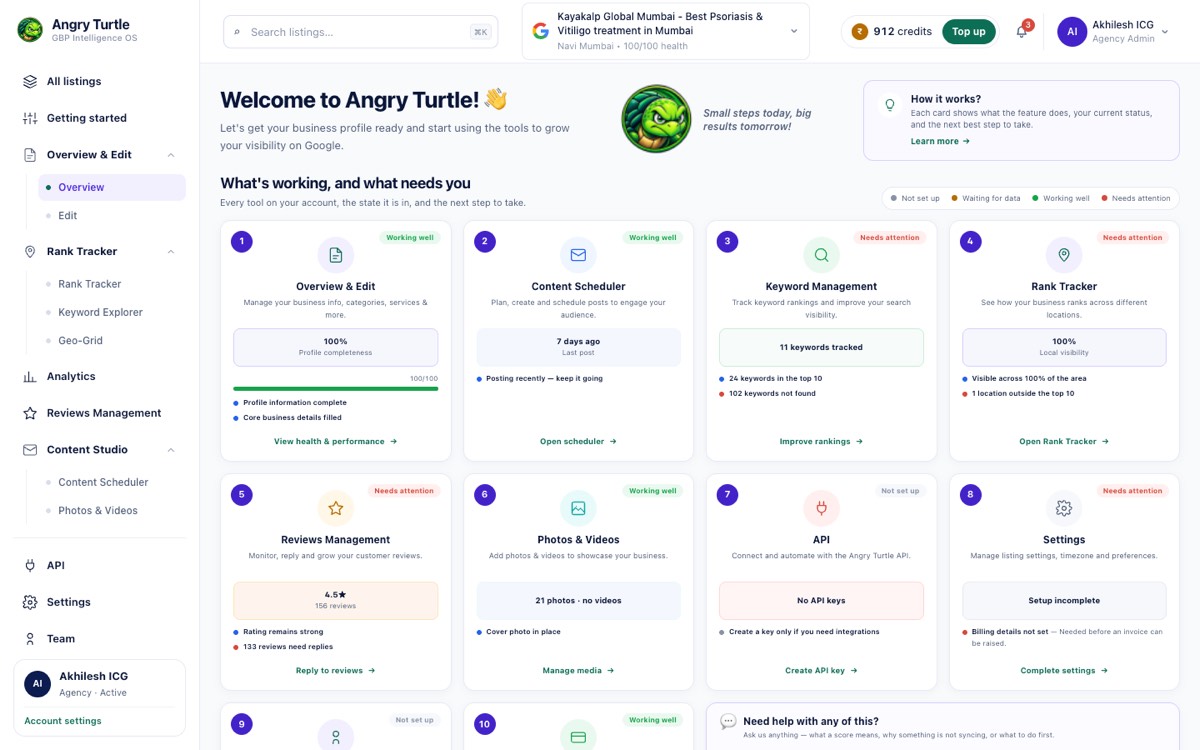
Rank OS gives every profile a 0–100 score built from five weighted dimensions — Relevance, Review Health, Freshness, Entity Authority and AIO Readiness — and the weights are tunable. Underneath it sits a ranked list of the fixes that move the number, each with the point lift it unlocks.
Ready to have this run for you?
Book a free audit — we'll show you where you stand in 48 hours.