 Angryturtle
Generative Engine Optimization
GEO (Generative Engine Optimization) helps Indian businesses get cited by ChatGPT, Perplexity, Gemini, and AI Overviews. Angryturtle's managed GEO service. Book a free audit.
·
SEO, AEO, and GEO aren't three unrelated disciplines competing for budget. They're three names for the same underlying work, aimed at three different surfaces.
| SEO | AEO | GEO | |
|---|---|---|---|
| Target surface | Google organic results | Google AI Overviews specifically | ChatGPT, Perplexity, Gemini, and AI Overviews together |
| What success looks like | A rank position | A named citation in Google's AI answer | A named citation across whichever of those engines a customer actually uses |
| Primary underlying asset | Website links and content | GBP, reviews, schema | All of the above, plus entity consistency across every source an LLM might browse or have trained on |
Generative Engine Optimization (GEO) is the broadest of the three — the practice of making a business visible and citable across the full range of large language model systems people now consult for recommendations, not just Google's. Angryturtle treats it as local SEO and AEO's natural extension rather than a fourth thing to sell separately, because the entity signals that get a business cited in one engine are largely the same signals that get it cited in the others.
How LLMs decide who to name
Two different mechanisms are at work, and they call for different fixes.
For non-browsing responses, an LLM answers from its training data — text crawled from the open web before a cutoff date. A business with consistent, specific, multi-source web presence accumulated over time is more likely to already be inside that training data than one whose only footprint is a two-month-old GBP.
For browsing-enabled responses — ChatGPT with browsing, Perplexity, and Gemini answering a current query — the model searches, crawls the top-ranking pages, and synthesises a recommendation with citations live, on the spot. This is the mechanism that ties local SEO and GEO together directly: a business ranking in the local pack top three for "best dermatologist in Koramangala" gets crawled by a browsing LLM answering that exact query, because the LLM is reading the same search results a human would see. Strong local search rank is not a nice-to-have next to GEO. It's the foundation the browsing mechanism depends on.
What gets cited, once the crawl happens
Specific, verifiable claims outperform vague ones. "4.8-star rating from 340 Google reviews" gets extracted and cited; "highly rated" doesn't carry enough information to be worth quoting. "Established 2016, treating 3,000-plus patients annually" beats "years of experience" for the same reason — one is a fact an LLM can lift verbatim, the other is an assertion it has no way to verify or attribute.
Structured formats — numbered steps, comparison tables, FAQ pairs, defined terms — get extracted ahead of flowing prose, because an LLM parsing a page for a citable fact finds a clearly bounded answer faster in a structured block than buried in paragraph three of a narrative. Recency matters too: LLMs with browsing access weight recently updated content more heavily, which is one more reason GBP freshness (posts, photos, Q&A updates) isn't purely a local-pack concern.
Where Angryturtle's platform actually does this work
The mechanics above sound like content advice until they're tied to something a business can actually run. Angryturtle's Rank OS scores five weighted dimensions — relevance, review health, freshness, entity authority, and AIO Readiness — and that last dimension is checked concretely through Ask Maps, a per-listing question bank testing whether a profile answers, in a citable way, the specific questions Google Maps' AI, AI Overviews, and ChatGPT are likely to ask about it. That's GEO's "what gets cited" question, made testable rather than theoretical.
Entity consistency — the requirement that a business's name, category, and description read identically across GBP, its website, and every directory an LLM might cross-reference — is tracked through the citation and NAP tooling across 20-plus platforms, catching the kind of small mismatch (a slightly different business name on one directory) that quietly undermines an LLM's confidence in an entity even when every individual source looks fine on its own. This is the same underlying problem covered in entity SEO and entity disambiguation.
And once a gap is identified, the fix doesn't stay a recommendation. The GBP editor pushes changes straight to Google — category corrections, a rewritten description with a direct-answer opening, added services — with a visual preview before publishing. Most tools in this category are read-only or partial on write access; full write-back is the piece Angryturtle built as its central bet, because a GEO diagnosis that never gets executed doesn't move anything.
Multi-location entities and the vernacular layer
For a brand with several locations, each one has to read as a clearly defined sub-entity of the parent brand — "Sharma Skin Clinic, Koramangala" as part of "Sharma Skin Clinic," not as an ambiguous standalone. That relationship needs to be legible in schema, in content, and in directory structure, because an LLM cross-referencing sources will get less confident about an entity it can't cleanly place inside a hierarchy.
Vernacular presence matters for the same underlying reason: GEO effectiveness for Hindi, Tamil, Telugu, Marathi, or Bengali queries depends on having some actual content in that vernacular search — a GBP description insert, a website section, seeded Q&A — not on the English-language version being technically excellent. An LLM answering in Hindi is drawing on Hindi-language sources where they exist and struggling where they don't, regardless of how strong the English content is.
The technical layer underneath all of it
An llms.txt file at the website root signals which pages matter most for AI grounding and training; it isn't universally honoured yet but is respected by a growing set of AI systems, and it costs little to set up. Robots.txt configuration for AI crawlers — GPTBot, PerplexityBot, and Google-Extended — is a deliberate choice, not a default; most businesses should explicitly allow these crawlers, because blocking them removes a business from both training-data inclusion and live browsing citation. And none of this works if the content sits behind heavy client-side JavaScript rendering or a login wall; LLMs generally can't render complex JavaScript, so server-rendered HTML for anything meant to be extracted is close to a hard requirement rather than a nice-to-have. Further detail on the markup side lives in schema markup for AI search, entity SEO and the knowledge graph, and the learning centre's structured data primer.
Demand clusters: writing for the actual question, not a guess
None of the content advice above matters if the content answers a question nobody's asking. Angryturtle's demand clusters group a business's category into industry-aware keyword clusters with a momentum reading — scaling, broadening, concentrating, decaying — derived from the business's own GBP performance data, alongside a potential score sized from Google Ads Keyword Planner. For GEO specifically, this means content investment goes toward the questions LLMs are actually being asked for that category and city, rather than a generic content calendar copied across every client an agency manages. Reviews and their effect on AI search visibility covers the review side of the same demand signal.
Measuring GEO honestly
Share of AI voice — the percentage of a defined query set where a business is cited, tracked across the AI engines that matter to it — is the closest thing GEO has to a rank-tracking equivalent, and it behaves differently: an AI engine cites or it doesn't, there's no position 4 to celebrate incremental progress toward. Prompt coverage (how many of a defined question set produce a citation) and AI-referred sessions in GA4 both add signal, though the latter undercounts badly, since most AI citations never produce a tracked click. None of this is live or automated at scale for every engine as of today — Share of AI voice tracking covers exactly what Angryturtle does and doesn't currently claim to measure, including where that measurement is still being built out.
What GEO isn't
GEO doesn't require rebuilding a website — it requires making the existing one more structured and more crawlable, which is additive work, not a rebuild. It's not a guarantee of citation on any specific platform; OpenAI, Anthropic, Google, and Perplexity each control their own model's citation behaviour, and no vendor sits inside that decision. And AI-generated content or schema produced as part of a GEO programme should get a human review pass before publishing — grounded generation reduces but doesn't eliminate the need for a check, particularly for anything going live on a real business's public-facing pages.
FAQ
What is GEO versus AEO? AEO refers specifically to optimization for Google AI Overviews. GEO is the broader discipline spanning ChatGPT, Perplexity, Gemini, and AI Overviews together. GEO includes AEO rather than sitting apart from it.
How do I know if I'm being cited by an LLM right now? Manual spot-checks against a defined query set across the engines that matter to you are the most reliable current method. Angryturtle's Ask Maps runs a version of this check specific to your listing rather than a generic prompt list.
Is GEO relevant for B2B businesses, not just consumer-facing ones? Yes, particularly for lifesciences and BFSI businesses in India, where procurement teams are starting to use ChatGPT and Perplexity for vendor discovery. The mechanics are the same — entity consistency, structured content, directory presence on platforms like IndiaMART.
Does allowing AI crawlers hurt my website in any way? For most businesses, no — blocking GPTBot, PerplexityBot, or Google-Extended removes you from both training data and live browsing citation without any offsetting benefit. There are edge cases (proprietary content a business specifically doesn't want reused) where blocking is a deliberate choice, but that's the exception, not the default.
Do I need llms.txt? It's advisable rather than mandatory. It's not universally honoured across every AI system yet, but it's respected by a growing number, and the setup cost is low relative to the potential benefit.
Does Angryturtle manage GEO across all these engines, or just Google's? The Rank OS AIO Readiness dimension and Ask Maps question bank are built to check citability across Google Maps' AI, AI Overviews, and ChatGPT specifically, with broader share-of-voice tracking extending to Perplexity and Gemini as that measurement matures. See AEO services for how the full stack fits together.
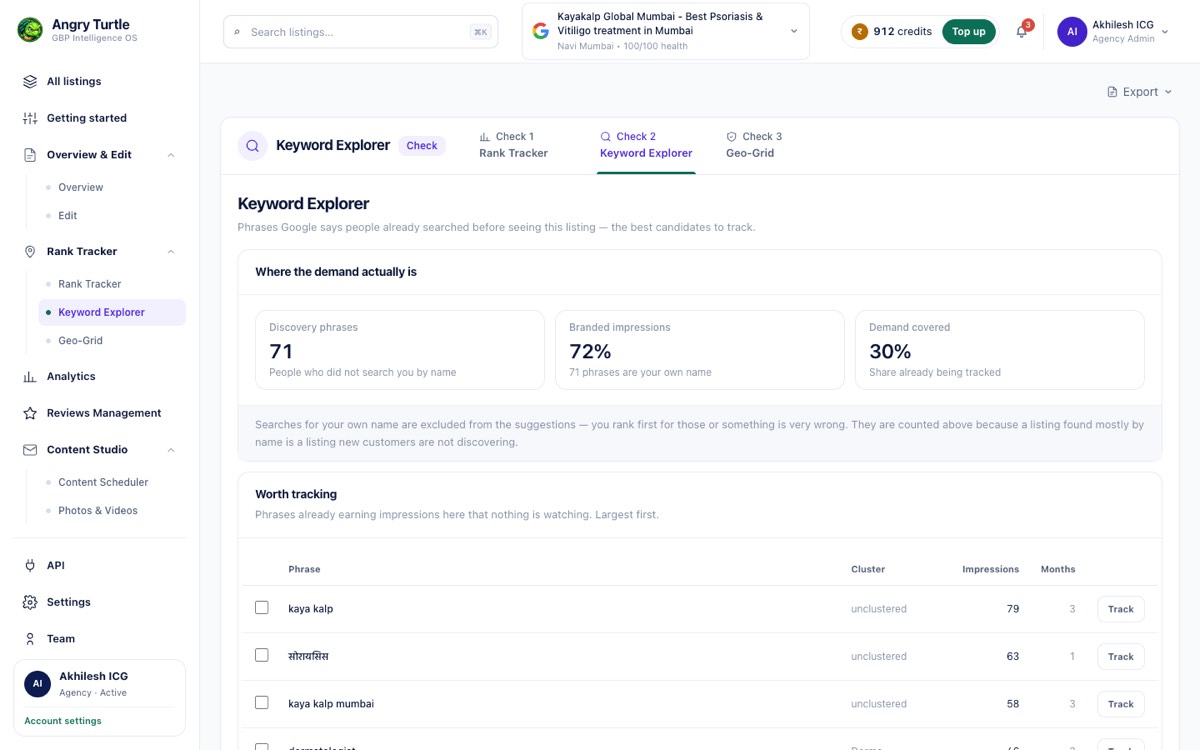
Which demand is growing, and which is decaying
Search terms group into industry-aware demand clusters, each with a momentum read — scaling, broadening, concentrating or decaying — computed from your own Business Profile data rather than a generic keyword tool.
Ready to have this run for you?
Book a free audit — we'll show you where you stand in 48 hours.