 Angryturtle
Managed local SEO. You run the business — we run the rank.
A dedicated pod, an AI-native rank platform, and a defined monthly scope — GBP, citations, reviews and rank tracking, executed for you.
·
Managed local SEO means a specialist team runs your Google Business Profile, citations, reviews, and rank tracking for you, using the same Rank OS platform Angryturtle's self-serve customers use. The team follows a fixed sequence, called DCG at Angryturtle: fix what's broken before adding volume, then grow what compounds. Nothing about the process is guaranteed to hit a specific rank, but the sequence itself is what separates an engagement that actually moves numbers from one that just generates monthly activity.
Two ways to run local SEO, and why "managed" is only one of them
Buy tools and run local SEO yourself, or hand it to a team that runs it for you. Managed local SEO is the second path: a dedicated pod audits, executes, and reports every month without asking your team to learn a new discipline or absorb an operational process it doesn't have room for.
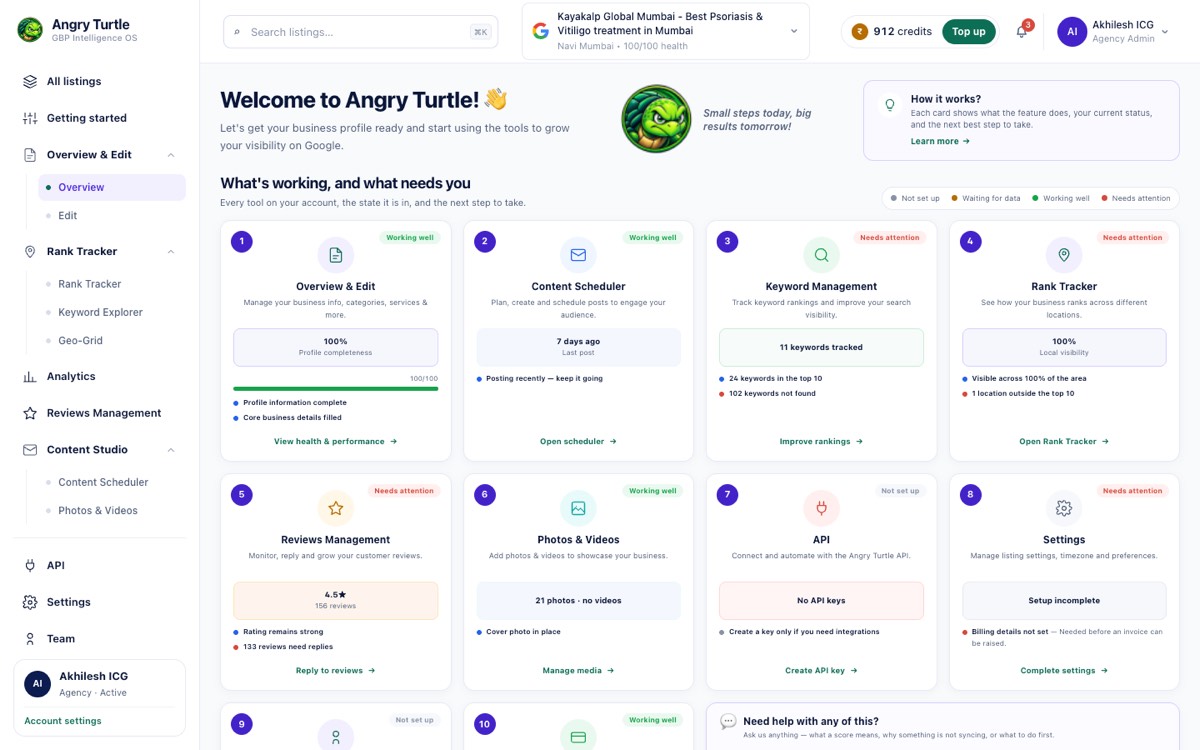
Angryturtle's managed offering runs on the same Rank OS platform available to self-serve customers. That's worth being direct about, because plenty of vendors quietly imply managed and self-serve are two different products with two different levels of "real" capability. They're not. Managed is a team of specialists operating the same engine you could log into yourself — the difference is who's driving, not what's under the hood.
How we actually run this
Every managed engagement runs on Angryturtle's own DCG framework: Diagnosis, Cost Optimization, Growth. It's the same sequence described in full here, and it's the reason we don't jump straight to reviews and posts the way a lot of pitches do.
Diagnosis takes the first month. You get a GBP audit, a geo-grid baseline, a NAP check across 20+ directories, and a Rank OS score with a dimension breakdown telling us which of the five areas is actually dragging performance down. We need GBP manager access from you, and ideally your own read on who the real competitors are, since the geo-grid baseline is only useful if it's scanning the right rivals. Full Diagnosis mechanics →
Cost Optimization runs across months two and three. This is where a wrong category gets corrected, NAP errors get fixed on priority directories, and any active suspension gets resolved before anything else starts. You get a monthly report showing which specific errors closed. We need fast turnaround from you on anything that needs sign-off — a business-name change, a category dispute — because a slow approval here delays everything behind it.
Growth starts in month four and continues for as long as the engagement runs: review velocity targets, citation expansion into tier 2 and tier 3 directories, a monthly post calendar, and AI Overview readiness work. What Growth actually does →
None of these time ranges are fixed law. A profile with an active suspension can push Diagnosis findings into a longer Cost Optimization phase before Growth has anything solid to build on.
Who gets the most out of managed local SEO
Multi-location businesses running three or more clinics, branches, or franchise units find that coordinating GBPs, citations, and reviews independently across locations becomes something close to a second job. Managed removes that overhead outright.
Regulated industries — healthcare, BFSI, pharma, legal — face real constraints on what can be said in a GBP description, a review reply, or a post, and a specialist team that already knows those guardrails avoids the mistakes a generalist marketer would make by accident.
In genuinely contested categories — dermatology in south Delhi, real estate development in Gurgaon, co-working in Bengaluru — five or more well-funded competitors are already investing seriously, and DIY effort at a few hours a week can't keep pace with sustained execution. Marketing teams without dedicated local SEO depth, which is most of them, get instant access to specialist skill without a full-time hire. And franchise networks past 50 locations need governance frameworks and bulk operations that only a managed team backed by the right technology can run reliably.
Where this is the wrong spend
Managed local SEO is the wrong spend for a single location in a low-competition category where nobody is actively contesting the map pack — a self-serve Solo account, run for twenty minutes a week, gets most of the same result without the monthly fee. It's also the wrong spend if the actual constraint is your website rather than your Google Business Profile; if organic blog traffic or on-page content is where you're losing, that's different work, and a real audit says so instead of selling you scope you don't need.
It's a poor fit, too, if you can't grant GBP manager access. We can't run Diagnosis on a profile we can't see into. And if the goal is a guaranteed position by a fixed date, no honest agency can promise that, managed or otherwise — anyone who does is selling you certainty they don't control.
What the managed engagement looks like
Every managed client gets a pod: an account manager who runs the monthly strategy call and coordinates the team, a local SEO specialist who owns the monthly execution, and a rank analyst who watches the geo-grid and flags priorities. The pod runs on a roadmap agreed at the start of each month — foundation work in month one (full audit, NAP remediation, GBP remediation, geo-grid baseline, review pipeline setup), a first full execution cycle in month two, and locked-in monthly cadence with optimization decisions grounded in real rank data from month three onward.
What's actually inside the scope
GBP management covers profile optimization, weekly posts, Q&A, photos, products and services, booking links, attribute upkeep, and suspension monitoring. Citation management runs a NAP audit and error correction across 20+ platforms via our citation engine, building new citations across JustDial, Sulekha, IndiaMART, Practo, 99acres, MagicBricks and the wider Indian directory set, with a monthly score reported back. Review management covers generation flows, response handling inside SLA, negative review triage, and velocity tracking. Rank tracking runs geo-grid reports per keyword and location, a Rank OS score, and competitive comparison. Reporting closes the loop with a monthly report and call, a quarterly deep-dive, and full dashboard access.
The platform underneath the managed team
The Rank OS score is built from five weighted dimensions — Relevance, Review Health, Freshness, Entity Authority, and AIO Readiness — at 25, 25, 20, 15, and 15 points respectively, and the weighting is disclosed rather than hidden, tunable per account. That number tells our team exactly what to prioritize for each location each month; it isn't a vanity metric sitting on a dashboard nobody reads.
Beneath that score sits the actual execution machinery. GBP edits publish live to Google through the API, not into a private report waiting for someone to act on it manually — write-back covers name, description, hours, categories, service areas, photos, posts, and products. Demand clusters surface industry-aware keyword groups computed from your own first-party GBP data, tracking whether a cluster is scaling, broadening, concentrating, or decaying, with opportunity sizing pulled from Google Ads Keyword Planner. Geo-grid tracking with Pin Checker gives pin-drop rank accuracy across your service area. The citation engine flags NAP discrepancies across 20+ directories automatically. And Reviews AI pulls every review across every location into one feed with drafted responses queued for approval.
What the platform doesn't do is make judgment calls. Our team interprets what Rank OS surfaces, writes the actual post and response copy, manages the relationship, and handles anything that needs a human decision — a suspension, a negative-review crisis, a disputed edit. The system removes the administrative weight. People still decide what matters.
The four things Rank OS does that the category leaders don't
Against BrightLocal, Yext, Whitespark, and Birdeye, four things separate Rank OS specifically: a transparent 0-100 score with disclosed, tunable weights rather than a black-box completeness number; a Local Presence Score that adjusts to your category instead of a fixed template; demand-cluster opportunity sizing that ties keyword movement to actual Ads-derived demand rather than static volume estimates; and AI-drafted review auto-reply that runs at the speed reviews actually arrive, not the speed a human team can individually type responses. None of the four are exclusive to managed clients — they're platform capabilities the managed pod operates on your behalf.
Onboarding, week by week
This maps directly onto DCG. Weeks one and two are Diagnosis, weeks two through four start Cost Optimization, and Growth proper begins once month two's roadmap is agreed on the week four call.
Week one grants GBP access and runs the profile audit, establishes the geo-grid baseline, maps the top three competitors per keyword and location, and checks NAP across 20+ directories. Week two optimizes the profile fully, corrects NAP errors in priority directories, and sets up the review flow along with a response template library. Week three publishes the first posts, sends the first review requests, and begins new citation submissions while Rank OS establishes a baseline score. Week four delivers the month one report, runs the strategy call to agree month two's roadmap, and hands over dashboard access.
What moves, and when
Profile accuracy and category fixes move first, usually within the four to eight weeks it takes Google to reflect a corrected category and a cleaned-up NAP record across priority directories. This is Cost Optimization territory, and it's the fastest-moving part of the whole engagement because it's mostly closing errors rather than building anything new.
Review velocity and geo-grid share of local voice take longer. Review and citation improvements tend to show a measurable effect within 60 to 90 days of consistent execution, and SoLV movement on the geo-grid usually follows a quarter or two behind that, since rank changes lag the underlying signal changes rather than moving in step with them.
Competitive commercial phrases, the ones every well-funded rival in your category is also fighting for, take the longest. Real movement in genuinely contested categories usually needs three to six months of sustained work, sometimes longer in markets like south Delhi dermatology or Gurgaon real estate where five or more funded competitors are already investing seriously.
None of this is guaranteed. Nobody who guarantees a specific position on a specific date controls the variable they're promising — Google's algorithm, competitor behavior, and seasonal demand all move independently of anything an agency does. What we can commit to is the process: a defined monthly scope, a report showing what moved and what didn't, and a next-month priority tied to whichever Rank OS dimension is still the constraint.
Where managed fits by industry
Healthcare runs through the Practo-plus-Google citation stack with compliance-safe review replies at Healthcare Local SEO. Lifesciences carries added regulatory guardrails and entity-authority work at Lifesciences Local SEO. Real estate manages project-site profiles and 99acres/MagicBricks citations at Real Estate Local SEO. Hospitality handles menu and reservation attributes across multi-outlet groups at Hospitality Local SEO. Education runs admission-season campaigns and parent-review flows at Education Local SEO. Franchise networks get HQ-versus-franchisee governance and bulk onboarding at Franchise Local SEO. Retail chains manage store-locator and seasonal campaigns at Retail Local SEO, and BFSI runs branch and ATM bulk management under regulatory guardrails at BFSI Local SEO.
Managed versus DIY versus self-serve
DIY with third-party tools puts execution entirely on you and demands real time and expertise per location per month. Angryturtle's own self-serve platform gives you the same Rank OS engine and write-back capability with less required expertise, since the platform surfaces the ranked action list itself. Managed hands execution to our pod entirely — zero hours required from your team, with a dedicated account manager as your strategic layer. Full done-for-you vs. DIY breakdown →
What we report, and how you check it
Every month you get a Rank OS score broken down across all five dimensions, not just a single composite number, plus geo-grid share of local voice, review velocity against target, and a citation score flagging any new errors that appeared since last month. How the reporting layer works in full →
You don't have to take the report on faith. The geo-grid data underneath Pin Checker is a scan of actual positions across real grid points in your service area, and you can request the raw scan rather than only the summary. Rank OS itself, the composite score, is visible in your own dashboard with full access, not held back as an agency-only artefact. And every GBP edit we make is visible in your account's own change history, since we write directly through Google's API rather than into a private system — if a category changed or a service was added, it shows up on your Google Business Profile's own edit log, not just in our report to you.
Ask for the dimension-level breakdown before you accept a summary report from anyone, us included. A single number moving from 62 to 71 tells you almost nothing about which of the five areas actually improved.
What managed doesn't do
We're honest about the edges. This isn't a website or on-page SEO service — if the problem is your site's own content, that's separate work. We don't build backlinks; citation work is directory listings, not link acquisition. Nothing here is real-time, since Google's own reporting lags roughly a month and edits can take hours to reflect live. And the GBP Q&A feature is being deprecated by Google itself, so while we still moderate it where it exists, we don't build long-term strategy around it.
Frequently asked questions
Does "managed" mean you need our login? Yes, GBP manager access, not owner access. Every change we make is visible to you at all times, and you can revoke access whenever you choose.
Can we run ads alongside managed local SEO? Yes, and it's a good combination. We don't manage paid media directly, but we coordinate on landing pages and offer posts with your ads team.
What about locations in cities where our brand has no presence yet? They start from a lower baseline but follow the same process, with citation building and GBP foundation work carrying the most weight early. Expect four to six months to reach competitive positions in a genuinely new market.
What if franchise owners want to manage their own GBPs? Hybrid governance is normal — franchisees can get view access and limited posting rights while core profile fields, categories, and NAP stay under central control.
Do you write the GBP post content, or do we? We write it, briefed monthly off your calendar and offers, with a review-and-approve step on Growth and Enterprise plans.
Is there a minimum contract term? Three months. Month one is foundation work; impact compounds from month two, and a single month doesn't give the process room to show anything real.
How does the DCG framework show up in a managed engagement specifically? Diagnosis happens in month one, Cost Optimization in months two and three, and Growth from month four onward — the same three-stage sequence described on the DCG framework page, just executed by our pod instead of self-serve.
When should we expect to see actual rank movement, not just profile fixes? Category and NAP fixes usually show within four to eight weeks. Meaningful rank movement in a genuinely competitive category usually takes three to six months of consistent execution, longer in the most contested metros — see what moves, and when above for the full breakdown.
How do I know if managed is right for us versus self-serve? Book a free audit. We'll run a geo-grid baseline, review your GBP and citations, and give you a scope with a projected trajectory — including telling you honestly if the numbers point toward self-serve instead.
A score you can argue with, not a black box
Rank OS gives every profile a 0–100 score built from five weighted dimensions — Relevance, Review Health, Freshness, Entity Authority and AIO Readiness — and the weights are tunable. Underneath it sits a ranked list of the fixes that move the number, each with the point lift it unlocks.
Ready to have this run for you?
Book a free audit — we'll show you where you stand in 48 hours.