 Angryturtle
India's AI-native local SEO agency.
Managed GBP optimisation, citation building, review management and geo-grid rank tracking — done for you, across every location.
·
What a local SEO agency in India actually does
A local SEO agency in India manages the systems that decide whether your business shows up when someone nearby searches for what you sell. A Google Maps result. A "near me" query. A voice search in Hindi. The businesses that occupy the top three map-pack positions capture most of the clicks, calls, and footfall from that search — everyone below position three is mostly invisible.
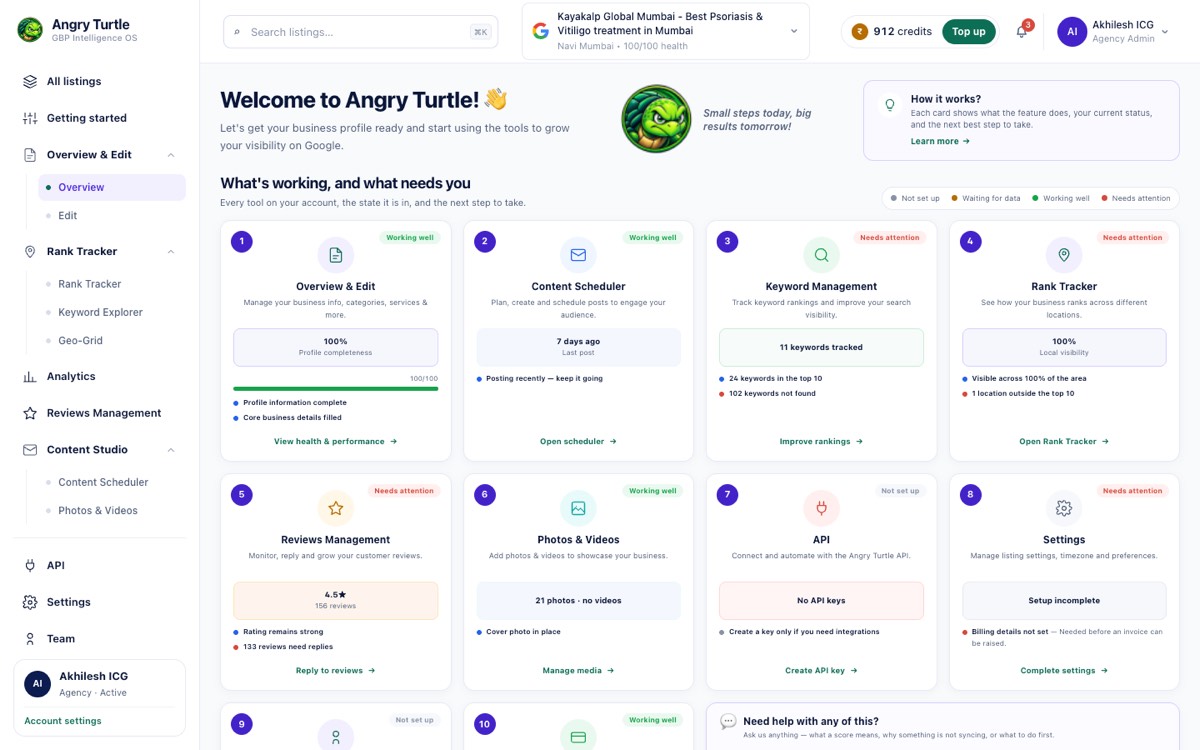
Most agencies that call themselves local SEO specialists are really doing one thing: editing a Google Business Profile once and hoping it holds. Angryturtle does something structurally different, and it is worth naming plainly because it is the actual point of this page. Angryturtle writes changes back to Google — name, description, phone, hours, categories, service areas, photos, posts, products, and review replies all publish live to your GBP, not into a private dashboard you then have to manually copy into Google yourself. Most tools in this category are read-only, showing you data about your listing without a path to fix it. A handful are partially editable. Angryturtle's write-back is close to complete, and it's the single biggest operational difference between us and a report-generating tool wearing an agency's clothes.
You can run this yourself on our self-serve platform, or hand it to our managed team, or split the work — some locations self-serve, some managed. Both paths run on the same underlying system. Neither is the "real" product with the other bolted on for marketing.
Why local search in India runs on different rules
Local SEO playbooks written for the US or UK don't transfer cleanly. A few things about India specifically change how the work gets done.
The directory ecosystem runs parallel to Google, not underneath it. JustDial, IndiaMART, Practo, Sulekha, 99acres, and MagicBricks are primary discovery channels in their own right — Practo for healthcare, 99acres and MagicBricks for real estate, JustDial for general services especially outside the top six metros. A citation strategy that only touches Google is missing half the market.
Regional-language intent is rising fast, and it shows up in ways a generic tool won't catch. Voice and vernacular queries in Hindi, Tamil, Telugu, Marathi, and Bengali are a growing share of Maps searches. Angryturtle's demand cluster engine is industry-aware and computed from your own first-party GBP data rather than a fixed keyword list, so it picks up regional search patterns specific to your category and city instead of assuming every city searches the same way.
Verification friction is real. Google's postcard and video verification is slower and less reliable here than in Western markets, and knowing the escalation paths matters.
Review culture is different too. Indian consumers aren't habitual reviewers by default — they need prompting, and WhatsApp consistently outperforms email as a review-request channel here. Competition in the metros is intense: in Delhi, Mumbai, Bengaluru, Hyderabad, Pune, and Chennai, local-pack positions for clinics, real estate, legal, and banking are fought over hard, and generic optimization doesn't move anything.
Rank OS: the score behind every decision we make
Every listing on Angryturtle carries a transparent 0-100 Rank OS score, built from five weighted dimensions: Relevance (25 points), Review Health (25), Freshness (20), Entity Authority (15), and AIO Readiness (15) — that last one being whether your profile can actually be cited in Google AI Overviews and ChatGPT-style answers, not just ranked in a blue-link list.
The weights are stated, not hidden, and they're tunable per account rather than a fixed formula you have to trust blindly. That matters more than it sounds. BrightLocal, Yext, and Whitespark each publish some version of a health score, but none of them show you the weighting logic or let you adjust it for a category where, say, review health should count for more than freshness. Angryturtle does both.
Each of the five dimensions maps to a ranked list of specific actions with an expected point lift attached — not "improve your profile," but "add these three service categories, expected +4 points" or "respond to the 11 unanswered reviews from the last 60 days, expected +6 points." That's the difference between a scorecard and an actual work plan.
Our managed process, month by month
This rhythm has a name, and it's worth knowing so you can go check it against how any other agency describes their own process. We call it DCG — Diagnosis, Cost Optimization, Growth, run in that fixed order because skipping a stage almost always wastes money on the one that comes after it.
Diagnosis is month one: a complete GBP and local presence audit, a NAP consistency check across 20-plus platforms via our citation engine, review velocity benchmarked against your top three competitors, and a geo-grid rank map for your primary keywords across your service area using Pin Checker. You see exactly where you stand before anything changes, and you get a prioritised gap map rather than a narrative report.
From there we move into Cost Optimization — standardizing your name, address, and phone across JustDial, Sulekha, IndiaMART, Practo where relevant, 99acres and MagicBricks for property businesses, and the broader Indian directory set, flagging duplicates our engine finds along the way. We correct the GBP category itself, since a wrong category caps which searches you're even eligible to appear in, then optimize categories, services, attributes, photos, Q&A, and weekly posts. Every one of those edits publishes live through Google's own API, so you're not waiting on a manual Google review queue for changes we've already made.
By month four, most engagements shift into Growth — the compounding stage. We build and run review generation flows calibrated to your business (WhatsApp, SMS, QR, email) and draft responses to every review with an AI layer trained on your brand voice, reviewed by a human before it goes out on most plans. Reviews get read for sentiment through Reviews AI, and where a customer's language of complaint or praise repeats across many reviews, that becomes a Brand Identity vs Brand Image gap worth fixing — the story you tell about yourself in your GBP description compared with what your actual reviews say back to you. It's an uncomfortable comparison sometimes. It's also one almost nobody else runs.
DCG isn't a one-time sequence we run once and file away. Each month, Rank OS identifies which of the five dimensions is the current constraint, and that dimension gets the following month's priority, even if it means dropping back into Cost Optimization work in month eight because a new NAP error appeared. If you want the mechanics behind any single stage, or a worked example of what a diagnosis actually finds and fixes, DCG case study walks a fictional clinic through all three stages start to finish.
What moves, and when
Nobody who tells you a fixed date for a specific rank position is telling you something they control. Rank in a competitive local pack depends on what your competitors do too, and no agency, including us, can promise an outcome that also depends on someone else's next move. What we can tell you honestly is the order in which different things tend to move, because that order is consistent across almost every engagement we run.
Profile accuracy and category fixes are the fastest. A corrected GBP category, a cleaned-up NAP record, a fixed suspension — these are structural corrections, not new signals, and they typically show measurable effect within four to eight weeks because they remove something that was actively working against you rather than adding something new that has to accumulate.
Review velocity and geo-grid share-of-voice take longer, because they're compounding signals rather than one-time fixes. Consistent review generation and a widening geo-grid footprint usually need 90 days of consistent execution before the shift shows up clearly across a service area, not just at one address.
Competitive commercial phrases take the longest of all. If your category is dentist, clinic, or real estate broker in a metro with a dozen established competitors already running review flows and citation programs of their own, that's the search where movement is slowest and the outcome is least certain, because you're not just fixing your own gaps, you're closing a gap against businesses that are also actively working.
None of this is a promise. It's a pattern we've seen hold across enough engagements to state it plainly, and we'd rather tell you the honest order than a comfortable one.
What we report, and how you check it
A managed engagement is only worth paying for if you can verify what you're being told, not just trust it. Angryturtle's reporting is built to be checked, not taken on faith — see DCG reporting and Rank OS for the full mechanics behind what follows.
Every month you get the Rank OS score broken down by all five dimensions, not just the composite number, so you can see specifically which dimension moved and which didn't — a NAP fix should show up in Entity Authority, a category correction should show up in Relevance, and if it doesn't, that's worth asking about directly rather than accepting the summary. You get the geo-grid map itself through Pin Checker, block by block across your service area, so you can see exactly which zones you hold and which a competitor three streets over is still winning, rather than a single averaged rank number that hides both. You get review velocity against your own target and against the competitor set identified in Diagnosis. And you get the action log: every edit pushed live to your GBP that month, timestamped, so you can confirm the work happened rather than reading a description of it after the fact.
Every month closes with a call, not just an emailed PDF. What moved, what didn't, and what's next month's priority based on whichever Rank OS dimension is currently the constraint.
What Ask Maps and AIO Readiness actually check
Ranking in Google Maps and being cited by an AI answer engine are related but not the same problem. Ask Maps is Angryturtle's per-listing question bank that tests whether your profile would actually be a citable answer if ChatGPT or Google's AI Overviews were asked about your category in your area — does your description answer the question a customer would actually ask, does your Q&A section carry real content instead of empty placeholders, is your entity data consistent enough across the web for an AI system to trust it.
Almost no local SEO tool checks this specifically. AIO Readiness carries 15 of the 100 points in Rank OS precisely because it's a distinct, measurable thing, not a vague "future-proofing" claim.
Ask Virtual CMO
Reports tell you what happened. Ask Virtual CMO is closer to an analyst you can interrogate — grounded specifically in your own listing's Rank OS score, your actual reviews, and your named competitors, not a generic local-SEO chatbot answering from a training set. Ask it why a specific competitor jumped two positions last month, or what the single highest-leverage fix is for a branch that's stalled, and it answers from your data, not a template.
Industries we serve
Angryturtle manages local SEO across eight industries, each with a distinct citation stack and its own compliance profile. Healthcare — hospitals, clinics, diagnostic labs, dentists — runs through Healthcare Local SEO, where Practo carries real weight alongside Google. Lifesciences and pharma, covering pharmacies and distribution hubs, sits at Lifesciences Local SEO. Real estate developers, brokerages, and project sites are at Real Estate Local SEO, where 99acres and MagicBricks matter as much as the map pack.
Hospitality — hotels, resorts, restaurants, cafés — lives at Hospitality Local SEO. Education institutes, from schools to coaching centres, are covered at Education Local SEO. Franchise networks running at scale have their own playbook at Franchise Local SEO, retail chains and showrooms at Retail Local SEO, and banks, NBFCs, and insurance offices at BFSI Local SEO.
What you don't get from us
Angryturtle is not a website builder or an on-page SEO tool for your site's blog — if your core problem is thin website content, that's a different engagement. We don't build backlinks; the citation work above is directory listings, not link acquisition, and we don't pretend otherwise. We don't gate or filter reviews to hide negative ones — every review gets a response, good or bad. And nothing here is real-time: Google's own performance data lags by roughly a month, and a profile edit can take hours to reflect live even after it's pushed. We say this upfront because an agency that only tells you what sounds good tends to also be the one that overpromises on timelines.
Pricing and how to start
Angryturtle's self-serve platform runs on a tiered model: a 15-day free trial that runs on the Solo or Agency plan itself rather than as a separate stripped-down tier, Solo at ₹999/month (₹1,296.70 charged with the platform fee and GST, 2 profiles, 1 seat, 130 credits), Agency at ₹3,499/month (₹4,541.70 charged, 10 profiles, unlimited seats, 300 credits), and a custom Enterprise tier with SSO for large networks. Full pricing detail is here.
Managed engagements — the DCG process described above, run by our team rather than by you — start at ₹1,499 per location per month, and the right scope from there depends on category competitiveness, location count, and target geographies. Book an audit and we'll build a proposal within 48 hours rather than quote blind.
Frequently asked questions
What is a local SEO agency? It manages your visibility in location-based search — Google Maps and the local pack primarily, plus directory platforms like JustDial and Practo in India — handling GBP optimization, citation building, review management, and rank tracking on an ongoing basis, either as a managed service or as a platform you run yourself.
How is Angryturtle different from a general SEO agency? We specialize in local SEO and GBP management specifically. Our platform writes changes directly back to Google rather than just reporting on your listing, and our Rank OS score shows its weighting logic instead of hiding it behind a black-box number.
What actual process do you follow month to month? DCG — Diagnosis, Cost Optimization, Growth, in that fixed order. Diagnosis in month one finds the real constraint, Cost Optimization in months two and three fixes it, and Growth from month four on builds the compounding signals on top of a foundation that's no longer broken. See how DCG differs from a generic local SEO playbook.
How long before I see results, realistically? Category and NAP fixes typically show up within four to eight weeks. Review velocity and geo-grid share-of-voice movement usually need 90 days of consistent execution. Competitive commercial phrases in a crowded metro category take the longest, and nobody, including us, can guarantee a specific position or date — see what moves, and when above for the honest ordering.
Do you work with single-location businesses? Yes, through the Solo plan. Managed service tends to deliver the strongest return for businesses with three or more locations or in genuinely competitive categories, but a single clinic or shop is a normal Solo customer.
What Indian cities do you cover? Active management spans Delhi, Gurgaon, Noida, Mumbai, Bengaluru, Hyderabad, Pune, Chennai, Kolkata, and Ahmedabad among others, and geo-grid rank tracking covers any city in India.
Do you handle GBP suspension recovery? Yes — GBP reinstatement is a dedicated service, included at reduced scope inside managed plans and available on its own.
Can I use the platform myself instead of going managed? Yes. Self-serve and managed run on the same Rank OS backbone. Some clients start self-serve and add managed support for review response only, or vice versa — the split is common, not an edge case.
How do I get started? Book a free local SEO audit. We'll review your current GBP, run a geo-grid snapshot, and return a gap analysis within 48 hours, no cost and no obligation.
A score you can argue with, not a black box
Rank OS gives every profile a 0–100 score built from five weighted dimensions — Relevance, Review Health, Freshness, Entity Authority and AIO Readiness — and the weights are tunable. Underneath it sits a ranked list of the fixes that move the number, each with the point lift it unlocks.
Ready to have this run for you?
Book a free audit — we'll show you where you stand in 48 hours.