 Angryturtle
Angryturtle vs Synup
Synup manages listings and reputation; Angryturtle scores your Google profile, prioritises the fixes, and makes them — self-serve or managed.
Synup is a competent listings and reputation platform built for Western directories and Western review sites. Angryturtle is an India-first local SEO and AEO platform that scores a Google Business Profile, ranks the fixes by impact, and pushes the approved ones straight to Google. This page lays out both plainly, without pretending Synup is bad at what it was actually built to do.
What Synup does well
Synup's core strength is listing distribution and review aggregation across a wide network of directories, with reporting dashboards agencies can hand straight to clients. For teams managing US or European locations, that network coverage is genuinely useful, and Synup has been in the reputation-management space long enough to have ironed out the basic listing-sync workflow. Its dashboards are clean and its client-facing reports read well, which matters for an agency trying to keep a retainer client engaged month over month.
Synup vs India
Synup vs India isn't really a fair fight, because Synup's directory network wasn't built with Indian search behavior in mind. JustDial, Sulekha, and Practo carry real weight for Indian local search and for how AI systems answer India-specific queries, and a Western-built tool tends to treat them as an afterthought or skip them entirely. An agency running Synup for an Indian client book ends up reporting clean listings on directories the client's own customers never open.
There's a second gap that matters more over time than directory coverage alone. Synup reports on listing health. It doesn't have a transparent scoring model that tells you which three fixes actually move ranking, and it doesn't score whether a profile shows up as a citable answer when someone asks an AI assistant a local question. That second problem is becoming the bigger one as more local search moves into AI Overviews and chat-based answers — see how AI Overviews treat local businesses for the broader pattern.
The Unique 4, and why they exist
Angryturtle's design starts from a different question: not "what's wrong here" but "what should get fixed first, and can the tool just do it." That acts-not-reports difference shows up in four places the site calls the Unique 4.
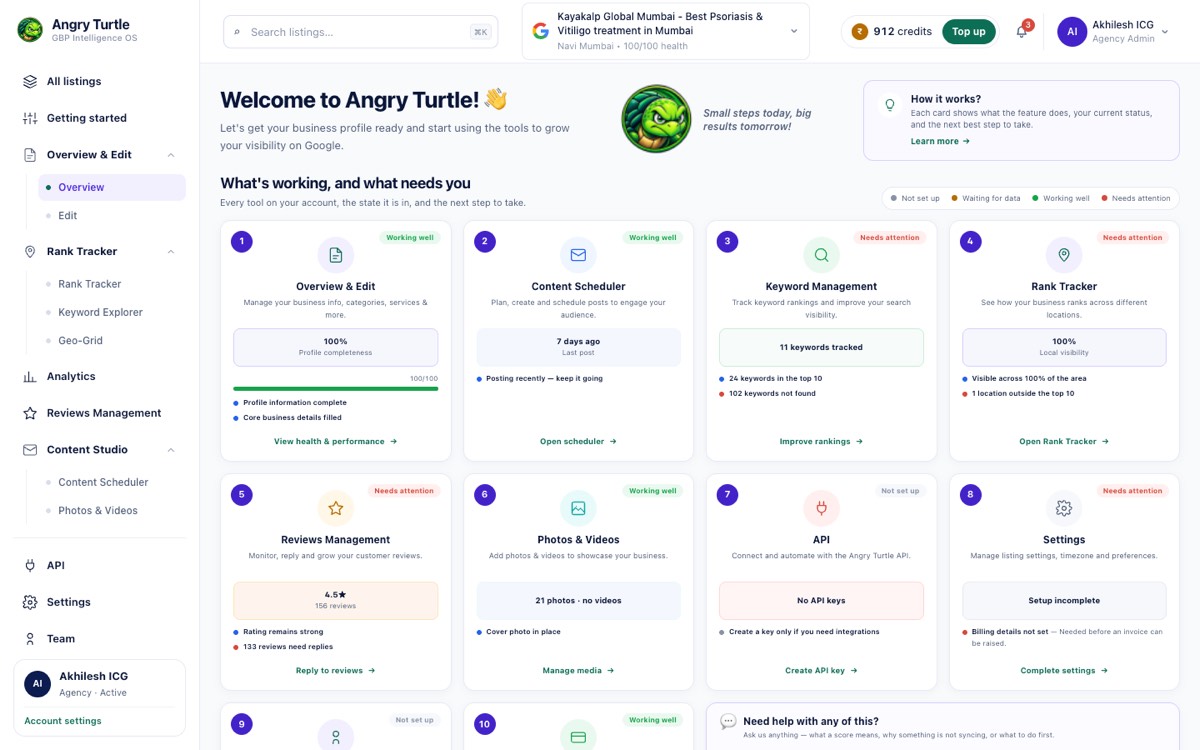
Rank OS is a single 0-100 score built from five weighted dimensions: relevance, review health, freshness, entity authority, and AI-answer readiness. The weights are visible and adjustable, not a black box, and every score comes with a ranked list of the highest-leverage fixes to make next.
The Local Presence Score works alongside Rank OS and is tunable the same way, so an agency running client accounts can adjust what "healthy" means for a given vertical instead of accepting one fixed formula for every business type.
Demand clustering sizes untapped keyword opportunity using Google Ads Keyword Planner data alongside real GBP performance, and flags whether a cluster is scaling, broadening, concentrating, or decaying. Synup doesn't do this kind of demand sizing.
AI review replies draft a response with a personalized greeting and the brand's own voice, then publish it to Google in one click, instead of leaving reply-writing as a manual chore across dozens of listings.
Everything underneath the Unique 4
Underneath the Unique 4, Angryturtle also does full write-back through direct GBP editing. Categories, hours, service areas, posts, photos, and Q&A can all be edited in the tool and pushed live to the Google profile, with a visual preview of exactly how the change will look before it goes out. And unlike a pure self-serve SaaS, Angryturtle is available both ways: run it yourself on the Solo or Agency plan, or hand the execution to Angryturtle's managed team if you'd rather not touch the dashboard at all — the managed GBP services page covers that option in full.
Its citation engine also covers the Indian directory set that Synup's network mostly misses, with the same underlying NAP consistency checks either platform relies on. City-specific pages for major Indian metros exist because the directory landscape genuinely varies by market, something a Western-first tool has no reason to account for.
Angryturtle vs Synup at a glance
| Angryturtle | Synup | |
|---|---|---|
| Core model | Platform that acts, self-serve or managed | Self-serve listings and reputation SaaS |
| Regional focus | India-first (JustDial, Sulekha, Practo, IndiaMART), global-ready | Western directory network |
| Scoring | Rank OS (0-100, 5 weighted dimensions, tunable) | Standard health/reporting dashboard |
| AI-answer readiness | Ask Maps / AIO readiness scoring | Not a stated focus |
| Demand sizing | Cluster momentum plus Keyword Planner sizing | Not a stated focus |
| Review replies | AI-drafted, one-click publish | Reputation monitoring and response tools |
| Write-back to Google | Full: NAP, hours, categories, posts, media, Q&A | Listing sync across directory network |
| Managed option | Yes, optional managed team on top of the platform | Primarily self-serve |
| Pricing shape | Solo ₹999/mo, Agency ₹3,499+/mo, Enterprise custom | Not published here; check Synup directly |
An agency's switch, walked through
A Bengaluru agency running Synup for eighteen clients, mostly local restaurants and salons, had grown its book by word of mouth over two years. Every client got the same monthly PDF: listing status across Synup's directory network, review counts, a couple of charts. Clients rarely asked questions about the report, which the agency founder had started reading as a sign of satisfaction rather than disengagement.
A churned client's exit conversation changed that read. The client mentioned, almost in passing, that a competitor two doors down kept showing up when she asked ChatGPT for restaurant recommendations near her and her own restaurant didn't. The agency checked: the client's Zomato listing hadn't been touched in over a year, and there was no JustDial presence at all, both invisible inside Synup's Western-oriented dashboard because neither directory sat in its network. The agency didn't drop Synup outright, since the tool still handled the Western-style directory sync it had always done well. It layered a citation and AI-readiness pass on top for its Indian client accounts specifically, closing exactly the gap the exit conversation had surfaced.
What goes wrong when a report looks clean but isn't
The recurring failure here isn't a bad tool, it's a false sense of completeness. A dashboard showing every tracked listing as "healthy" reads as reassurance, but it's only reassuring about the directories the dashboard actually tracks. For an Indian client base, a clean Synup report and a genuinely well-managed local presence are two different things, and the gap between them stays invisible until a client mentions, almost by accident, that a competitor is winning a channel the report never measured in the first place.
What to check before assuming coverage is complete
A short check settles this without waiting for a client complaint. Does the client's category depend on JustDial, Practo, Zomato, Sulekha, or IndiaMART for real customer volume — if yes, confirm those specific listings directly rather than trusting a dashboard that doesn't track them. Has anyone asked ChatGPT or Perplexity the kind of question a customer would actually ask, by name, to see whether the business shows up at all. And is the agency's own reporting cadence measuring what clients care about, or just what the current tool happens to track.
Who each is for
Synup fits a team whose locations sit mostly in the US, UK, or similar markets, where its directory partnerships are strongest, and whose main need is straightforward listing sync with review monitoring layered on top.
Angryturtle fits differently depending on who's asking. A solo owner running one or two locations in India gets a single score and a short, ranked list of fixes instead of ten separate dashboards to interpret. An agency managing ten or more client listings gets white-label reporting, roles and permissions, pooled credits, and a scoring narrative it can hand straight to a client. An enterprise chain gets unlimited profiles, SSO, and volume pricing without losing the same underlying scoring engine everyone else uses — see enterprise local SEO for how that scales.
Frequently asked questions
Is Angryturtle a good synup alternative for agencies? Yes, if the agency manages Indian listings or wants a client-facing scoring narrative instead of a raw metrics dump. Angryturtle's Agency plan includes white-label reports, roles and permissions, and pooled credits across the client book.
Synup vs Angryturtle: which has better India coverage? Angryturtle. It's built around Indian directories like JustDial, Sulekha, Practo, and IndiaMART, with city-specific landing pages for major Indian metros, while Synup's directory network is oriented toward Western markets.
Does Angryturtle guarantee higher rankings? No. Angryturtle scores a profile, models a realistic near-term target, and prioritizes the moves most likely to help, but no local SEO tool can guarantee a Google ranking outcome.
Can I get Synup-style listing management with a managed team instead of doing it myself? Yes. Angryturtle offers both a self-serve platform and an optional managed service, so a team can run the dashboard itself or hand execution to Angryturtle's team while keeping the same underlying scoring engine.
Does switching from Synup mean starting citation-building over? No. Existing citations on the directories Synup already reached stay live; Angryturtle's citation engine adds the Indian directories Synup's network doesn't cover, following the same NAP citation basics either tool builds on.
Compare more options: see how Angryturtle stacks up against Whitespark and Uberall, or go straight to Rank OS to see the scoring engine in action. Prefer someone else to run it? Check managed GBP services. Ready to see plans? Visit pricing.
More comparisons
A score you can argue with, not a black box
Rank OS gives every profile a 0–100 score built from five weighted dimensions — Relevance, Review Health, Freshness, Entity Authority and AIO Readiness — and the weights are tunable. Underneath it sits a ranked list of the fixes that move the number, each with the point lift it unlocks.
Ready to have this run for you?
Book a free audit — we'll show you where you stand in 48 hours.