 Angryturtle
Share of AI Voice Tracking
Share of AI Voice measures your business's citation frequency across AI engines. Angryturtle tracks Share of AI Voice across AI Overviews, ChatGPT, Perplexity, and Gemini. Book a demo.
·
Share of AI voice is a straightforward idea with a complicated measurement problem behind it. The idea: what percentage of the questions a real customer might ask an AI engine actually return your business by name — the concept is defined more formally on the share of AI voice glossary entry. The complication: unlike a rank position, which any tool can scrape from a search results page, an AI-generated answer varies by session, by model version, and by exactly how the question is phrased — there's no stable URL to check.
Angryturtle's Share of AI Voice tracking is built to measure this discipline properly rather than around it. It's worth being direct about where that build currently stands: the live, automated tracking layer across OpenAI, Perplexity, and Gemini is built into the platform but not yet running end to end — it's blocked on API access from those providers, which Angryturtle is in the process of securing. What is fully operational today is the diagnostic layer that predicts and drives share of AI voice before it's measured at scale: Ask Maps and the AIO Readiness dimension of Rank OS. Anyone telling you they have a live, running dashboard of your share of AI voice across every major LLM today is worth a follow-up question about how, exactly.
What share of AI voice actually measures
Share of AI voice is the proportion of a defined query set — the real questions your customers ask, phrased the way they'd actually phrase them — for which your business is named in the AI-generated answer, across whichever engines you're tracking. It's a market-share metric, not a position metric: an AI engine either names you or it doesn't, and there's no partial credit for sitting at position four the way there is in organic search. Prompt coverage — how many of the defined prompts return a citation at all — is the closely related metric sitting underneath the headline percentage.
The formula is simple in principle — citations found, divided by queries checked, times 100 — but the number is only as honest as the query set behind it. A shallow list of five generic prompts produces a number that looks precise and means very little. Angryturtle builds the query set deliberately, informed by the same demand clusters used to prioritise content: category-plus-locality prompts ("best dermatologist in Koramangala"), problem-led prompts ("where to treat acne scars in Bengaluru"), comparison prompts ("top skin clinics in south Bengaluru"), attribute-qualified prompts ("dermatologist open on Sunday near Koramangala"), and, where relevant, the Hindi or regional-language equivalents customers actually use. The set gets reviewed quarterly against seasonal demand and new services rather than left static.
The measurement gap, stated plainly
Here's what's genuinely true right now, without softening it: there is no published industry-average share of AI voice figure anywhere, from Angryturtle or anyone else, and no reliable way to benchmark your number against "typical" performance for your category, because nobody has published that data credibly. Automated, real-time citation tracking across Google AI Overviews, ChatGPT, Perplexity, and Gemini simultaneously, at scale, for every client, isn't something any vendor — including Angryturtle as of today — can honestly claim to run live. Manual query monitoring, run consistently against a defined set, remains the most reliable method available right now, and it's slow and labour-intensive by nature. Angryturtle's platform layer for automated tracking across OpenAI, Perplexity, and Gemini specifically is built and waiting on API access; Google AI Overview monitoring, which doesn't depend on those same third-party keys, is closer to operational. We'd rather tell you that directly than ship a dashboard number that implies more certainty than the underlying data supports.
What's actually working today: the leading indicator
The reason this gap matters less than it might sound is that share of AI voice isn't the only lever available, and it isn't even the most actionable one. AIO Readiness — the fifth dimension of Rank OS, checked concretely through Ask Maps — predicts share of AI voice before share of AI voice itself is measurable, the same way a completed, well-structured GBP predicts local pack rank before the rank tracker confirms it. Ask Maps tests, question by question, whether your profile is a citable answer for the specific things Google Maps' AI, AI Overviews, and ChatGPT are likely to be asked about your category and city — for a healthcare business specifically, this often surfaces gaps around consultation and teleconsultation questions before anything else. That's a concrete, checkable signal today, independent of whether the live cross-engine tracking layer is fully running yet.
In practice this means the work that raises your eventual share of AI voice starts now, using AIO Readiness as the interim scoreboard, rather than waiting for a perfect measurement system to exist first.
The mechanics behind AIO Readiness, briefly
Entity completeness comes first: a verified, complete GBP and consistent NAP across the Indian directories that AI engines actually cross-reference — JustDial, Practo, Zomato, 99acres, IndiaMART — tracked through Angryturtle's own citation and NAP tooling, so that an engine resolves your business to one confident entity rather than several slightly different ones. Citation frequency as a measurement concept sits downstream of exactly this kind of entity work. Structured, extractable content follows: FAQ, how-to, and glossary-style pages that answer category questions directly, including in Hindi or regional language where your customers search that way. Schema — LocalBusiness, FAQPage, sameAs — disambiguates and reinforces the entity data underneath all of it. Reviews contribute count, velocity, and rating as prominence signals, without a fixed threshold, because none has ever been published by any AI vendor. Crawler access matters mechanically: GPTBot, PerplexityBot, and Google-Extended need to be explicitly allowed in robots.txt, with an llms.txt file pointing to the content worth grounding on. And directory depth on the high-authority Indian sources relevant to a given category rounds out the picture.
When a gap turns up in any of these — a missing schema field, an inconsistent business name on one directory, a robots.txt line silently blocking a crawler — it routes into the GBP editor, which pushes the fix straight to Google with a preview before publishing, rather than leaving it as a line item in a report someone has to act on separately.
What we track today, without overstating it
Manual query-set monitoring against Google AI Overviews specifically, run on a defined cadence rather than ad hoc. AI-referred session tracking in GA4 (from google.com AI-attributed sessions and, once the relevant referral patterns are confirmed, chatgpt.com and perplexity.ai) — useful directionally, though this significantly undercounts total AI influence, since most citations never produce a tracked click at all. AIO Readiness score, tracked monthly, as the leading indicator described above. What we don't yet offer: a live, always-on citation percentage across all five engines simultaneously, updated automatically. That's the piece under active build, blocked specifically on OpenAI, Perplexity, and Gemini API access rather than on anything Angryturtle controls unilaterally.
Reporting, matched to what's actually measured
For a managed client, the monthly report includes the AIO Readiness score and its month-on-month movement, the current manual AI Overview query-set findings, and GA4 AI-referral signal where it exists. It does not include a fabricated cross-engine percentage dressed up as a live number. As the OpenAI, Perplexity, and Gemini tracking layer comes online, reporting will expand to include it — and we'll say plainly when that happens rather than backfilling a number retroactively.
Alongside the metrics you already track
Keyword rank answers where a page sits in a ranked organic list. Share of local voice answers how much of a geographic catchment sees you in the local pack, tracked via geo-grid. Share of AI voice, once fully running, answers how often AI engines name you in a generated answer rather than a ranked list. Read together, these three answer different questions, and a business can be strong on the first two while still invisible on the third — which is precisely the gap this whole discipline exists to close, and precisely why it's worth building the measurement properly rather than shipping a placeholder number early.
What this can't tell you yet
It can't give you a live, cross-engine citation percentage today — that's the honest state of the build, not a hedge. It can't compare you to an industry average, because no credible one exists. It can't guarantee a specific score or movement, because citation is controlled entirely by Google's, OpenAI's, and Anthropic's own models, and shifts unpredictably as those models update. What it can do is tell you, concretely and today, which specific questions your profile doesn't yet answer well enough to be cited — and route the fix for that straight into your GBP.
FAQ
Is share of AI voice tracking live right now? Partially. AIO Readiness scoring and Ask Maps question-level checks are fully operational. Automated, live cross-engine tracking across ChatGPT, Perplexity, and Gemini specifically is built but not yet running — it depends on API access from those providers that Angryturtle is in the process of securing.
What's a good share of AI voice score? There's no honest answer to give here yet, because no credible published benchmark exists for any Indian local category, from Angryturtle or anyone else. Treat your AIO Readiness score as the meaningful comparison point in the interim — it's checkable today.
Can I track this myself without a tool? Yes, manually — run your defined query set through each AI engine and log whether you're cited. It's time-consuming and results vary somewhat session to session, but it's a legitimate method and exactly what most automated tools are approximating anyway.
Will Angryturtle guarantee my share of AI voice hits a specific number? No, and treat any vendor who does with suspicion. Citation is decided by the AI engines' own models, not by any tool sitting outside them. We commit to the entity, schema, content, and review work that raises citation probability, and to reporting movement honestly.
How does this relate to Rank OS and Ask Maps? AIO Readiness is one of Rank OS's five weighted dimensions, and Ask Maps is the mechanism that actually checks it — a per-listing question bank testing citability question by question. Share of AI voice, once fully measurable across all engines, becomes the outcome metric that AIO Readiness has been predicting all along.
When will full cross-engine tracking be available? As soon as the necessary API access from OpenAI, Perplexity, and Gemini is in place. There's no committed date to publish here, because it depends on factors outside Angryturtle's own timeline, and it wouldn't be honest to promise one.
Related: AI Overview optimization · AEO services · Generative engine optimization · Get cited by ChatGPT · AI search readiness audit · Measuring AI search visibility
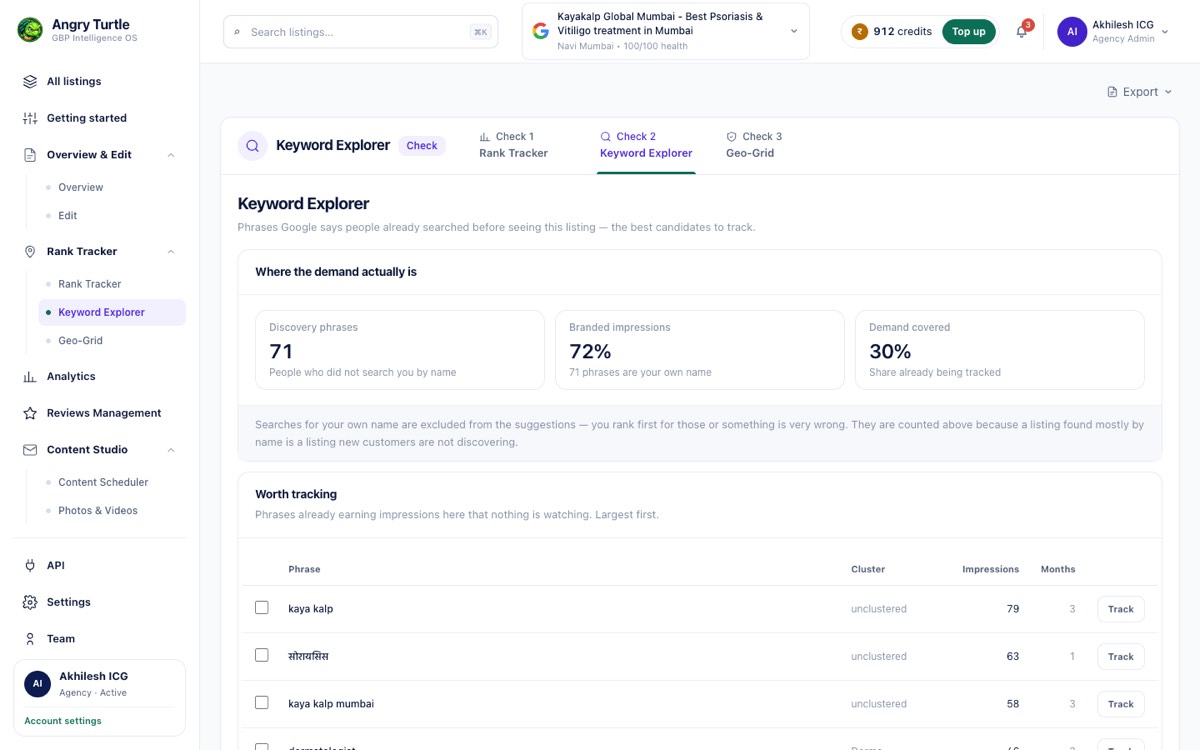
Which demand is growing, and which is decaying
Search terms group into industry-aware demand clusters, each with a momentum read — scaling, broadening, concentrating or decaying — computed from your own Business Profile data rather than a generic keyword tool.
Ready to have this run for you?
Book a free audit — we'll show you where you stand in 48 hours.