 Angryturtle
Get Cited by ChatGPT
How Indian businesses get cited and recommended by ChatGPT. Practical steps covering entity building, directory presence, structured content, and monitoring ChatGPT citations.
·
A clinic owner in Bengaluru asked ChatGPT "best dermatologist in Koramangala" last month, out of curiosity about where his own practice stood. It named three competitors. Not because they were better clinics — because their entity data was cleaner: consistent name and category across Practo and Google, a Practo profile with actual credentials filled in, and a website that opened its services page with a real answer instead of a welcome banner. That's the whole mechanism, more or less, once you strip away the mystery around what ChatGPT does. The same mechanism plays out across healthcare generally and is covered in more depth on healthcare AI search and in AI citations across ChatGPT, Perplexity, and Gemini.
Two different mechanisms, two different fixes
ChatGPT's browsing mode — available in Plus, Teams, and Enterprise — searches the web live when it needs current information. Asked about a local business, it searches, crawls the top-ranking pages (local search results, Practo listings, relevant blog content), extracts what it finds, and synthesises a recommendation with citations. This ties directly to local search rank: a business sitting in the local pack top three gets crawled by browsing ChatGPT for that exact query, because it's reading the same results a person searching directly would see.
Non-browsing responses draw on training data instead — text crawled from the web before a cutoff date. A business with consistent, specific presence accumulated across directories and publications over time has a better shot at being represented there than one whose footprint is thin or contradictory. There's no fix for training-data inclusion that acts quickly; it's a cumulative-presence problem, which is exactly why entity consistency work needs to start now rather than the week before it matters — see LLM citation for how this mechanism is defined more precisely.
What actually correlates with being named
Research on LLM citation behaviour, and Angryturtle's own observation of what a citable profile looks like, points at a consistent pattern rather than any single trick. Businesses with review volume across multiple platforms — Google plus Practo for a healthcare business, Google plus Zomato for a restaurant — read as more established than ones with reviews concentrated on a single source. Directory profiles that are complete, not just claimed — full services, photos, credentials where relevant — feed both browsing crawls and, over time, training data, and Angryturtle's citation and NAP tooling tracks exactly this across 20-plus platforms. A website page titled and written specifically for a query ("laser hair removal in Koramangala, Bengaluru") outperforms a generic services page covering ten procedures in one paragraph, because the specific page is a cleaner match for the specific question. And entity consistency — identical name, address, category, and description across GBP, Practo, JustDial, IndiaMART, and the business's own site — gives any LLM cross-referencing sources more confidence in what it's looking at. This same logic applies just as directly to a real estate developer's project pages as it does to a clinic.
None of these is a threshold that flips a switch at a specific number. Google, OpenAI, and Anthropic have never published one, and no independent study establishes one either — treat all of this as a gradient a business moves up, not a gate it clears once. Citation frequency as a concept is worth understanding on its own terms before chasing any single number.
Where Angryturtle checks this against your actual listing
Rather than guessing which of the factors above matters most for your specific category and city, Ask Maps runs a per-listing question bank testing whether your profile is a strong, citable answer to the actual questions ChatGPT, Google Maps' AI, and AI Overviews are likely to be asked about a business like yours. It's not a generic score — it names the specific question your profile doesn't answer well yet, which is usually more useful than a percentage on its own. That result feeds the AIO Readiness dimension inside Rank OS, Angryturtle's five-dimension scoring model, at a 15-point default weight that can be tuned per client.
Turning a gap into a live fix
Once Ask Maps or an audit identifies the specific gap — an unclaimed Practo credential field, a GBP description with no direct-answer opening, a missing service listing — the GBP editor pushes the correction straight to Google, with a preview of how it'll render before it goes live. Photos, posts, products, and review replies publish the same way. This is the part most listings tools in this category either don't do or do partially; Angryturtle built full write-back as its central differentiator specifically because a citation gap that stays a recommendation document doesn't get fixed.
Building the directory presence ChatGPT actually crawls
For Indian queries, JustDial, Practo, and IndiaMART are confirmed browsing sources — a fact that gives Indian businesses a specific, actionable advantage over generic international advice that only mentions Google. A claimed, complete JustDial profile with accurate NAP and services matters. A verified Practo profile with credentials, specialisation, consultation fees, and patient reviews is, for a healthcare business specifically, among the highest-leverage single assets to get right, because it's a primary ChatGPT source for that category. IndiaMART carries the same weight for B2B queries — "medical equipment supplier in Pune," "laboratory reagent distributor Mumbai" — where a complete profile feeds citation the way a consumer directory would for a retail business. Angryturtle's citation tooling tracks presence and consistency across 20-plus platforms including these, catching mismatches before they quietly undercut an otherwise-strong profile.
The website side: structuring pages ChatGPT can actually extract
A service page that opens with two sentences of direct, specific definition — "laser hair removal at our Bengaluru clinic uses diode and Nd:YAG laser systems suitable for South Asian skin tones; we offer 6-8 sessions spaced 4-6 weeks apart" — gives ChatGPT something concrete to extract and cite. An About page with founding year, credentials, and disclosable patient or client volume adds the kind of specific, verifiable detail LLMs favour over generic claims. An FAQ section with real question-and-answer pairs, structured with FAQPage schema, does double duty: it answers the question a human is likely to have, and it's formatted in a way an LLM can lift cleanly. And a checked robots.txt matters more than it sounds like it should — if User-agent: GPTBot / Disallow: / is sitting in there, ChatGPT's AI crawler can't reach the site at all, and no amount of on-page work compensates for that.
Reviews, freshness, and the identity-image gap
Review reply automation with a personalised greeting and brand signature, one-click published to Google, keeps response rates current without demanding constant manual attention — worth a quick human glance before publishing, especially for anything sensitive. Freshness (recent posts, photos, Q&A activity) contributes to how active an entity reads to an AI system evaluating it, independent of anything about the reviews themselves. And Angryturtle's Brand Identity vs Brand Image comparison checks what a business's own marketing claims against what its review corpus actually says — a gap here tends to surface eventually as inconsistent claims across the sources an LLM is cross-referencing, which is exactly the kind of inconsistency that erodes citation confidence.
Tracking whether it's working
Monthly manual monitoring — running your most relevant local recommendation queries through ChatGPT and logging whether you're cited — remains the most reliable available method today. GA4 referral traffic from chatgpt.com captures citations that produce a click, though this significantly undercounts total ChatGPT influence, since most citations don't generate a tracked visit at all. Angryturtle's broader measurement approach, including what is and isn't currently trackable at scale across engines, is covered honestly on Share of AI voice tracking — worth reading before assuming any vendor's dashboard shows a complete picture.
What this can't promise
Nobody controls ChatGPT's citation decisions except OpenAI, and that includes Angryturtle. What we can commit to is the entity, directory, content, and review execution that makes citation eligible — and, for factually wrong information already circulating in non-browsing responses, correction sits with OpenAI's own content channels, not with any third-party tool, because that data comes from training rather than a live source we can edit. This is also local and GBP-centred work, not website SEO or link building; it checks your site's NAP against your GBP but doesn't rank your pages independently.
FAQ
How long does it take to get cited by ChatGPT? There's no fixed timeline, and it depends on where entity consistency, review signals, and content structure currently stand. Businesses starting from a stronger base — consistent directories, decent review volume, structured content — tend to see initial citations sooner than businesses building all three from scratch.
Can I control what ChatGPT says about my business? For browsing-mode answers, yes indirectly: ChatGPT extracts from your website and directory profiles, so keeping those accurate and current is how you influence what gets said. For factually wrong training-data-based claims, correction goes through OpenAI's own channels, since that data isn't something any third party can edit directly.
Does a claimed but incomplete Practo profile still help? Less than a complete one. A claimed profile with missing credentials, no consultation fee, and no photos gives ChatGPT less to extract and cite than a complete one — claiming it is the first step, not the whole fix.
Is there a review count that guarantees citation? No. There's no published threshold from any AI vendor and no independent study establishing one. Review volume and recency function as a gradient that makes citation more likely, not a specific number that unlocks it.
Does Angryturtle track ChatGPT citations specifically, separate from AI Overviews? Ask Maps checks citability across Google Maps' AI, AI Overviews, and ChatGPT together as part of the AIO Readiness score. Broader per-engine tracking, including ChatGPT specifically, is covered on Share of AI voice tracking.
Which demand is growing, and which is decaying
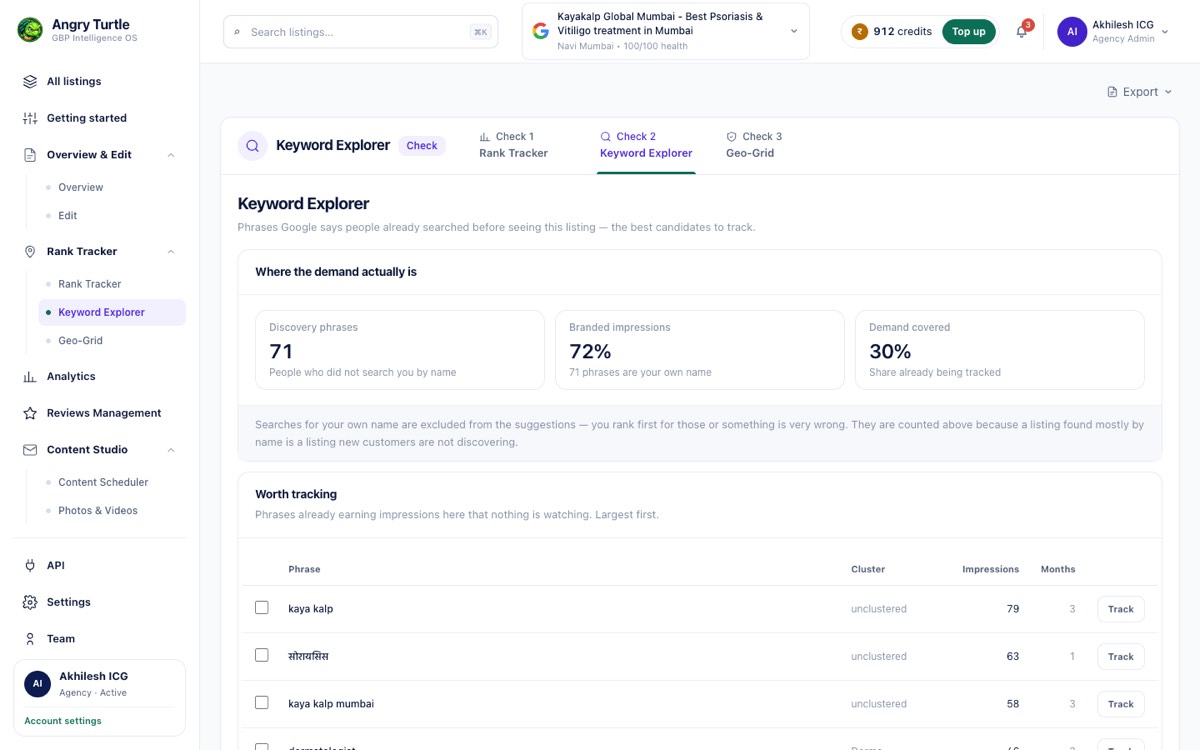
Search terms group into industry-aware demand clusters, each with a momentum read — scaling, broadening, concentrating or decaying — computed from your own Business Profile data rather than a generic keyword tool.
Ready to have this run for you?
Book a free audit — we'll show you where you stand in 48 hours.