 Angryturtle
Yext Alternative for India
Looking for a Yext alternative for your Indian locations? Angryturtle delivers managed GBP management and India-native citations without Yext's enterprise pricing and limited India coverage.
·
Anyone searching for a Yext alternative is usually solving one of two problems: the platform costs more than the value it returns at their scale, or its publisher network was never built for the directories their customers actually use. Both are fair reasons to look, and neither is an argument that Yext is a bad product — it is a good product aimed at a different market. This page sets out where Angryturtle fits as a Yext competitor for Indian businesses, and where staying put is the better call.
Two very different businesses, two different problems
A US retail chain running 400 storefronts across ten states has one kind of problem: keep the same name, address, hours, and photos consistent across 200-plus publishers without someone manually editing Yelp, Bing, Apple Maps, and forty other listings by hand. A twelve-clinic chain in Mumbai and Pune has a different one: get found on the directories Indian patients actually use, keep the Google Business Profile active, and turn reviews into more bookings. Yext was built for the first problem. Most Indian businesses, even ones with twenty or thirty locations, have the second.
Yext is an enterprise location-data platform built around a structured Knowledge Graph. Angryturtle is a platform that scores a Google profile, tells you the fixes that matter, and can push them live itself, self-serve from ₹999 a month, handed to an agency, or run as a fully managed service. The two aren't really solving the same problem, which is why the comparison isn't as simple as feature-for-feature.
Most people who search "Yext competitor" or "Yext competition" from India are actually looking for something narrower than a like-for-like syndication swap — a tool built for the directories Indian customers actually use, that also does the GBP management, review, and rank work Yext leaves to a separate team. That's the comparison this page is built to answer.
What Yext does well
Yext built its business on syndication. Update one record in the Knowledge Graph and it propagates across a publisher network Yext says covers 200-plus directories, search engines, and apps. For a large Western brand with hundreds of storefronts, that's genuinely useful, and it's the reason enterprises with sprawling US and European footprints keep renewing annual contracts. Yext also sells Pages (hosted location landing pages), review aggregation, and an AI search layer on top of the Knowledge Graph, and it markets itself primarily to large brands on enterprise terms — see Yext's own site for current plans and eligibility.
None of that is a knock on the product. If your publisher network is genuinely 200 Western directories and your team already runs GBP posting and review replies separately, Yext does what it says.
Why Indian businesses look elsewhere
The publisher network is the whole value proposition, and in India it's thin. JustDial, Sulekha, Practo, and IndiaMART, the directories that actually carry weight for Indian local search, aren't part of Yext's syndication list. A business selling into Mumbai or Bengaluru gets a product built for a directory ecosystem that barely touches its market.
Contract structure is the second consideration. Yext sells on annual enterprise contracts priced per location for syndication — check Yext's own pricing page for current terms and location minimums. Whatever the specific figure, that's a budget line worth weighing against what it actually covers: syndication alone, with no GBP posting, review replies, or rank tracking bundled in.
Yext also doesn't act. It syndicates data and provides tools; it doesn't score a listing, doesn't diagnose why one location underperforms another, and doesn't read AI-answer readiness. Your GBP posts, review responses, Q&A, and photo uploads still need a person doing them somewhere, on Yext or off it. And Yext positions itself toward enterprise brands with larger location counts, which can leave a business running five to fifty Indian locations stuck between an enterprise minimum built for a different market and a shortage of good managed alternatives built for this one.
What Angryturtle provides that Yext doesn't
| Capability | Yext | Angryturtle |
|---|---|---|
| Model | Enterprise SaaS, self-serve | Platform that acts, self-serve or managed |
| Rank / health scoring | Not included | Rank OS, five-dimension score |
| Location data syndication | See Yext's published publisher network | India-native, 20+ platforms |
| GBP active management | Sync only | Full monthly management, posts included |
| Review response execution | Not included | Done for you, within 48 hrs |
| Review generation (WhatsApp) | Not included | Included |
| Demand-cluster / keyword sizing | Not included | Included |
| Geo-grid rank tracking | Not included | Included |
| AI-answer / AIO readiness | Not included | Included |
| Full write-back to Google | Partial, base fields via sync | Full: NAP, hours, categories, posts, media |
| Positioning | Enterprise, larger location counts | Starts at 1 location |
| Billing | USD, annual contract | ₹ pricing, monthly or annual |
The score-and-act model
Angryturtle leads with four things the platform does that Yext, and most of the category, doesn't. First, the Rank OS score itself: a single 0-100 number built from five weighted dimensions — relevance, review health, freshness, entity authority, and AI-answer readiness — that tells you exactly where a listing stands. Second, the weights behind that score are visible and tunable rather than a black box. Third, demand-cluster sizing shows which keyword clusters are scaling, broadening, or decaying for a listing, using first-party GBP data plus Google Ads Keyword Planner volumes, which answers a different question than "am I ranking" — it answers "is this keyword worth ranking for at all." Fourth, AI-drafted review replies run against sentiment analysis across the whole review corpus and publish to Google in one click.
Underneath those four sits full write-back. Angryturtle edits name, hours, categories, service areas, photos, posts, and Q&A directly inside the tool, and the change goes live rather than sitting in a sync queue. It also scores AIO and Ask Maps readiness, checking whether a profile is positioned as a citable answer when Google's AI systems or ChatGPT get asked about a business category or location, a layer almost nothing else in this category covers.
Syndication vs. a platform that also acts
The clearest way to frame the choice is the operating model behind each.
Yext is a syndication platform. You maintain a single source of truth for your location data inside it, and Yext pushes that out to its publisher network and keeps it synced. It's data plumbing: powerful for consistency at scale, but the strategy, the content, the review handling, and the rank work stay with your team.
Angryturtle is a platform that also does the work, on your terms. Beyond holding your data, the tool, and if you want it, our team, does the local search work itself: builds and corrects listings on the Indian directory stack, manages and posts to your GBP, generates and responds to reviews, tracks geo-grid rank, and prepares your presence for AI answer engines. Syndication is one input; execution across the whole local surface is the actual product. See citations and NAP management for how that plays out on the listings side specifically.
Worked scenario: a 30-store apparel retailer weighing the two
A 30-store apparel retailer with outlets across Bengaluru, Hyderabad, and Chennai is currently running on Yext for base NAP syndication, because a previous marketing head signed the contract two years ago and nobody has revisited it since. The stores' GBP profiles are inconsistently posted to, review responses happen roughly once a month in a batch when someone remembers, and nobody has ever checked whether any of the 30 stores actually appear correctly on JustDial or Sulekha.
The constraint that decides the call here is what the Yext contract is actually still doing versus what it's costing. If an audit shows the syndication feed genuinely keeps NAP consistent across the handful of Western-style directories that still matter for a footwear or apparel brand's India presence, and the real gap is entirely on the GBP-management and review side, layering Angryturtle's managed GBP service on top for a quarter while deciding whether to keep or drop Yext at renewal is the lower-risk move. If the audit instead shows Yext's syndication network barely touches the directories Bengaluru, Hyderabad, and Chennai shoppers actually use, the retailer is paying an enterprise contract for something that isn't reaching its own customers, and the more defensible call is a full switch at the next renewal date rather than paying twice for overlapping, partly-unused coverage.
What actually goes wrong when the tools get mismatched
A chain signs an annual Yext contract expecting it to cover GBP posting and review replies, discovers three months in that neither is included, and ends up paying for a second tool or a person to do that work anyway, on top of the syndication fee already committed. A business with fifteen Indian locations gets quoted enterprise Yext pricing sized for a much larger US footprint, decides it's not worth it, and ends up doing citation cleanup manually on JustDial and Sulekha for a year longer than necessary because nobody looked at India-specific alternatives. And a marketing team assumes syndication alone will move Maps ranking, when ranking actually depends on category accuracy, review health, and freshness, none of which a pure syndication platform touches.
What to check before switching either way
A few questions are worth confirming directly before signing anything, on either side of this comparison. Does the current or prospective tool's directory list actually include JustDial, Practo, Sulekha, or IndiaMART, by name, rather than a vague "200+ publishers worldwide" claim? Does the price quoted include GBP posting and review replies, or only base-record syndication? And is there a real person accountable for reading the monthly report either tool produces, because neither one fixes anything on its own if nobody acts on what it finds.
India multi-location fit
For an Indian brand running anywhere from five to five hundred locations, the practical questions differ from an enterprise syndication buyer's. The publishers that matter are Indian: Google Business Profile plus a focused set — JustDial, Sulekha, Practo, IndiaMART, 99acres, MagicBricks, Zomato — carry local authority here, and depth on that set beats breadth across Western publishers you'll never be found through. Each branch gets GBP management, review handling, and locally relevant posts, not one syndicated record fanned out unchanged. Vernacular content — Hindi and regional-language descriptions, Q&A, and posts — is standard scope, matching how customers actually search; our vernacular search glossary entry covers the mechanics. And listing and review copy for healthcare (NMC/CDSCO), real estate (RERA), and BFSI is written with those norms in mind — see our healthcare, real estate, and BFSI pages.
Who each is for
Yext fits a global brand whose problem is data consistency across a wide, largely Western publisher network, and that already has staff running GBP posting and review replies separately. Angryturtle fits an Indian solo owner who wants one tool telling them the next fix, an agency running ten-plus client profiles that needs white-label reporting and pooled credits, and an enterprise chain that wants India-specific directory coverage plus SSO and volume pricing without a US-contract price tag.
Where staying on Yext still makes sense
If a business runs Yext globally across dozens of countries and India is one more market inside that same existing system, ripping it out just for the Indian locations can create more integration overhead than it solves, especially if the internal team configuring new regions inside Yext already knows the platform well. In that case, the more sensible move is often the one described below — keep Yext for the global syndication layer and add Angryturtle specifically for the India-side GBP management, review, and rank work Yext was never built to do, rather than treating the two as an either-or choice.
Migrating off Yext for your India operations
Moving off Yext for India is low-friction because there's no proprietary data locked inside it worth rescuing. We start with an audit, capturing the current state of your GBP, listings, reviews, and rank across each Indian location. Where Yext has been syndicating NAP, we confirm the canonical record and carry it forward, so nothing regresses when syndication stops. Then we rebuild depth: building and correcting the Indian directory listings Yext's network never reached, and taking over active GBP management. Reviews, posts, geo-grid tracking, and AEO readiness come online next. Once the managed service is live, you retire the Yext licence for India, or scope it to Western markets only if you're running both. Your GBP history stays in your Google account the entire time. Our NAP citations primer and multi-location governance guide cover the mechanics in more depth.
Yext competitors, and how to read a shortlist
Searches for Yext competitors and Yext alternatives usually come from the same place: a renewal is due, or a first quote came in higher than expected. The useful way to read a shortlist is to sort it by what the buyer actually needs rather than by feature count. Enterprise brands with hundreds of locations across North America and Europe are the market Yext was built for, and its publisher network reflects that.
For an India-first business the shortlist narrows quickly, because the question stops being how many directories a platform syndicates to and becomes whether it reaches the ones Indian customers use. JustDial, Sulekha, Practo and IndiaMART are where a great deal of Indian local discovery happens, and a citation network built around Western publishers treats them as an afterthought. The second question worth asking any Yext competitor is whether it acts or only reports: whether a detected error gets corrected on the live Google listing, or whether someone on your team still has to go and fix it by hand.
Frequently asked questions
Does Yext cover Indian directories like JustDial?
No. JustDial, Sulekha, Practo, and IndiaMART aren't part of Yext's publisher network, which is built primarily around US and European directories.
Can Angryturtle replace Yext's citation syndication for India?
Yes, for India-specific operations. Our citation management covers the Indian directory stack that matters for Indian local search, which is different from Yext's Western publisher network, and we build and maintain those listings as a managed service rather than syndicating to publishers you won't be found through.
What if we run Yext globally and need India covered separately?
This is a common arrangement. Angryturtle handles the India citation and GBP management layer while Yext manages Western market data syndication. We define the scope boundary at onboarding so there's no overlap on your Indian records.
Is there a minimum number of locations?
No. We start from a single location and scale up. Check Yext's own site directly for their current location minimums and enterprise terms.
Beyond listings, what actually moves the needle in India?
Reviews — WhatsApp-led generation and posted responses — geo-grid rank tracking, and AEO readiness for AI answer engines. These sit outside a pure syndication platform's scope and are core to what we do.
How does Angryturtle's pricing compare to Yext's?
Yext runs on annual USD enterprise contracts, priced per location — see Yext's own pricing page for current figures and terms. Angryturtle starts at ₹999 a month for a solo owner and ₹3,499 or more a month for an agency managing multiple listings, with enterprise volume pricing available for larger footprints. See pricing →
Curious what the score-and-act model looks like on your own profile? Try Rank OS, or see how Angryturtle stacks up against another enterprise syndication player in the Uberall comparison.
Related: Enterprise local SEO · Managed local SEO · GBP management services · Local SEO agency India · AEO services · Product: Geo-grid
What is the best Yext alternative for an Indian business? It depends which half of Yext you actually use. If the value is publisher syndication across Western directories, no Indian-first platform replaces that and you should keep it. If the value is keeping listings accurate where your customers search — Google, JustDial, Practo, IndiaMART — then an India-native platform covers the ground that matters here, in rupees, with edits pushed live to Google rather than reported back to you.
Who are Yext's main competitors? The category splits three ways: enterprise syndication platforms built for large Western estates, mid-market listings-and-reviews tools, and India-first platforms like Angryturtle built around the directories that drive discovery in this market. Which competitor fits depends far more on where your locations are than on any feature grid. Check each vendor's own pricing and publisher list before shortlisting — they publish both.
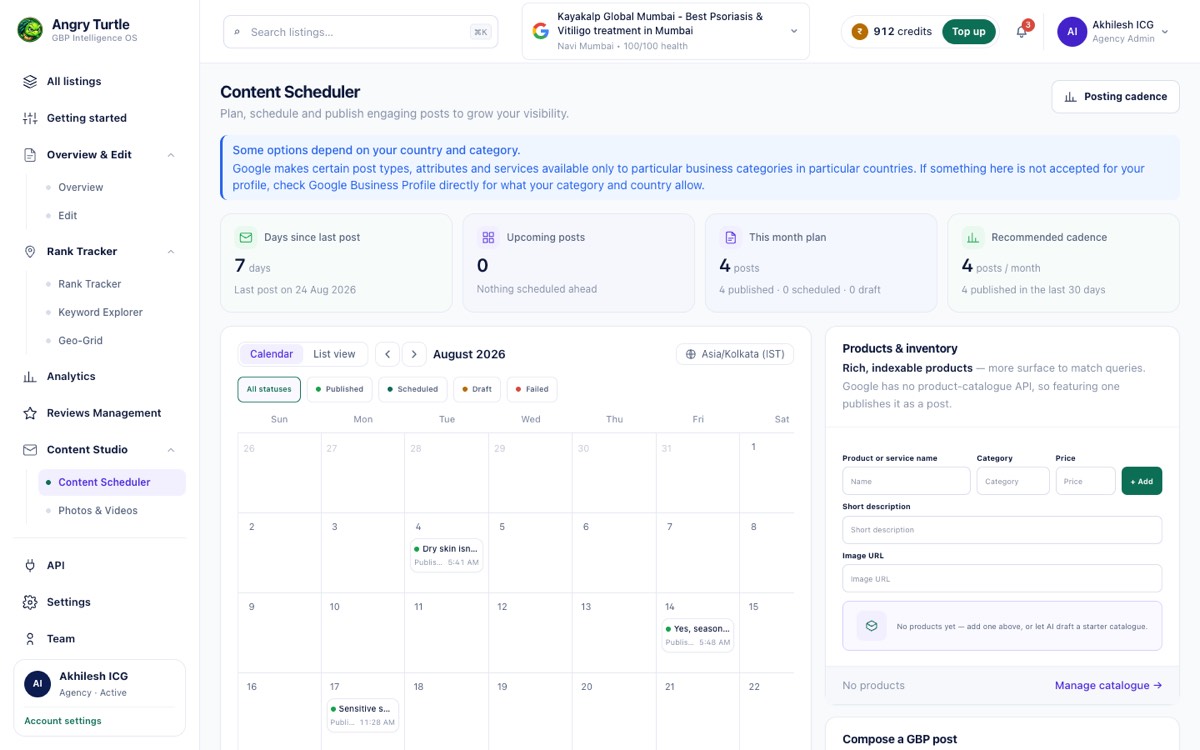
Write it, schedule it, and it publishes to Google
Posts, photos, products and review replies are composed here and publish live to the Google profile — timezone-correct to the listing. Most tools in this category are read-only or stop at a recommendation.
Ready to have this run for you?
Book a free audit — we'll show you where you stand in 48 hours.