 Angryturtle
Angryturtle vs Moz Local
Moz Local keeps your listings consistent across directories; Angryturtle scores your Google profile, tells you what to fix, and makes the fix for you.
Picture a two-location retail chain in Pune. The listings are live, the phone numbers match across directories, and the owner still can't tell you why a competitor three streets over keeps beating them into the map pack. That's the gap Moz Local was never built to close, and it's the reason most searches for a moz local alternative in India end up here.
Moz Local vs Angryturtle at a glance
| Moz Local | Angryturtle | |
|---|---|---|
| Core job | Citation/NAP sync across directories | Profile scoring plus prioritized fixes plus execution |
| Geographic focus | US/UK-centric directory network | India-first (JustDial, Sulekha, Practo, IndiaMART) plus global |
| Scoring | No unified score | Rank OS: 5-dimension 0-100 score, tunable weights |
| GBP write-back | Limited | Full: NAP, hours, categories, posts, media, replies |
| AI-answer readiness (AEO) | Not offered | Ask Maps module plus AIO scoring dimension |
| Review management | Basic monitoring | AI-drafted replies, sentiment analysis, one-click publish |
| Delivery model | Self-serve only | Self-serve (Solo/Agency/Enterprise) or managed |
| Agency features | Limited | Multi-tenant, white-label, roles, client portals |
What Moz Local does well
Moz Local's core job is NAP consistency — getting your business name, address, and phone number to match across data aggregators and directories, then flagging mismatches when they drift. For a single-location US business that just needs its listings to stop contradicting each other, that's a real and useful function, and it handles duplicate listing suppression and basic listing distribution reasonably well, particularly in markets with mature, standardized directory ecosystems.
Moz built its reputation on Moz's broader SEO research and its data partnerships with directories like Yelp, Apple Maps, and Bing Places. For a business whose customers search primarily on those Western platforms, the distribution list lines up with where the traffic actually is. It's a narrow tool, but it does that narrow job without much friction.
The directory gap
Moz Local's directory network is built around US and UK data aggregators. It has no native coverage for JustDial, Sulekha, Practo, or IndiaMART, the directories Indian customers actually search on for services, doctors, and suppliers. That two-location Pune retailer ends up with clean listings on directories nobody in Pune checks, and no coverage at all on the ones a real customer would type into a search bar.
The bigger gap: diagnosis, not distribution
Moz Local syncs data. It doesn't diagnose or act on the Google Business Profile itself. It won't tell you that a review reply rate below a competitor's is dragging visibility down in a specific pincode, or that a missing service-area setting is costing rank in a neighboring locality. It reports what's inconsistent across directories; it has no model for which fix moves the needle first, and it doesn't touch AI-answer readiness at all — whether a profile shows up when someone asks Google's AI or ChatGPT a local question. In a market where the Google Business Profile, not a third-party directory listing, is the main battlefield, that's the thing that actually needs solving.
How Angryturtle closes both gaps
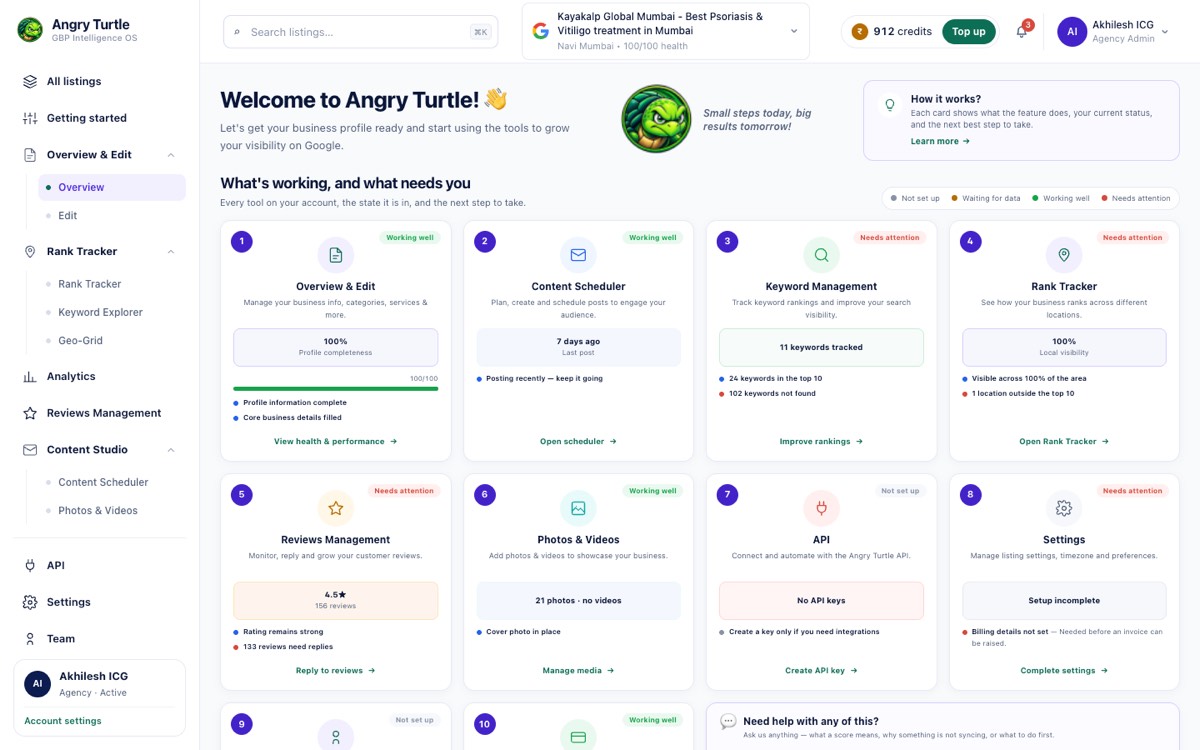
Angryturtle isn't a citation syncer with a dashboard bolted on. Every Google Business Profile gets scored using Rank OS — a 0-100 score built from five weighted dimensions: Relevance, Review Health, Freshness, Entity Authority, and AI-answer readiness (AIO). The weights are visible and adjustable, and every score comes with a ranked list of specific actions that would move it, each with an expected point lift.
Four things separate it from Moz Local specifically: the Rank OS score itself, a tunable Local Presence Score at the field level, demand-cluster sizing pulled from Google Ads Keyword Planner data, and AI-drafted review replies that publish with one click. None of those exist in a pure citation-sync product, because citation sync was never trying to solve the same problem in the first place.
Angryturtle also writes back to Google directly. Name, description, phone, address, hours, categories, service areas, posts, media, review replies — edits made in the tool push live to the profile through direct GBP editing, with a preview of exactly how the change will look before it goes out. Moz Local's citation layer exists inside Angryturtle too, through the same citation engine that handles automated discovery, NAP consistency checks, and duplicate finding — it's one module in a bigger loop rather than the whole product, and it includes JustDial, Sulekha, Practo, and IndiaMART alongside the Western directories Moz Local already covers well.
The AEO piece matters more each month. Google Maps' AI and tools like ChatGPT increasingly answer local questions directly, without sending the searcher to a results page. Angryturtle's Ask Maps module checks whether a profile is a strong, citable answer for the questions customers are actually asking, and coaches the fixes. Almost nothing in this category, Moz Local included, touches that yet — see how AI Overviews treat local businesses for the broader shift this is part of.
None of this requires hiring anyone. Solo owners run it themselves for ₹999/month across up to two profiles. Agencies managing ten or more listings get white-label reporting, roles, and pooled credits through Agency OS from ₹3,499/month. Larger chains get unlimited profiles, volume pricing, and SSO on Enterprise. A managed team is also available for anyone who'd rather hand execution off entirely — the platform doesn't force a choice between doing it yourself and outsourcing it.
Who each one is actually for
Moz Local suits a single-location Western business, or an agency already deep in the Moz ecosystem, that just needs directory data kept clean and nothing more ambitious than that. It's a narrow tool and it does that narrow job fine.
Angryturtle suits an Indian business owner, agency, or chain that wants to know what's actually wrong with a Google profile and wants it fixed, not just flagged. That covers a solo clinic running one location under industries/healthcare, an agency managing forty client listings across healthcare, real estate, and retail, or an enterprise brand that needs SSO and volume pricing across hundreds of stores. For anyone comparing against other categories in this space, the Whitespark comparison and Uberall comparison cover the same ground from different angles.
Frequently asked questions
Is there a real moz local alternative for Indian directories? Yes. Angryturtle covers JustDial, Sulekha, Practo, and IndiaMART natively, alongside the broader directory set Moz Local already handles, and adds Google Business Profile scoring and write-back on top.
Moz local vs Angryturtle — which is cheaper? Angryturtle's Solo plan starts at ₹999/month for up to two profiles, with Agency plans from ₹3,499/month for ten or more. Moz Local's exact current pricing should be checked directly on their site before comparing, since plan structures change.
Does Angryturtle replace the need for an agency? No, and it isn't trying to. It works self-serve for owners who want to run it themselves, and it also comes with an optional managed GBP service for anyone who'd rather have a team execute the fixes.
Can Moz Local do AI-answer optimization? Not currently. Moz Local's product is built around citation and listing sync, not around whether a profile is a citable answer for Google's AI Overviews or tools like ChatGPT. Angryturtle's Ask Maps module and AIO scoring dimension are built specifically for that, and measuring AI search visibility covers how that gets tracked over time.
What happens to my existing citations if I switch from Moz Local? Nothing breaks. Existing citations stay live on the directories Moz Local already synced; Angryturtle's citation engine layers on top and extends coverage into the Indian directory set, following the same NAP citation basics either tool relies on.
Ready to see your own Rank OS score? Check current pricing and start with the free trial — up to two profiles, no card required.
More comparisons
A score you can argue with, not a black box
Rank OS gives every profile a 0–100 score built from five weighted dimensions — Relevance, Review Health, Freshness, Entity Authority and AIO Readiness — and the weights are tunable. Underneath it sits a ranked list of the fixes that move the number, each with the point lift it unlocks.
Ready to have this run for you?
Book a free audit — we'll show you where you stand in 48 hours.