 Angryturtle
See which demand is rising — before your competitors do.
Demand Clusters group the searches that bring you customers into industry-aware themes — a café never gets healthcare clusters. Cluster Momentum then reads each theme from your first-party GBP data as Scaling, Broadening, Concentrating or Decaying, so you know where demand is heading. Cluster Potential sizes the opportunity using Google Ads Keyword Planner, so you chase the demand that's actually worth chasing.
In brief
A demand cluster groups the searches that surface your business into an industry-aware theme. The taxonomy adapts per vertical, so the clusters reflect how your customers actually search rather than a generic keyword dump.
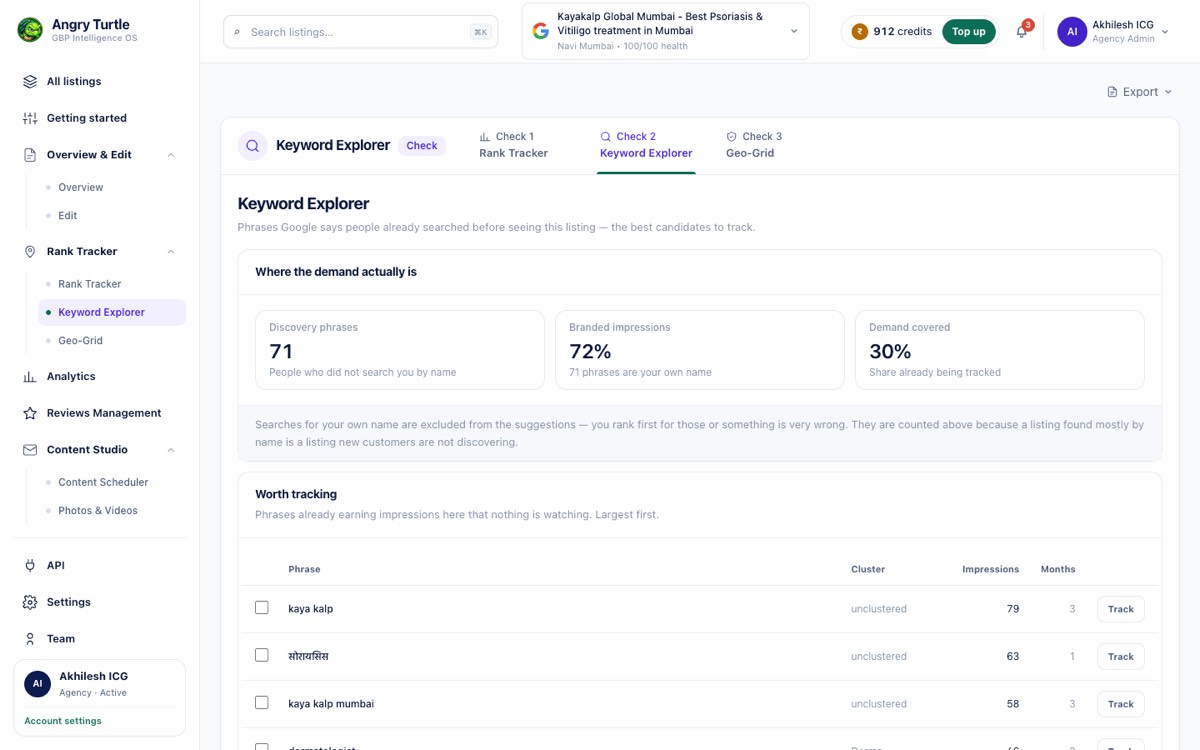
Demand Clusters & Momentum — from the live Angryturtle console.
How Demand Clusters & Momentum works.
Cluster
Your keywords are grouped into industry-aware demand clusters automatically.
Read momentum
Each cluster is tagged Scaling, Broadening, Concentrating or Decaying from your GBP data.
Size it
Cluster Potential estimates the demand from Google Ads Keyword Planner so you prioritise.
What's inside.
The building blocks that make this module work.
Who it's for.
Spotting a Scaling cluster early and posting into it before rivals.
Deciding which service to promote based on where demand is broadening.
Agencies showing clients demand trends, not just raw keyword lists.
Four words: Scaling, Broadening, Concentrating, Decaying
Those are the only four states a demand cluster can be in, and most of the value of this feature is just learning to trust what they mean before the raw keyword numbers confirm it weeks later. Scaling means more people and more different search terms are both rising together — real, broadening demand. Broadening means the keyword list is growing while impressions stay flat, which sounds unremarkable but is actually healthy: it means new ways of searching for you are appearing before the volume behind them has caught up. Concentrating means demand is narrowing onto fewer terms, which isn't automatically bad but deserves a look. Decaying means both the terms and the impressions are shrinking, and that's the one that should interrupt whatever else is on the to-do list that week.
The mistake this catches
Most small businesses pick their content and post topics based on what used to work, updated occasionally by gut feeling. A salon owner in Koramangala kept posting about hair spa packages because that's what built the client base three years ago, while the demand cluster around "keratin treatment Koramangala" had been quietly scaling for two quarters. Nobody was lying to her — the hair spa cluster still had decent volume — but she was pouring content into a cluster that was concentrating while ignoring one that was scaling, and Cluster Potential (sized from Google Ads Keyword Planner, scoped to her city) would have told her the second cluster was worth roughly four times the search volume of the first.
How to read the screen without overreacting
A cluster tagged Decaying isn't automatically an emergency. Seasonal businesses — wedding venues after wedding season, tax consultants after filing deadlines, school-admission consultants outside the admission window — will show entire clusters decaying on a predictable annual clock, and chasing that with new content is wasted effort. The state only matters against the calendar and against Cluster Potential together: a small, decaying, low-potential cluster is background noise; a large, decaying, high-potential cluster in a business's actual off-season is worth investigating, because it might mean a competitor took the demand rather than the demand disappearing.
The cluster-wise traffic compare is the tool for telling those two apart. Pull the same cluster across the same period last year. If the decay lines up with last year's calendar dip, it's seasonal. If this year's dip is steeper or starts earlier than last year's, something outside the calendar moved — usually a competitor, sometimes a category change on the profile itself, occasionally a citation or NAP problem quietly pulling the listing out of consideration.
A second decision: which cluster gets this month's budget
Every business with more than one service line eventually has to decide where the next round of content, posts and paid attention goes, and that decision is usually made by whoever's most vocal in the room rather than by what customers are actually searching for. A modular kitchen showroom in Jaipur with three product lines — kitchens, wardrobes, and office interiors — had always assumed kitchens deserved the lion's share of attention because that's what the brand was known for. The cluster data told a different story: the kitchens cluster was Concentrating, meaning demand was narrowing to a smaller set of repeat searchers, while the wardrobes cluster was Broadening, picking up new search phrasing every few weeks. Reallocating even a third of the content calendar toward wardrobes, based on that read rather than on brand history, is the kind of decision this feature is built to settle.
A worked example: a Jaipur furniture workshop
A custom furniture workshop in Jaipur sold mainly through referral and had never taken keyword clusters seriously. Its "custom wardrobes Jaipur" cluster was Scaling steadily, but Cluster Potential sized it as modest next to a smaller, newer cluster — "modular kitchen Jaipur" — that was Broadening fast, adding new search terms every few weeks without a matching jump in impressions yet. Broadening-but-not-yet-scaled is the window to move before the crowd notices, and it's exactly the situation where posting into a Content Studio calendar early, rather than waiting for the volume to prove itself, pays off the most. Waiting for Scaling to show up before acting means arriving after several competitors already have.
Where this doesn't help
Demand Clusters reads your own first-party GBP data plus Keyword Planner sizing — it does not see what your competitors' clusters are doing, only what's happening around your own listing. Two businesses two streets apart, one strong and one weak, will show the same city-level Cluster Potential number even though one of them is capturing most of it. Closing that particular gap needs Competitor Intelligence sitting next to this feature, not instead of it. The clustering also depends on the industry taxonomy being a reasonable match for the business — a hybrid business that spans two categories (a café that also does event catering, say) will sometimes see its demand split unevenly across clusters that don't map cleanly onto how the owner actually thinks about the two halves of the business, and that split is worth sanity-checking rather than trusting blind. It also won't tell you whether a scaling cluster is scaling because of genuine new demand in the city or because of a seasonal event calendar quirk specific to India's festival and school-admission cycles — the AEO India playbook covers that seasonal pattern in more detail than a per-listing dashboard reasonably can.
What it connects to
Relevance is a quarter of the Rank OS score, and cluster coverage is a direct input into it — a profile that's strong in a Scaling cluster and thin in everything else will show that unevenness in the relevance dimension specifically, and in the broader set of local ranking factors Google weighs. The momentum read also feeds directly into what Ask Maps should be watching for AI-answer readiness, since a cluster that's scaling in ordinary search tends to show up in AI-generated answers not long after. Because Cluster Potential is scoped by city, it plugs into how Insights & Performance should be read too — a rising discovery number only makes sense once it's clear which cluster is actually driving it. Multi-location brands running the same cluster taxonomy across branches will find it interacts with multi-location SEO planning generally, and any change worth making usually gets pushed live through Edit Location once the priority cluster is chosen.
Demand Clusters & Momentum — questions, answered
The rest of the platform.
Rank OS Scoring
One transparent 0–100 score, split into the 5 weighted levers that move the map pack — with the top 3 fixes ranked by expected point lift.
Explore Rank OS ScoringGeo-Grid Rank Maps
A colour-coded grid showing your true rank at every point around your business — with a pin checker for any pincode and a rank tracker for every keyword.
Explore Geo-Grid Rank MapsAI Reviews + Virtual CMO
On-brand, one-click AI replies to every review — plus a Virtual CMO grounded in your own data, and a Brand Identity-vs-Image gap read that shows how customers really perceive you.
Explore AI Reviews + Virtual CMONAP & Citation Intelligence
A live directory-presence matrix of every listing that has your business wrong — with duplicate detection, missing-citation gaps and a prioritised fix list.
Explore NAP & Citation IntelligenceOne-Click Google Posting
Write once and publish an offer, event or update across all your listings on a schedule — a freshness signal that feeds your Rank OS score.
Explore One-Click Google PostingCompetitor Intelligence
A standardised view of your top-5 local rivals — ratings, review volume and the Us-vs-Competitor citation landscape — with the gaps you need to close.
Explore Competitor IntelligenceInsights & Performance
Real GBP metrics — views, calls, directions, clicks — split by branded vs discovery, over any date range.
Explore Insights & PerformanceAsk Maps / AIO Readiness
A per-listing question bank and visibility checks that show if your profile is a citable AI answer.
Explore Ask Maps / AIO ReadinessEdit Location (Write-Back to Google)
A full GBP editor with a live "how it looks on Google" preview — every change pushes straight to Google.
Explore Edit Location (Write-Back to Google)Brand Identity vs Image
Your canonical brand story set against how reviews say customers really see you — plus the gap and the fix.
Explore Brand Identity vs ImageAgency OS
Multi-tenant, white-label local SEO with roles, metered credits, client portals and a full API.
Explore Agency OS