 Angryturtle
AI Search Readiness Audit
Angryturtle's AI search readiness audit checks your business across 6 pillars: entity, schema, GBP, reviews, content, and crawlability. Book your free audit today.
·
Most businesses find out they're invisible to AI search the same way: a customer mentions, almost in passing, that ChatGPT recommended a competitor instead. By then the gap has been sitting there for months. Angryturtle's AI search readiness audit exists to catch that gap before a customer does — by running your actual listing through the same question bank and scoring model that drives our managed AEO work, rather than a generic checklist.
What the audit actually runs
The audit isn't a manual review dressed up as a report. It runs Ask Maps — a per-listing question bank testing whether your profile is a strong, citable answer for the specific questions Google Maps' AI, AI Overviews, and ChatGPT are likely to ask about a business in your category and city — against your actual GBP. The results roll into your Rank OS score, the five-dimension model covering relevance, review health, freshness, entity authority, and AIO Readiness, with AIO Readiness weighted at 15 points by default. Everything after this point is that model applied to six practical areas.
The six areas the audit covers
Entity clarity. Is your business described consistently — same name, category, and key attributes — across GBP, your website, JustDial, Practo, IndiaMART, and other directories relevant to your category, tracked through the same citation and NAP tooling used across the platform? Inconsistency here is the single most common finding in audits Angryturtle runs, and it's usually invisible to the business owner because each individual listing looks fine in isolation — a NAP consistency problem, in other words, hiding across several sources at once.
Schema markup. Is your website marked up in a way AI systems can actually extract? The audit checks for LocalBusiness or the relevant subtype schema on location pages, FAQPage schema on FAQ sections, Speakable on answer capsules, HowTo where genuinely applicable, and BreadcrumbList for site structure. Missing or invalid schema doesn't break a website for human visitors, but it quietly excludes it from AI extraction.
Google Business Profile completeness. Primary category (checked for whether a more specific one is available), individually listed services with real descriptions, complete attributes, seeded Q&A where it's still active, a description that opens with a direct answer rather than a marketing line, current photos, a working booking link, and a post published within the last 30 days — the same checklist covered in more depth in the learning centre's profile optimisation guide.
Review signals. Total Google review count and monthly velocity compared against the visible top local competitor, average rating, response rate, and presence on the vertical platforms relevant to the category — Practo for healthcare, Zomato for hospitality, 99acres for real estate. There's no fixed number the audit treats as a pass/fail gate here, because no such number exists in any published source; it reports where you sit on the gradient and how that compares to the competitor set actually visible in your local pack.
Content structure. Do service pages open with a direct-answer capsule instead of marketing copy? Do FAQ sections use question-format headings with concise, specific answers? Is there an About page with credentials and a founding year? Is anything relevant to AI extraction hidden behind JavaScript rendering or a login wall that would block a crawler?
Crawlability. Does robots.txt allow GPTBot, PerplexityBot, and Google-Extended — the crawlers most businesses should be allowing rather than blocking? Is llms.txt implemented? Is critical content server-rendered? Is page load speed reasonable, since slow pages are deprioritised by AI crawlers the same way they're deprioritised in organic ranking?
What comes out the other end
The audit produces three things, not a single verdict. An AIO Readiness score from 0 to 100, weighted across the six areas above, that establishes a baseline you can track month to month as work progresses. A priority gap map — specific findings ranked by likely impact, not a generic checklist: "your Practo profile uses a different business name format than your GBP" is a finding; "improve entity consistency" is not. And a 30-day action plan mapping the highest-impact fixes to what should actually get done first, in the order that moves the score fastest, informed by which demand clusters are actually scaling for your category.
An illustrative composite example, not drawn from any specific client, shows the kind of specificity the audit aims for: a profile using "Doctor" as its primary category when "Dermatologist" is available and unused, excluding it from every specialty-level search regardless of how strong its reviews are; a review count and velocity well below the visible local competitor's, with the gap quantified rather than described vaguely; service pages opening with "welcome to our world-class dermatology centre" instead of anything extractable; and llms.txt absent with GPTBot partially and possibly unintentionally blocked in robots.txt.
From the audit to a fix, without a second tool
An audit that ends in a PDF is only half useful. Every gap the audit identifies routes into the GBP editor, which shows a visual preview of a change before pushing it straight to Google — categories, description, services, hours, and more, plus photos, posts, and review replies. This is the piece most AEO audits from other vendors stop short of: a finding you have to go implement yourself, in a different tool, weeks later, once someone finds the time. Here the fix is a few clicks away from the finding that identified it. Edits still take a few hours to reflect on Google's side, which is Google's own processing time rather than anything the tool controls.
What the audit doesn't cover
The audit is local and GBP-focused. It won't crawl or score your website's organic SEO independently, though it does check your site's NAP consistency against your GBP as part of the entity check. It's not a backlink audit. And the score and findings are a snapshot at the moment of the audit — Google's own review and performance data lags by roughly a month, so a fix made today won't show up in next week's numbers, only in the next reporting cycle. Any AI-generated finding or draft recommendation in the report should be treated as a starting point for review rather than something to publish or act on unread.
Self-serve access versus the free managed audit
The audit described here is offered free for businesses evaluating Angryturtle's managed AEO service, and it's also just the surfaced version of what's available continuously inside the self-serve platform: Rank OS, Ask Maps, and the citation and schema checks all run live for anyone with platform access, not just at a single audit moment. Businesses on Solo, Agency, or Enterprise plans see this scoring update continuously rather than as a one-time report. If you'd rather see the one-time version first, that's what this audit is for.
What it requires from you
Access to your current GBP data (we don't need ownership transfer, just visibility), your website URL, and roughly 30 minutes for a findings call once data collection is done. Data collection itself runs 48 to 72 hours after access is granted.
What happens after
You receive the AIO Readiness score, the gap map, and the 30-day action plan. From there the choice is genuinely open: engage Angryturtle's managed service to have the plan executed, implement it yourselves using the findings as a reference, or simply hold onto the report as a benchmark for later. There's no obligation attached to the audit itself.
FAQ
What does the audit cost? Free for businesses evaluating Angryturtle's managed service. A standalone written audit, without any managed engagement attached, is available separately — see pricing for current standalone audit rates.
How long does the whole process take? Data collection runs 48 to 72 hours once GBP and website access are granted, the findings call is about 30 minutes, and the full written report follows within five business days.
Is this only useful for businesses that have already invested in SEO? No. Businesses with no prior local SEO or AEO investment typically get a longer gap list, which usually means the initial action plan produces faster visible improvement, simply because there's more low-hanging fruit to fix first.
Can you audit more than one location? Yes. Multi-location audits produce a score per location plus a network-level aggregate, since AI citation is decided per location rather than at the brand level — see multi-location local SEO services for how this extends into ongoing management.
Does the audit include a competitor comparison? Yes, as part of the review signal check — your review count and velocity are shown against the competitor actually visible in your local pack, not against an industry-wide figure that doesn't reflect your specific market.
What happens if the audit finds very little wrong? That happens, and it's a genuinely useful outcome — it means the conversation shifts from fixing gaps to the demand-cluster and content side of AEO, covered on AEO services, where the next gains are less about basic completeness and more about coverage of the questions people are actually asking.
A score you can argue with, not a black box
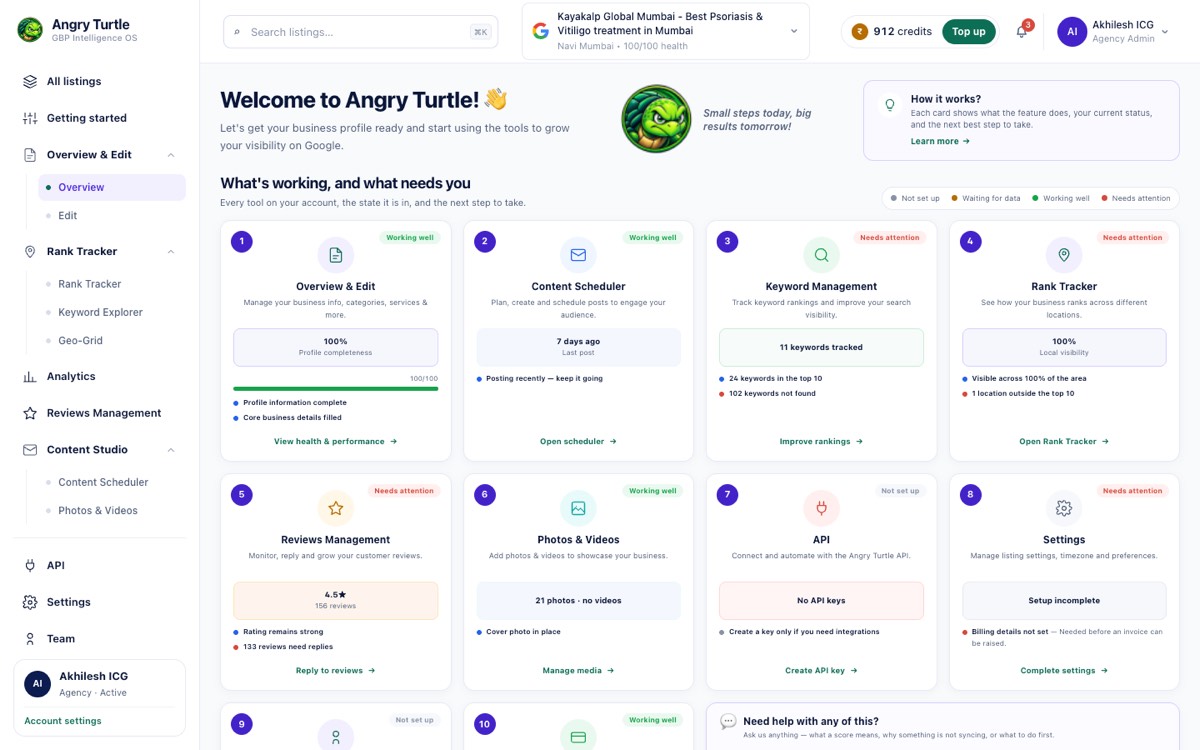
Rank OS gives every profile a 0–100 score built from five weighted dimensions — Relevance, Review Health, Freshness, Entity Authority and AIO Readiness — and the weights are tunable. Underneath it sits a ranked list of the fixes that move the number, each with the point lift it unlocks.
Ready to have this run for you?
Book a free audit — we'll show you where you stand in 48 hours.