 Angryturtle
How to Optimize a Restaurant for AI Search in India
When a diner asks "best biryani near me in HSR Layout" or "romantic rooftop dinner in Bandra," AI Overviews and assistants now answer before the map even loads — and they pull from GBP, Zomato, Swiggy, and review text. This playbook is a restaurant-specific system to make your outlet the one AI recommends across Indian food-discovery queries. The outcome: a complete, consistent, review-rich presence that both AI and hungry customers can act on.
When a diner asks "best biryani near me in HSR Layout" or "romantic rooftop dinner in Bandra," AI Overviews and assistants now answer before the map even loads — and they pull from GBP, Zomato, Swiggy, and review text. This playbook is a restaurant-specific system to make your outlet the one AI recommends across Indian food-discovery queries. The outcome: a complete, consistent, review-rich presence that both AI and hungry customers can act on.
Step 1 — Nail the GBP category and cuisine signals
Diners and AI both filter by cuisine and type, so your categories must be precise. In GBP:
- Primary category: the most specific true type — "North Indian restaurant," "Udupi restaurant," "Cafe," "Fine dining restaurant" — not a generic "Restaurant."
- Secondary categories: add every genuine one — "Biryani restaurant," "Vegetarian restaurant," "Bar," "Delivery restaurant."
- Attributes that drive AI filters: dine-in / takeaway / delivery, outdoor seating, rooftop, serves alcohol, pure veg, Jain food available, family-friendly, live music, valet parking, UPI accepted, pet friendly.
Every attribute you complete is a query filter you can now satisfy.
Step 2 — Build a machine-readable menu
AI answers menu and price questions constantly ("does X have a Jain thali," "biryani price at Y"). Make your menu extractable:
- Add the menu to GBP's menu section with item names, 1-line descriptions, and ₹ prices.
- Mirror it on your website as text (not just a PDF/image) so it's crawlable, ideally with Menu schema.
- Flag dietary markers clearly: veg/non-veg, Jain, egg, contains nuts. These map directly to dietary queries.
Keep prices current — a stale ₹ figure in an AI answer erodes trust and annoys walk-ins.
Step 3 — Dominate the review surfaces that matter for food
Restaurants live and die on reviews, and AI corroborates across platforms. Run review generation on all three:
- Google — primary for AI and Maps. Push toward the citation band (100–150+ for competitive city queries) and keep velocity.
- Zomato & Swiggy — critical for delivery discovery and their own in-app ranking; respond to reviews and maintain rating.
- Encourage reviews that name dishes ("the mutton biryani and phirni were excellent") — that dish-level language is exactly what AI lifts for "best biryani" queries.
Reply to every review. Thank diners by naming the dish they praised — you're reinforcing your specialty entity.
Step 4 — Feed the visual and freshness signals
Food is visual and AI/diners both reward active listings:
- Upload high-quality photos of signature dishes, interior, exterior, and menu, named descriptively. Aim for 30+ and add regularly.
- Post GBP Updates weekly: today's special, festival menus (Navratri thali, Christmas brunch), new dishes, offers.
- Keep hours accurate, including late-night and festival hours — "open now" is a core AI filter for dining.
Step 5 — Optimise for "near me" and hyper-local intent
Most restaurant discovery is proximity-driven. Reinforce location signals:
- Ensure GBP address, pin, and service area are exact (see the NAP playbook).
- On your website, name the locality and landmarks — "rooftop dining in Indiranagar, 5 minutes from 100 Feet Road."
- Publish answer-style content: "Where to get late-night food in Koramangala," "Best pure-veg thali in Ahmedabad" — with your outlet as a genuine, well-argued answer.
Step 6 — Add FAQ content for real dining questions
Create an on-page FAQ (with FAQPage schema) answering what diners actually ask:
Do you take reservations for large groups? Yes — we seat groups up to 30 on the rooftop. Reserve on {number} or WhatsApp; a deposit of ₹500/head applies on weekends.
Is there Jain and Jain-no-onion-garlic food? Yes, our entire veg menu can be made Jain on request, including Jain pav bhaji and Jain biryani.
Cover: reservations, parking, alcohol, outdoor/AC seating, delivery radius, private dining, live screenings (IPL/cricket). Each answer is a citable fact.
Step 7 — Handle festivals, events, and seasonality proactively
Indian dining is deeply seasonal. Plan content and updates around demand spikes:
- Festivals: Navratri (fasting menus), Diwali, Eid, Christmas, Pongal/Onom sadya — post special menus in advance.
- Events: cricket screenings, New Year's Eve — publish and pin them.
- Update hours for dry days and festival closures so AI never sends a diner to a shut kitchen.
What good looks like
- Precise cuisine categories, a full attribute set, and an extractable text menu with live ₹ prices.
- Strong, recent, dish-naming reviews on Google, Zomato, and Swiggy — replied to.
- 30+ named photos, weekly posts, accurate festival hours.
- FAQ + Menu schema validated and live.
- Consistent NAP across GBP, Zomato, Swiggy, JustDial, and your website.
Do this and when someone asks an assistant where to eat in your area, your outlet is the well-documented, well-reviewed, easy-to-recommend answer. Consistent execution over months — not any single trick — is what compounds here.
Related: Industries we serve · GBP management services · Local SEO agency India · Book a demo
More how-to playbooks
A score you can argue with, not a black box
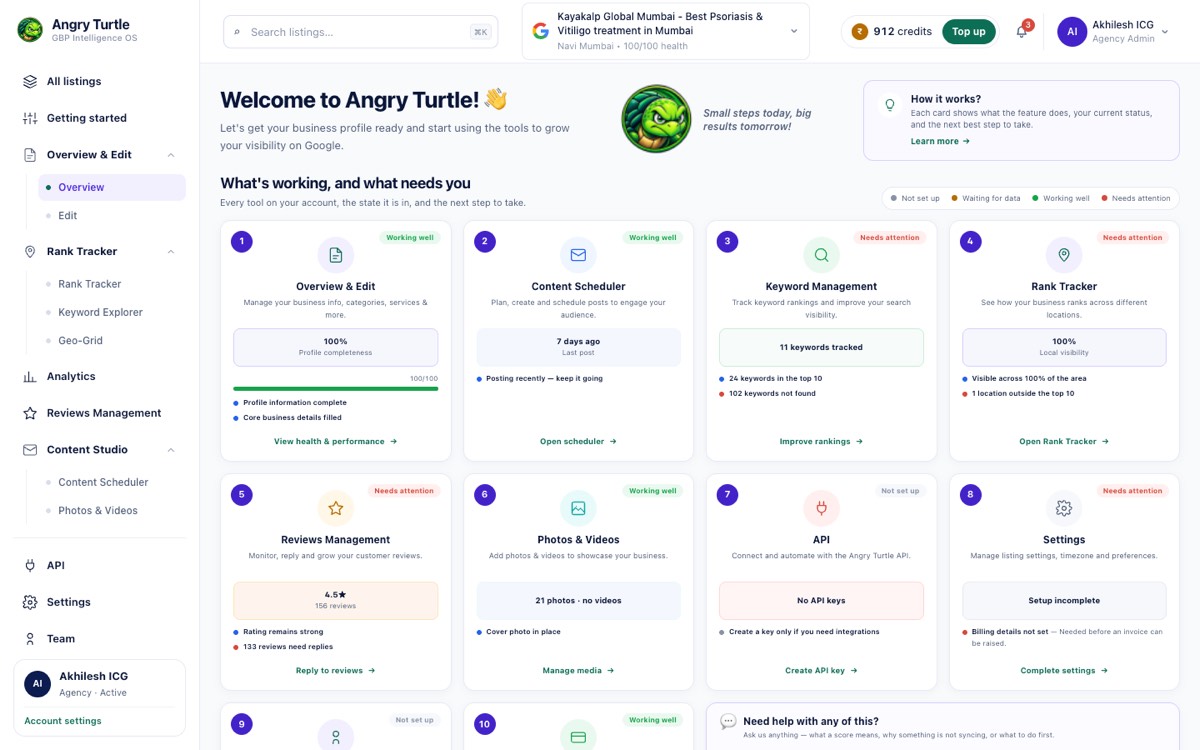
Rank OS gives every profile a 0–100 score built from five weighted dimensions — Relevance, Review Health, Freshness, Entity Authority and AIO Readiness — and the weights are tunable. Underneath it sits a ranked list of the fixes that move the number, each with the point lift it unlocks.
Ready to have this run for you?
Book a free audit — we'll show you where you stand in 48 hours.