 Angryturtle
llms.txt Setup Service
Angryturtle implements llms.txt and AI crawler access configuration for Indian businesses. Help AI systems find and cite your most relevant content.
·
llms.txt Setup Service
In brief: llms.txt is a proposed standard (analogous to robots.txt for AI crawlers) that allows websites to specify which pages are most useful for LLM training and grounding. Implementing llms.txt — alongside AI crawler access configuration and structured content — improves the probability that AI systems find and extract your most relevant business information. Angryturtle runs this as a managed done-for-you service: we author the file, configure crawler access, keep it current as your business changes, and fold it into your wider AEO/GEO programme.
What Is llms.txt?
llms.txt is a plain-markdown file placed at the root of a website (yourdomain.com/llms.txt) that signals to AI crawlers which content is most relevant for training and real-time grounding. Where robots.txt tells crawlers what they may not access, llms.txt tells language models where your best, most authoritative answers live — a curated map to the pages you most want cited.
The format is deliberately simple. An H1 with the business name, a blockquote summary, then markdown link lists grouped under headings, each link followed by a short description. Many sites also publish an expanded llms-full.txt containing the full text of key pages so a model can ground on the content without a second crawl.
It matters because AI answer engines — GPTBot (ChatGPT), PerplexityBot (Perplexity), Google-Extended (Gemini / AI Overviews), ClaudeBot (Claude), and others — increasingly synthesise answers from a small set of trusted, easy-to-parse sources. A business that hands those crawlers a clean, structured, unambiguous summary of who it is, what it does, where it operates, and what its authoritative pages are gives itself a better chance of being read accurately and cited.
Why It Matters for AI Citation
For an Indian local business, the path to being named by an AI engine runs through entity clarity and extractability. llms.txt contributes to both:
- Disambiguation. If three clinics in Bengaluru share a similar name, a well-structured llms.txt with a canonical description, address, and sameAs-style links helps a model attach the right facts to the right entity.
- Extractability. Models prefer sources they can parse cheaply. A markdown index of your services, locations, and FAQ pages is far easier to extract than the same information buried in JavaScript-rendered layouts.
- Freshness signalling. Because the file is small and curated, you can keep it genuinely current — new location, new service line, updated hours — without waiting for a full site re-crawl.
- Coverage of the whole answer surface. llms.txt works alongside GBP, schema, and directory presence. It is one lever in the AEO stack, not a replacement for the others.
To be clear about scope: llms.txt is an emerging, voluntary convention. Not every crawler honours it today, and it is not a ranking guarantee. We treat it as a best-practice foundation that costs little to maintain and compounds as adoption grows.
What We Include in Your llms.txt
Angryturtle authors your file around the entities and pages an AI engine needs to answer questions about your business correctly:
- Canonical business description — name, category, city/locality, and a one-line summary written for machine extraction.
- Locations — each branch with address and the URL of its location page or GBP.
- Core services — one link and one-line description per service, using the language your customers actually search.
- Authority pages — About/credentials (doctor registrations, RERA number, certifications where relevant), pricing, and contact.
- Answer content — links to your FAQ, glossary, how-to, and Q&A pages that directly answer category questions.
- Trust signals — links to review-bearing profiles (Google Business Profile, Practo, JustDial, Zomato, 99acres, IndiaMART as relevant to your category).
- Vernacular pointers — where you publish Hindi or regional-language content, we surface it so models can match vernacular queries.
The Setup Process
- Audit & entity mapping. We map your locations, services, and authoritative pages, and identify gaps (missing service pages, thin About page, absent schema) that would weaken the file.
- Crawler access configuration. We review robots.txt and server rules to confirm the AI crawlers you want are allowed — GPTBot, PerplexityBot, Google-Extended, ClaudeBot, CCBot — and that nothing is inadvertently blocking them.
- Authoring. We write
llms.txt(and, where it adds value,llms-full.txt) in clean markdown, tuned to your category and Indian locality. - Deployment. The file is placed at the domain root and served as
text/plain. We verify it resolves at yourdomain.com/llms.txt and returns HTTP 200. - Validation. We confirm every linked URL is live, canonical, and crawlable, and that descriptions match on-page content.
Ongoing Maintenance
llms.txt is only useful while it is accurate. As a managed service we keep it current: new locations and services are added, closed branches removed, pricing and hours updated, and new answer content (FAQ, how-to, glossary) linked as it publishes. We re-check crawler access after any hosting or CDN change, and we review the file each quarter against your GBP and schema so all three tell the same story about your entity.
Example llms.txt
# Sharma Skin Clinic

> Dermatology and cosmetology clinic in Koramangala, Bengaluru.
> NMC-registered dermatologists. Acne, pigmentation, hair loss,
> and laser treatments. Open Mon–Sat, 10:00–19:00.

## About
- [About & doctor credentials](https://sharmaskin.in/about): NMC registration, qualifications, years in practice
- [Contact & directions](https://sharmaskin.in/contact): address, phone, WhatsApp, Google Maps

## Locations
- [Koramangala (main)](https://sharmaskin.in/koramangala): 5th Block, Koramangala, Bengaluru 560095

## Services
- [Acne treatment](https://sharmaskin.in/services/acne): assessment, medical and procedural options, fees
- [Pigmentation & laser](https://sharmaskin.in/services/laser): Q-switched and fractional laser
- [Hair loss (PRP/GFC)](https://sharmaskin.in/services/hair-loss): diagnosis and treatment plans

## Answers
- [Dermatology FAQ](https://sharmaskin.in/faq): common patient questions with direct answers
- [Skin care how-to guides](https://sharmaskin.in/guides): structured, step-by-step content

## Trust & reviews
- [Google Business Profile](https://g.page/sharmaskin)
- [Practo profile](https://practo.com/bengaluru/clinic/sharma-skin-clinic)

## Vernacular
- [हिंदी में सामान्य प्रश्न (Hindi FAQ)](https://sharmaskin.in/hi/faq)
The companion llms-full.txt follows the same structure but inlines the full text of the About, Services, and FAQ pages so a model can ground on the content directly.
llms.txt vs robots.txt vs Schema
These three files are often confused. They are complementary, and a complete AI-readiness setup uses all three.
| File | Audience | Purpose |
|---|---|---|
| robots.txt | All crawlers | Access control — what a crawler may or may not fetch |
| Schema (JSON-LD) | Search + AI parsers | Structured facts about your entity, embedded in each page |
| llms.txt | AI/LLM crawlers | A curated markdown map to your best, most authoritative content |
robots.txt is a gate, schema is the labelled data inside each room, and llms.txt is the directory board at the entrance pointing visitors to the rooms worth seeing. Publishing llms.txt without allowing the AI crawlers in robots.txt is self-defeating — which is why crawler-access configuration is part of our setup, not an afterthought.
Common Mistakes We Prevent
- Blocking the crawlers you're courting. A security plugin or CDN rule quietly returns 403 to GPTBot or PerplexityBot. We audit and fix this.
- Linking to dead or non-canonical URLs. Every link in the file is validated to resolve to a live, canonical, indexable page.
- Letting it go stale. A file that lists a closed branch or old pricing actively misleads. Maintenance is the whole point.
- Serving it wrong. It must be at the root as text/plain returning HTTP 200 — not buried in a subfolder or served as HTML.
- Contradicting your other signals. If llms.txt, GBP, and schema tell three different stories about your entity, confidence drops. We keep all three consistent.
How This Fits the Wider AEO Programme
llms.txt sits inside a broader answer-engine strategy. On its own it is a lightweight, sensible file; combined with a complete Google Business Profile, LocalBusiness schema, consistent NAP across Indian directories, review velocity, and structured answer content, it becomes one coherent set of signals pointing every AI engine at the same accurate picture of your business. We deliver it as part of, or alongside, our managed AEO and GBP work rather than as an isolated deliverable.
Frequently asked questions
Will llms.txt guarantee that ChatGPT or Perplexity cites my business?
No, and we make no such promise. llms.txt is a voluntary, emerging convention that not every crawler yet honours. It improves the clarity and extractability of your information, which is a best-practice foundation for AI citation — but citation depends on many signals working together (GBP, reviews, schema, directory presence, content quality).
Where does the file go and how is it served?
At the root of your domain — yourdomain.com/llms.txt — served as plain text (text/plain) and returning HTTP 200. We deploy and verify this for you, including after any hosting or CDN change.
Do I still need robots.txt and schema if I have llms.txt?
Yes. They do different jobs. robots.txt controls crawler access, schema provides structured data for search and AI, and llms.txt curates a human-and-machine-readable map of your best content. They complement each other; llms.txt does not replace either.
Which AI crawlers does this target?
Primarily GPTBot (ChatGPT), PerplexityBot (Perplexity), Google-Extended (Gemini and AI Overviews), and ClaudeBot (Claude), plus general crawlers such as CCBot. As part of setup we confirm your server actually allows the ones you want to reach.
How often is it updated?
Continuously as part of the managed service — whenever locations, services, hours, pricing, or answer content change — with a formal quarterly review against your GBP and schema so all sources stay consistent.
Can you set this up if my site is on WordPress, Laravel, Shopify, or a custom stack?
Yes. The file is platform-agnostic; it only needs to be reachable at the domain root as plain text. We handle deployment for common CMS and custom stacks alike.
Related: AI search readiness audit · AEO services · Get cited by ChatGPT · Generative engine optimization · Managed local SEO
Which demand is growing, and which is decaying
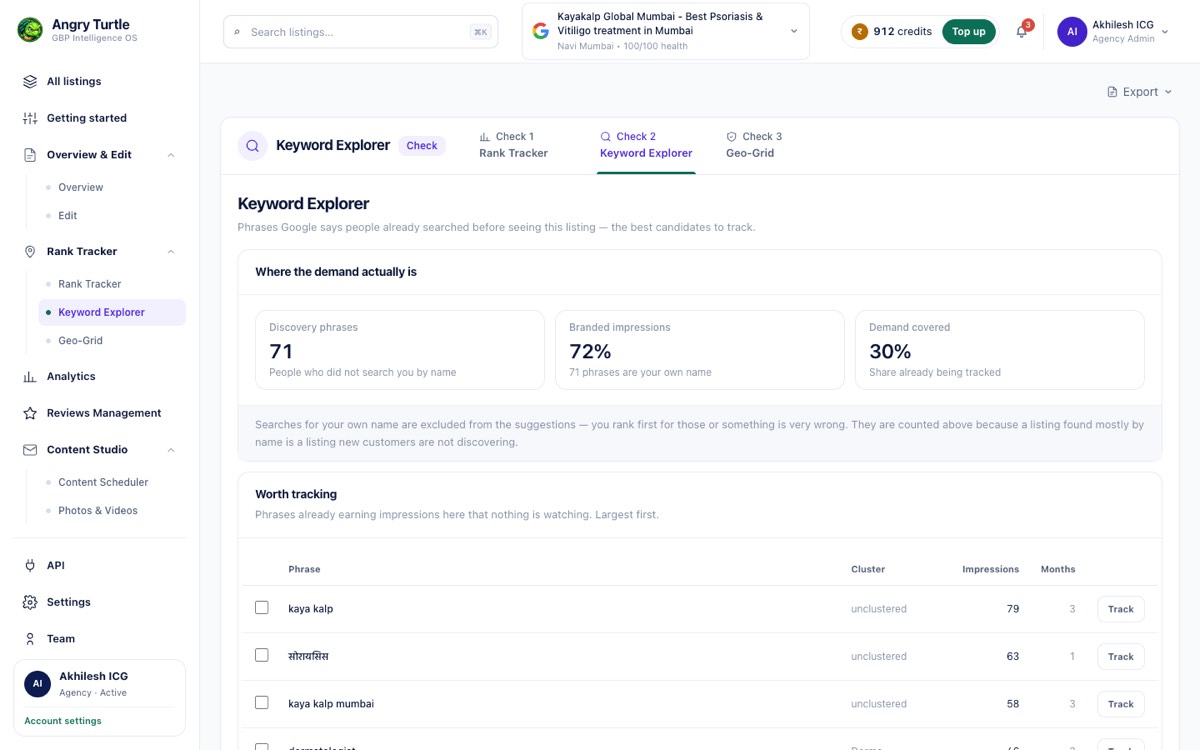
Search terms group into industry-aware demand clusters, each with a momentum read — scaling, broadening, concentrating or decaying — computed from your own Business Profile data rather than a generic keyword tool.
Ready to have this run for you?
Book a free audit — we'll show you where you stand in 48 hours.