 Angryturtle
LocalFalcon Alternative
Looking for a LocalFalcon alternative? Angryturtle includes geo-grid rank tracking in a fully managed local SEO service. We don't just track your rank — we move it.
·
How a geo-grid actually works
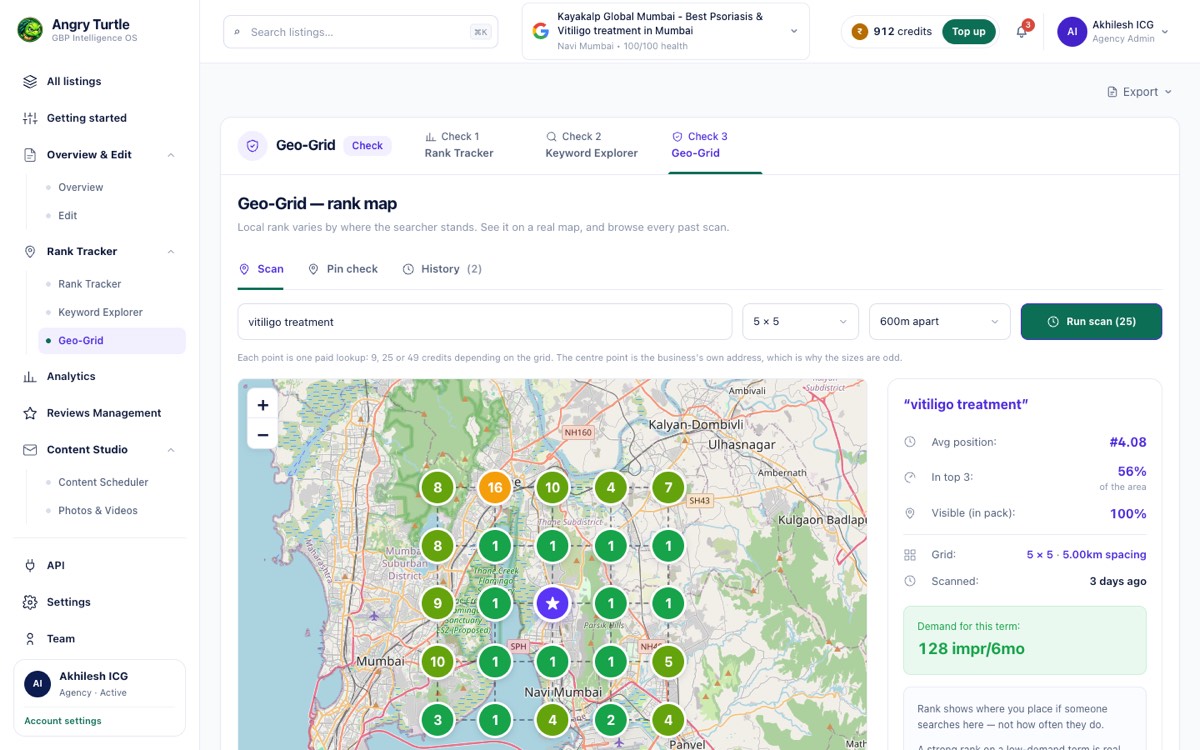
Point a geo-grid tool at a business and a keyword, and it drops a grid of virtual searchers across the map, runs the search from each point, and records where the business shows up. The output is a heatmap: green pins where you own the pack, red where a competitor does, and a couple of summary numbers in between. Local Falcon does exactly this, and does it well — it's a clean, visual way to show a client or a manager "here's exactly where you're invisible on the map."
That's also the entire product. The grid tells you where you rank. It doesn't say why you're weak in the northeast corner of your service area, and it doesn't do anything to fix it.
Why businesses look for a Local Falcon alternative
Two situations come up most often. Some businesses want the geo-grid data plus the execution: Local Falcon shows you that you're in position eight in the northeast quadrant for "dentist near me," but rank data is only useful once someone acts on it, and Local Falcon has no editing layer at all. Others need better India calibration: grid accuracy in dense Indian metro geographies, where results can vary within five hundred metres, has limits when the spacing was calibrated for a US suburb. Local Falcon is also built for the US market first, and its directory and citation coverage, such as it is, skips India-specific listings entirely.
Angryturtle's Rank OS includes geo-grid tracking — plus a Pin Checker for exact lat/long or pincode lookups — calibrated for Indian metro geographies, as part of a fully managed service. We track the data, interpret it, and act on it every month.
The core difference: tracking vs. moving
Local Falcon is a measurement tool. Angryturtle is a platform, and if you want it, a managed service, that uses geo-grid measurement as the input to monthly execution.
A weighing scale tells you your weight. It doesn't help you lose it; you need a plan and someone running it. Local Falcon tells you your rank. Angryturtle uses that data to run GBP optimisation, citation remediation, review generation, and competitive strategy, the execution that actually moves the number.
We include the geo-grid, and the rest of the platform besides
Choosing Angryturtle doesn't mean giving up geo-grid visibility. It means getting the same core artefact you'd expect from a standalone tracker — a map of pins across your service area, each showing your position for a target keyword, with average map rank and share-of-local-voice summarised — plus everything sitting around it.
The grid is one module, not the whole platform. Under it sits the Rank OS score, built from five weighted dimensions: relevance, review health, freshness, entity authority, and AI-answer readiness. The weights are visible and adjustable rather than a black box, and each listing gets a ranked list of the fixes that would move the score fastest, with the expected point lift next to each one.
Demand clusters take the keyword side further than a grid can. Angryturtle groups keywords by industry-aware cluster and tracks momentum, whether a cluster is scaling, broadening, concentrating, or decaying, using first-party GBP data plus Google Ads Keyword Planner sizing. That answers a different question than "where do I rank": it answers "which keywords are worth ranking for in the first place."
Reviews get the same treatment. Angryturtle reads the whole review corpus, drafts replies in the business's voice, and can publish them with one click. It also runs a Brand Identity vs. Brand Image comparison, checking what a business claims to be against what its reviews actually say, and flags the gap. Our glossary entry on review sentiment covers the mechanics behind that comparison.
Then there's write-back. Fix a category, an hour, a description, a service area, and the change pushes live to the Google profile from inside the tool. Local Falcon has no editing layer of its own; a grid without an execution path just confirms the same problem exists again next week. For citations and directory presence, Angryturtle runs discovery and NAP consistency checks against Indian directories like JustDial alongside the standard global set, which a US-built tool typically won't reach — see citations and NAP management.
None of this changes what the geo-grid scan itself looks like; a scan is a scan. What changes is what happens after it runs.
What Angryturtle provides that Local Falcon doesn't
| Capability | Local Falcon | Angryturtle |
|---|---|---|
| Model | Geo-grid rank tracker (SaaS tool) | Platform that acts, self-serve or managed |
| Geo-grid rank tracking | Included | Included (Rank OS geo-grid + Pin Checker) |
| Overall scoring model | Not included | Rank OS, five dimensions, tunable weights |
| Demand / keyword cluster sizing | Not included | Included, with momentum states |
| Review management | Not included | AI-drafted replies, sentiment, Identity vs. Image |
| GBP management | Not included | Full monthly management |
| Citation management | Not included | 50+ Indian directories |
| GBP profile write-back | Not included | Edits push live to Google |
| AI-answer / AIO readiness | Not included | Question-bank visibility checks |
| Rank interpretation & strategy | Not included | Monthly strategy call |
| India-calibrated grid | Partial | Built India-first |
| ₹ billing | Credit-based, USD | Included |
Full managed scope beyond the grid
Geo-grid tracking is one instrument inside a complete local SEO programme. As a managed client, you also get GBP management — categories, attributes, services, photos, and two to four posts a month — citation management across fifty-plus Indian directories including JustDial, Sulekha, Practo, IndiaMART, 99acres, and Zomato, review management via WhatsApp and QR-led generation with responses posted within 48 hours, AEO and AI-search readiness covering schema, entity consistency, and answer content, and a monthly strategy call with a named account manager translating the grid into next month's plan.
India-calibrated across cities
Grid accuracy in India depends on getting spacing right for very different urban forms, and a single national default doesn't work. In dense metros — Mumbai's Andheri and Bandra, Bengaluru's Koramangala and Indiranagar, Delhi's Chandni Chowk and Connaught Place — results shift within a few hundred metres, so tighter grids see the real picture. Tier-1 spread cities like Pune, Hyderabad, Chennai, Kolkata, and Ahmedabad have mixed density that calls for adaptive spacing across a wider service area. Tier-2 and suburban geographies need wider grids to capture a genuinely larger catchment without wasting scan resolution. We set grid spacing and pin density per location at onboarding, per our geo-grid rank tracking guide, so each city's scan reflects how customers there actually search.
Reading a geo-grid scan
A scan is only valuable if you know how to read it. Average Map Rank is your mean position across every pin in the grid, the single headline number for a service area. Average Total Rank counts pins where you don't appear in the top results at all, giving a harsher, truer read of coverage. Share of Local Voice is the percentage of the grid where you appear prominently — how much of your catchment actually sees you. And the cell-level pins are the map itself, with green where you own the pack, amber where you're mid, red where a competitor holds the position.
The value is in the pattern, not any single number. A grid that's green near your pin and red at the edges points to weak proximity signals and a case for a nearer citation footprint. A grid that's uniformly amber points to a category or review-velocity gap rather than a location one. Local Falcon shows the pattern; we diagnose it and act on it.
From grid to action: a worked example
A dental clinic in Andheri, Mumbai tracks "dentist near me" on a tight metro grid. The scan shows a strong green cluster within five hundred metres of the clinic but red pins across the western edge of the catchment, where a competitor holds the pack. A standalone tracker stops there — you have a map and a problem. In the managed loop, we diagnose the edge weakness: the competitor has more reviews and two directory citations with an address closer to that pocket. That month we lift review velocity via WhatsApp requests, add and correct citations that reinforce the clinic's service radius, and publish GBP posts targeting the treatments searched in that area. The following scan tells us whether the red pins moved toward amber or green, and the cycle continues.
The tool ends at the map. The service uses the map as the first step of the work. We make no promise about a specific pin turning green, rankings are Google's to decide, only that each grid drives concrete execution and honest re-measurement.
Who fits where
Local Falcon fits an agency or in-house team that already has execution covered elsewhere and just needs a fast, visual way to prove rank position to a client each month; if geo-grid reporting genuinely is the whole job, it's a reasonable, focused tool for that. Angryturtle fits a solo owner running one or two profiles who wants the platform to hand them the next best action, an agency running ten-plus client listings that wants white-label reporting, roles, and pooled credits alongside the tracking, and an enterprise chain that wants unlimited profiles and SSO on top of all of it.
Frequently asked questions
Do I need to subscribe to Local Falcon if I use Angryturtle?
No. Rank OS geo-grid tracking, including Pin Checker for exact lat/long or pincode lookups, is included in all Angryturtle managed plans, alongside the execution that acts on it.
How accurate is Angryturtle's geo-grid for Indian cities?
Grid spacing and pin density are configured for Indian metro geographies — denser grids for high-competition urban areas, wider grids for suburban service areas — and calibrated per client at onboarding.
Can you track multiple locations on separate geo-grids?
Yes. Multi-location brands get a geo-grid per location, each calibrated for its city, with rank movement tracked and acted on for every branch.
Does the geo-grid connect to what you actually do each month?
Directly. Each scan feeds the monthly plan; weak cells drive specific GBP, citation, and review actions, and the next scan measures whether they moved. Tracking and execution are one loop, not two separate products.
Can I just use Local Falcon and skip a full platform?
You can, if rank visualisation is genuinely the only gap you have. But a grid alone won't fix a missing category, a stale profile, or an unanswered review, and those are usually what's holding rank back in the first place.
What does a geo-grid scan cost separately?
Local Falcon runs on a credit-based model where cost scales with scan frequency. Angryturtle's geo-grid tracking is included in the managed service cost, with no separate credit purchase required. Pricing →
See how the citation side compares against Whitespark → · Explore Rank OS → · See the geo-grid module →
Related: Managed local SEO · GBP management services · Local SEO agency India · Enterprise local SEO · AEO services
Rank at every point, not one number
A single "you rank #4" figure hides the truth. The geo-grid runs the search from a grid of points across the service area and shows where you actually win, where you fade, and where you are not in the pack at all.
Ready to have this run for you?
Book a free audit — we'll show you where you stand in 48 hours.