 Angryturtle
Perplexity Optimization India
How to get your Indian business cited by Perplexity AI. Perplexity's source selection, Indian directory signals, and the structured content that earns Perplexity citations.
·
Perplexity Optimization for Indian Businesses
In brief: Perplexity is an AI-powered answer engine that browses live web sources and cites them directly in its answers. Perplexity optimization means ensuring your business appears on the live web sources Perplexity crawls for Indian local queries — primarily high-ranking local search results, authoritative Indian directories, and structured, recently updated website content.
How Perplexity Retrieves and Cites Sources
Perplexity operates primarily in real-time browsing mode — unlike ChatGPT's training data responses, most Perplexity answers browse live web sources and cite them with direct links.
For a Perplexity query like "best dermatologist in Koramangala Bengaluru," Perplexity:
- Queries search engines (primarily Bing, with some Google) for the query
- Crawls the top-ranking pages
- Extracts specific business information from those pages
- Generates an answer with inline citations to the source pages
The implication: local search rank is the primary input to Perplexity citation. A business that ranks in the local pack top 3 for "dermatologist near me in Koramangala" has its GBP and website data crawled by Perplexity for local recommendation queries.
What Perplexity Favours
Fresh content: Perplexity weights content recency. Pages with recent publication or update dates are preferred over static pages. Monthly GBP post cadence, regular blog content updates, and website freshness signals all contribute.
Structured, directly extractable content: Perplexity extracts and paraphrases content from source pages. Content with clear structure — headings, numbered lists, tables, direct answer sentences — is easier to extract and more likely to be cited. Dense prose is less extractable.
Sourced and specific claims: "Our clinic has treated 5,000+ patients since 2016" is more Perplexity-citable than "we have extensive experience." Specific, verifiable claims signal content reliability.
High-authority domains: Perplexity weighs source domain authority. Practo, JustDial, Times of India, Hindu Business Line, and local authority publications are high-weight Perplexity sources for Indian content.
Local Businesses in Perplexity
Perplexity citations for local business queries follow a predictable source hierarchy:
Tier 1 Perplexity sources (Indian local queries):
- Local search results (GBP-powered) — the structured local pack data Perplexity crawls first
- Practo (healthcare) — full doctor/clinic profiles
- Zomato (restaurants) — restaurant listings with reviews
- JustDial — general business directory with high DA
- Business website — particularly service pages and About pages
Tier 2 sources:
- 99acres / MagicBricks (real estate)
- MakeMyTrip / Booking.com (hospitality)
- IndiaMART (B2B)
- Local/regional publications
For Perplexity citation in India, maintaining strong presence on Tier 1 sources is the primary optimization lever.
Directories and Citations That Feed Perplexity in India
Perplexity's browsing visits are triggered by search results — which means the directories that rank well in Google for category + city queries are the directories Perplexity crawls.
In India, that means: Practo pages rank for healthcare queries; JustDial pages rank for general service queries; 99acres ranks for property queries; Zomato ranks for restaurant queries. Perplexity crawls these ranking pages and cites them.
Optimization implication: maintain comprehensive, accurate listings on the directories that rank for your category + city queries. A complete, recently updated Practo profile for a dermatologist — with credentials, services, reviews, photos, and fees listed — provides rich Perplexity-citable content when Perplexity crawls the Practo page for that clinic.
Tracking Perplexity Share of Voice
Manual tracking: Monthly, query Perplexity with your target local queries. Note whether your business is cited and which source Perplexity cites.
GA4 referral tracking: Perplexity-generated clicks appear as referrals from perplexity.ai in GA4. This undercounts total Perplexity influence but provides baseline measurement.
PerplexityBot access: Check your robots.txt for PerplexityBot. Most businesses should explicitly allow PerplexityBot (User-agent: PerplexityBot / Allow: /). Blocking it eliminates Perplexity's ability to crawl your website for browsing responses.
What Drives a Perplexity Citation
Distilled, five factors decide whether Perplexity cites an Indian local business — and they are the levers we work:
- Local search rank. Perplexity crawls the pages that already rank for your category + city query. A GBP that sits in the local pack top 3, and organic pages that rank on page one, are the pages Perplexity reads first. Rank is the entry ticket.
- Entity clarity. A consistent, unambiguous business identity — same name, address, and description across GBP, website, and directories — lets Perplexity attach the right facts to the right business.
- Reviews and trust. Review-bearing profiles (Google, Practo, Zomato) supply the social-proof content Perplexity paraphrases when a query asks for "best" or "recommended."
- Structured, fresh content. Recently updated pages with headings, lists, tables, and specific claims are more extractable than static dense prose.
- Crawler access. PerplexityBot must be allowed in robots.txt, or none of the above can be read.
Allow PerplexityBot (and Verify It)
The single most common own-goal is silently blocking the crawler. Explicitly allow PerplexityBot, then confirm the pages you care about return HTTP 200 to it.
# robots.txt
User-agent: PerplexityBot
Allow: /

User-agent: PerplexityBot-User
Allow: /
A minimal llms.txt at your domain root, mapping your best service, About, and FAQ pages, further helps Perplexity find and ground on the right content. Blocking the bot — often an unintended side effect of a security plugin or CDN rule — removes any chance of a live-browsing citation, so we audit this at onboarding and re-check after any hosting or CDN change.
India Specifics for Perplexity
- Category directories are the citation shortcut. Because Perplexity crawls what ranks, a complete, current Practo profile (healthcare), Zomato listing (F&B), 99acres/MagicBricks page (real estate), JustDial listing (general), or IndiaMART profile (B2B) is often the page Perplexity actually cites — sometimes ahead of your own website.
- Vernacular queries. Perplexity handles Hindi and mixed-language prompts; Hindi FAQ and Q&A content widens the queries you can be cited for.
- High-DA Indian publications. A mention or profile on established Indian media (Times of India, Economic Times, The Hindu, regional dailies) carries weight as a trusted source.
- Compliance-aware content. Healthcare (NMC/CDSCO) and real estate (RERA) content must state credentials and numbers factually — which happens to be exactly what makes it Perplexity-citable.
Angryturtle's Perplexity Optimization Process
Perplexity optimization at Angryturtle is included in the AEO/GEO managed service scope alongside ChatGPT, Gemini, and AI Overviews. The four platforms share foundational requirements — local search rank, directory presence, structured content, schema — with Perplexity's additional emphasis on content freshness and source diversity. Our process:
- Baseline — run your target local queries in Perplexity, record whether you're cited and which source it cites.
- Access audit — confirm PerplexityBot is allowed and key pages are crawlable; deploy or update llms.txt.
- Rank foundation — strengthen the GBP and pages that need to rank for Perplexity to reach them.
- Directory depth — complete and freshen the category directories (Practo, JustDial, Zomato, 99acres) that rank and get cited.
- Structured content — publish and update FAQ, how-to, and service pages with specific, sourced claims and clear structure.
- Track — monthly re-query plus GA4 referral monitoring from perplexity.ai to observe movement.
We make no promise of a specific citation outcome — Perplexity controls what it cites and its sources shift — only that we execute the best-practice signals that raise citation probability.
Frequently asked questions
Is Perplexity used by Indian consumers?
Yes, and growing. Perplexity has significant adoption among urban, educated, tech-forward Indian consumers (18–45 age bracket) for research and recommendation queries. Healthcare, real estate, and professional services are categories with emerging Perplexity usage.
What makes a page Perplexity-citable?
Ranking in local search (GBP local pack or organic), recently updated, structured content with specific claims, and crawlable by PerplexityBot. High-authority domain is a bonus but not a prerequisite for local businesses with strong local signals.
Does Perplexity use Google Business Profile data?
Indirectly — Perplexity crawls local search results, which are powered by GBP data. A complete, optimized GBP that ranks in the local pack is the primary GBP-to-Perplexity pathway.
Which sources does Perplexity trust most in India?
Practo (healthcare), JustDial (general), 99acres/MagicBricks (real estate), Zomato (food), MakeMyTrip (hospitality), and established Indian publications (Times of India, Hindu, Economic Times). Authoritative, high-DA Indian sources are prioritised.
How do I know if Perplexity is citing my business?
Manual query monitoring monthly. GA4 referrals from perplexity.ai. Emerging tools including Perplexity's own analytics features. We include this monitoring in the managed service.
Can you guarantee Perplexity will cite my business?
No. Perplexity decides what it cites and its live sources change constantly, so no honest provider can guarantee it. We execute the signals that improve citation probability — rank, entity clarity, directory depth, structured content, crawler access — and report the movement.
Related: Get cited by ChatGPT · AEO services · Generative engine optimization · AI search readiness audit · AI Overview optimization
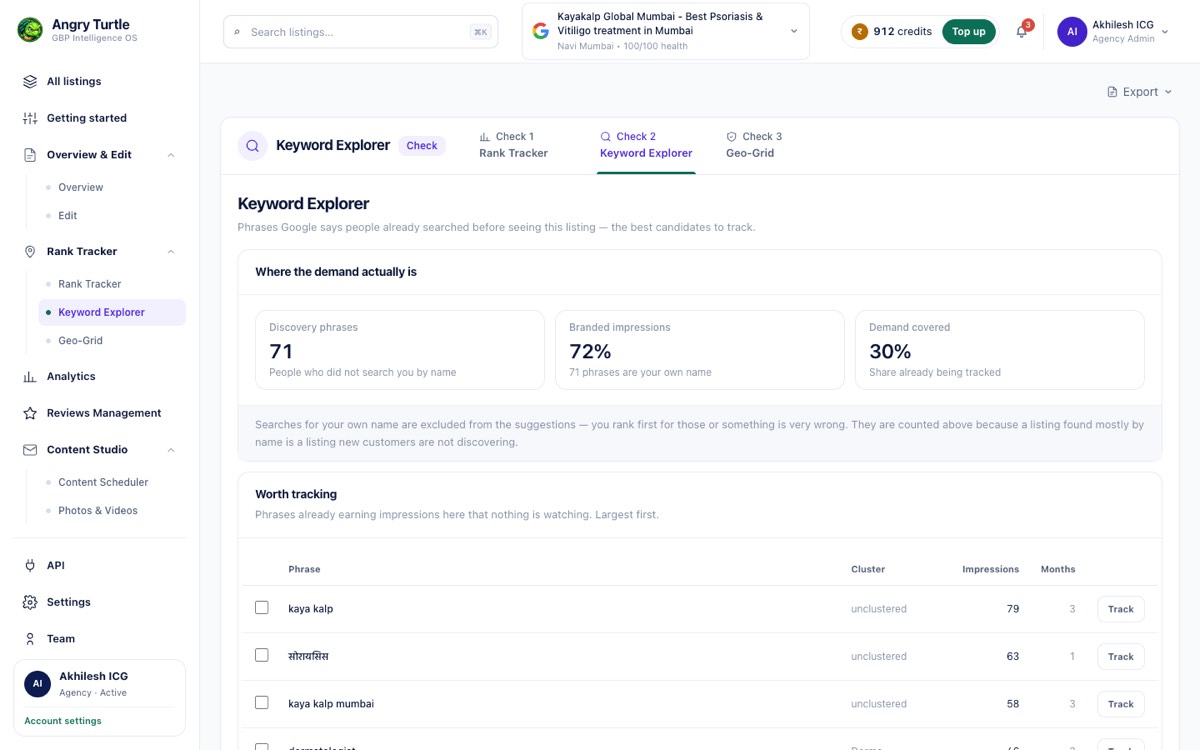
Which demand is growing, and which is decaying
Search terms group into industry-aware demand clusters, each with a momentum read — scaling, broadening, concentrating or decaying — computed from your own Business Profile data rather than a generic keyword tool.
Ready to have this run for you?
Book a free audit — we'll show you where you stand in 48 hours.