 Angryturtle
AEO Agency India
Angryturtle is India's AI-native AEO agency. We help businesses get cited in Google AI Overviews, ChatGPT, Perplexity, and Gemini. Managed and self-serve. Book a strategy call.
·
Picture an agency with fourteen client GBPs, three of them healthcare, two real estate, one a franchise chain with nine branches. The client on the call this week isn't asking about local pack rank anymore. They're asking why their competitor showed up when their own team typed "best dermatologist in Koramangala" into ChatGPT. That question is arriving at agency desks across India right now, and most agencies don't have an honest answer, because most agencies are still selling a rank-tracking dashboard.
Angryturtle built its agency layer for exactly this moment — as a white-label platform an agency runs itself across its whole client book, or as a managed AEO service where Angryturtle's team does the execution and the agency keeps the client relationship. Both sit on the same engine: Rank OS, the Ask Maps AIO readiness engine, and a GBP editor that writes changes back to Google rather than just reporting on them.
What an agency actually needs that a solo tool doesn't give it
A single business owner needs one score and one action list. An agency needs that fourteen times over, filterable, assignable, and reportable without fourteen separate logins. The agency operating system is multi-tenant and white-label, with roles split between Agency Admin, SEO, Project Manager, and Client, so a project manager can see everything and a client login sees only their own listing. Turtle Credits are metered per listing with usage dashboards and low-credit alerts, so nobody discovers a shortfall mid-month. The portfolio view — "All Listings" — is filterable by health score, views trend, interaction type, review frequency, and which ops manager or account manager owns it, with bulk actions and CSV export for the Monday morning standup. For agencies that want to build their own reporting layer or client portal on top, there's a documented Agency OS API with 22 endpoints. Agencies also get white-label local SEO branding across client-facing reports.
None of that replaces the diagnosis-and-fix work. It's the layer that makes running that work across fourteen clients not require fourteen browser tabs.
AEO inside an agency's existing workflow
For a client already on managed local SEO, AEO isn't a separate product bolted on — it's additional scope inside the same listing. The Rank OS score, detailed further on the Rank OS glossary page, already includes an AIO Readiness dimension weighted at 15 points by default (config-tunable per client, per vertical). Ask Maps runs the specific question-level check behind that dimension: is this profile a citable answer when Google Maps' AI, AI Overviews, or ChatGPT are asked the questions real customers in this category actually ask. An agency running Ask Maps across a real estate client's nine project pages will see nine different gap lists, not one generic score, because each project answers a different set of questions.
When the gaps are known, the GBP editor lets the agency (or Angryturtle's managed team) push the fix directly — category corrections, description rewrites with a direct-answer opening, service list additions, hours corrections — with a visual preview of how it will look on Google before it goes live. That write-back is the part most competing AEO or listings tools in this category don't do, or do partially. An agency that's used to exporting a recommendations PDF and waiting for a client's in-house team to implement it (or not) will notice the difference immediately: the fix happens in the tool, not after it.
Reviews and the identity-image gap, at agency scale
Review management doesn't scale well manually across a large client book, so this is one of the places automation earns its keep honestly. Angryturtle's AI-drafted review replies carry a personalised greeting and the client's brand signature, and publish to Google in one click rather than requiring a written response each time — though anything customer-facing should get a quick human glance before it goes out, especially for a sensitive reply. Angryturtle also runs Brand Identity vs Brand Image per client: what the client's marketing says they are, against what the review corpus actually says customers experience. For an agency managing a chain with inconsistent service quality across branches, this surfaces which specific branch is dragging the brand's perception down, rather than leaving the agency to guess from a star-rating average.
Demand clusters across a client portfolio
Content production is usually the most expensive line item in an AEO retainer, and the easiest place to waste it. Angryturtle's demand clusters group each client's category into industry-aware keyword groups with a momentum reading — scaling, broadening, concentrating, or decaying — computed from the client's own GBP performance data, alongside a potential size from Google Ads Keyword Planner. An agency writing monthly answer-targeted content for six clients can prioritise the clusters that are actually scaling for each one instead of running the same generic content calendar across every account. A coaching institute's admissions-season cluster and a jeweller's wedding-season cluster don't move on the same schedule, and treating them the same wastes budget on both. The country-level patterns behind this are pulled together in the AEO India playbook.
Competitors, at the level an agency needs to argue with
Every listing gets a standardised comparison against its top five local rivals — rating, review volume, and a citation landscape showing where competitors are listed and the client isn't. For an agency, that citation gap map is the difference between a vague "you need more citations" recommendation and a specific list: this competitor is on four directories you're not on, here they are, go claim them.
Reporting that doesn't require a separate deck
Each client gets a consolidated report drawing on Insights and Performance — Overview, Optimization, Competitors, Rank OS, and NAP — exportable as a white-labelled PDF, so an agency's monthly client update doesn't require rebuilding a slide deck from five different tool exports. Ask Virtual CMO, the Gemini-grounded chat tied to each listing's own Rank OS, reviews, and competitors, gives account managers a way to answer a client's "why did our score drop" question in the meeting instead of promising to get back to them. It runs in strict JSON mode against the listing's real data and is built to say when it doesn't have enough to answer rather than filling the gap with a guess.
What this doesn't solve for an agency
This is a local and GBP intelligence platform, not a website SEO or backlink tool — it checks a client's site NAP against their GBP, but it won't crawl or rank their site pages, and if a client wants on-page SEO or a link-building programme, that's a separate scope an agency needs to source elsewhere. It's not a social media manager beyond GBP posts. It won't gate or filter reviews, by design, because that's against Google's terms. AI-drafted content and review replies need a human review pass before publishing, particularly anything going live on a client's real profile — that's an agency workflow step, not something a tool should skip on your behalf. And Google's own data lags roughly a month for performance reporting, with edits taking hours rather than seconds to reflect; that's Google's infrastructure, and no agency tool changes it.
Self-serve, managed, or a mix across the client book
Most agencies end up running a mix: platform access for clients who want visibility into their own numbers, and managed execution for clients who'd rather not touch it themselves. Both options exist inside the same Agency plan, which starts at ten listings and scales, with unlimited seats and pooled credits. Enterprise pricing exists for agencies or in-house teams managing a large multi-location brand under one roof, with SSO and volume-based credits.
See agency pricing or book a strategy call to walk through what a fourteen-client AEO rollout actually looks like in the first thirty days.
FAQ
Is this an agency tool, or a managed agency service, or both? Both, and most agencies use a mix. The platform — Rank OS, Ask Maps, the GBP editor, reporting, and the agency operating system — is available white-label for an agency's own team to run. Angryturtle also offers managed execution for agencies who want the diagnosis and fixes done for them, either across a whole client book or for specific accounts.
How does Rank OS handle very different client verticals in one portfolio? The five dimensions — relevance, review health, freshness, entity authority, and AIO Readiness — stay the same, but the weights are config-tunable per listing, and demand clusters are industry-aware. A dermatology clinic and a real estate developer get the same scoring structure but different underlying question banks and cluster taxonomies.
Does the write-back editor work the same way for a nine-location franchise as for one clinic? Yes, per location. Each location gets its own GBP, its own Ask Maps question set, and its own Rank OS score — the franchise view aggregates them for reporting, but every write-back edit is location-specific, because a category or service fix on one branch has no bearing on another.
What's included in the Agency OS API? 22 documented endpoints covering the same data an agency sees in the dashboard — listings, scores, reviews, and reporting — for agencies that want to build their own client portal or dashboard on top rather than use Angryturtle's interface directly.
Can an agency guarantee AI citation results to its own clients? No agency honestly can. Citation is decided by Google's, OpenAI's, and Anthropic's models, not by any tool or agency. What an agency can commit to a client is the execution — entity consistency, schema, content, review velocity, and GBP write-back — and transparent reporting on whether AI citation is moving as a result.
How is this different from Angryturtle's core managed local SEO service? It's not a different service so much as a deeper layer inside the same one. AEO adds the AIO Readiness dimension, Ask Maps question-level checks, and answer-targeted content on top of the local SEO foundation — GBP, citations, reviews — that Angryturtle already manages. For details on the core managed offering, see managed local SEO and GBP management services.
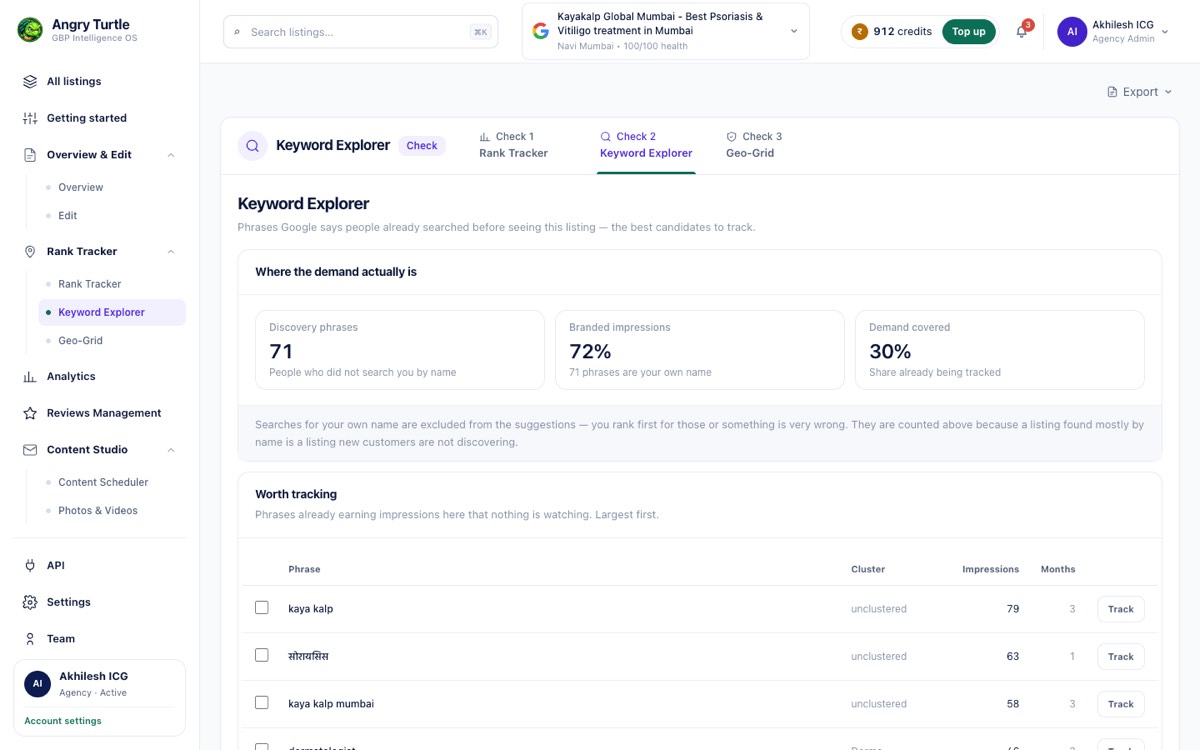
Which demand is growing, and which is decaying
Search terms group into industry-aware demand clusters, each with a momentum read — scaling, broadening, concentrating or decaying — computed from your own Business Profile data rather than a generic keyword tool.
Ready to have this run for you?
Book a free audit — we'll show you where you stand in 48 hours.