 Angryturtle
Rank OS
The definition, the 5 scoring dimensions, and how the score is used.
What Is Rank OS?
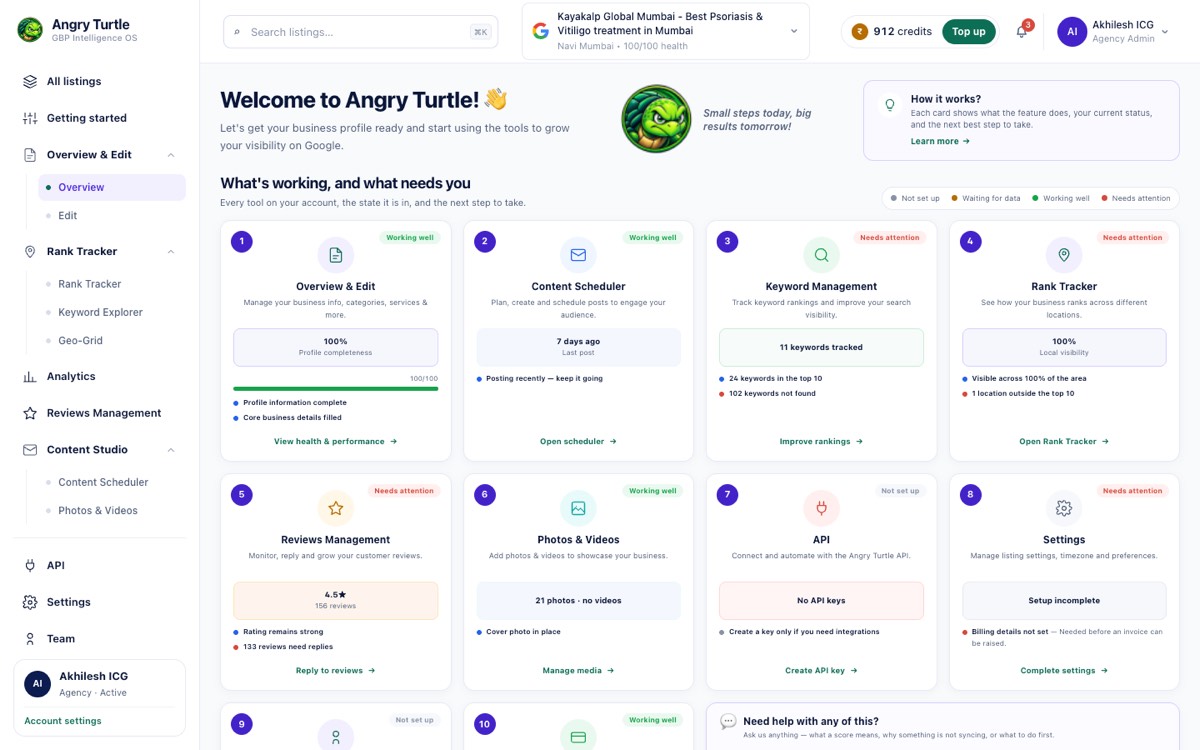
Rank OS is Angryturtle's rank intelligence system for Google Business Profiles under management. Instead of a single opaque rank number, it breaks a profile's competitiveness into five weighted dimensions, scores each one, and shows exactly which dimension is holding a location back. A profile can be told "you rank 6th for your primary keyword" by almost any tool. Rank OS is built to answer the next question — why, and what to fix first.
That distinction matters because local ranking isn't one lever. A dermatology clinic in HSR Layout might have a technically perfect GBP but a review count that's stalled for three months. A restaurant in Koregaon Park might have a strong, growing review base but citations that disagree on its phone number across a dozen directories. Both businesses are underperforming, but the fix is completely different, and a black-box rank score can't tell them apart.
The five weighted dimensions
Relevance (weighted 25%). How well the GBP's categories, services, description, and posts match the queries the business wants to be found for. A clinic listed only under "Doctor" instead of "Dermatologist," or missing half its services from the GBP services section, loses relevance points regardless of how many reviews it has.
Review health (weighted 25%). This is broader than a star rating. It covers review count, the pace of new reviews arriving, response rate, and how substantive the review text is. A profile with a high rating but no new reviews in months scores lower here than one that's actively growing, even at a slightly lower average rating.
Freshness (weighted 20%). How recently and how often the profile has been updated — new posts, new photos, edited hours, refreshed Q&A, and how current the linked website content is. Freshness is the dimension that decays fastest without ongoing management, which is part of why it carries real weight rather than being an afterthought.
Entity authority (weighted 15%). NAP consistency across directories, the strength and accuracy of sameAs links to other verified profiles, and the overall signal that this is one clearly-defined, well-documented business entity rather than a fragmented or duplicated one.
AIO readiness (weighted 15%). Whether the business's structured data, FAQ content, and GBP fields are set up in a way AI engines can actually extract and cite — separate from how it ranks in the traditional local pack.
Why the weights are tunable, not fixed
These percentages aren't arbitrary and they aren't permanent. Angryturtle publishes them because a transparent, adjustable model is more useful to a client than a hidden score that just moves around. In categories where AI-driven discovery is already a meaningful share of demand — say, healthcare in a metro like Bengaluru — the AIO readiness weight can be raised for that vertical's scoring. In a category where the local pack still drives nearly all volume, review health and relevance stay dominant. The point of naming the weights out loud is that a client can ask "why did this go up" and get an actual answer tied to a specific dimension, not a shrug.
How the score maps to action
Each month, Rank OS identifies whichever dimension is most constrained for a given location and that becomes the execution priority. If review health is the lowest score, review generation gets prioritised that cycle over, say, another round of GBP posts. If entity authority has dropped because a new directory picked up an old address, citation remediation jumps to the top of the queue. This is what separates a managed program built around a scoring model from generic "post something, ask for a review, hope for the best" local SEO — the priority isn't a guess, it's whatever dimension the data says is weakest right now.
For multi-location businesses, Rank OS scores each location independently and rolls them up, so a network with 40 branches can see at a glance which three or four locations are dragging the average down, rather than treating every location as if it needs the same fix.
What Rank OS doesn't do
It doesn't guarantee a rank position — no scoring system can, since Google's own algorithm weighs signals Angryturtle can't fully observe. And it doesn't replace human judgment on strategy; a location scoring low on relevance because it genuinely operates in a niche category needs a different conversation than one that's simply mis-categorised. Rank OS narrows down where to look. The decision about what to do still involves a person.
Related terms: Prominence → · Relevance in local SEO → · Proximity → · Review velocity → · Entity authority → · AEO readiness →
See Rank OS in the product → | Building local SEO on Rank OS → | Managed Local SEO → | GBP Management Services →
Related glossary terms
A score you can argue with, not a black box
Rank OS gives every profile a 0–100 score built from five weighted dimensions — Relevance, Review Health, Freshness, Entity Authority and AIO Readiness — and the weights are tunable. Underneath it sits a ranked list of the fixes that move the number, each with the point lift it unlocks.
Ready to have this run for you?
Book a free audit — we'll show you where you stand in 48 hours.