 Angryturtle
AI Local SEO
How AI search is changing local SEO in India. The AI local SEO stack — GBP, reviews, entity, schema, and directories — that earns citations for "near me" queries in AI engines.
·
How "near me" is changing with AI
"Near me" has always carried the highest intent of any local query type. "Dentist near me" means the person is ready to call and just wants to know who's closest and good. Through 2024 to 2026, a growing share of these queries now trigger an AI Overview, an AI Mode conversation, or get answered directly inside ChatGPT or Perplexity before the person ever scrolls a traditional local pack.
The AI answer to "best dermatologist near me" isn't ten blue links. It's a synthesized recommendation: this clinic is highly rated with several hundred reviews, specializes in acne and laser treatment, and here's the booking link. For the business cited in that answer, it's prime visibility ahead of the local pack entirely. For every business not cited, they effectively don't exist for that query in the AI-mediated version of search.
Rank OS's fifteenth point: AIO Readiness
This is exactly why Rank OS treats AI citability as its own measurable dimension rather than a marketing afterthought. Of the 100 points in the score, Relevance carries 25, Review Health 25, Freshness 20, Entity Authority 15, and AIO Readiness the remaining 15 — a distinct, weighted component specifically tracking whether a listing is structured to be cited by an AI answer engine, not just ranked in a blue-link result.
Ask Maps: testing citability directly
Ask Maps is the mechanism behind that score. It's a per-listing question bank that tests whether your profile would actually surface as a citable answer if an AI system were asked about your category and area — does the description answer the question a real customer would ask, does the Q&A section carry substantive content instead of empty placeholders, is entity data consistent enough across the web for an AI system to trust it rather than hedge or skip it. Almost no local SEO tool checks this specifically, which is part of why it's worth naming directly rather than folding into a vaguer "AI-optimized" claim.
The AI local pack is forming, and citations look different
AI engines are beginning to generate structured mini-lists of local businesses for competitive queries — an emerging local pack living inside the AI answer itself rather than beside it. Early patterns in India show this for restaurant recommendations, healthcare specialist queries, coaching institute comparisons, and hotel recommendations.
The citation format differs from a traditional local pack too. Where Google's classic local pack shows address and phone, AI citations tend to foreground reputation signals — rating, review count, years in business — and specialty alignment instead. The signals that earn inclusion largely mirror traditional local-pack signals: review prominence, category relevance, geographic proximity, plus one addition — content structure. Businesses with website content that clearly and specifically describes their services and differentiators get cited with more specificity than businesses without it.
The five-layer local AEO stack
Layer one is the GBP itself, the anchor: complete profile, specific category, services and attributes filled in, active Q&A, fresh posts, and ongoing reviews — the primary data source for essentially every AI local citation.
Layer two is reviews, which drive prominence: review count above whatever citation threshold applies for a competitive category (roughly 100-250 depending on how contested the space is), monthly velocity at or above the top competitor's pace, and reviews spread across Google plus whichever secondary platform matters — Practo, Zomato, 99acres — for the category.
Layer three is entity consistency, which builds trust: name, address, category, and description matching identically across GBP, website, JustDial, Practo, IndiaMART, Sulekha, and every relevant directory. Inconsistent entity data measurably reduces an AI system's confidence in citing you at all.
Layer four is schema, which makes the data machine-readable: LocalBusiness schema with full attributes, FAQPage schema, Speakable markup on answer capsules, and sameAs links tying back to directory profiles — the layer that lets an AI system extract entity data directly rather than having to infer it.
Layer five is content structure, which determines extractability: service pages with direct answer capsules near the top, FAQ sections phrased as actual questions, and specific, verifiable claims rather than marketing language an AI system can't confidently repeat. This is the layer that decides whether a page, once crawled, gives an AI system something citable or just prose to skip past.
Demand clusters and where AI search actually intersects with real volume
Chasing AI citability without knowing whether the underlying query even carries meaningful search volume is a common trap. Demand clusters tie the two together — industry-aware keyword groupings computed from your own first-party GBP data, tracked for whether a cluster is scaling, broadening, concentrating, or decaying, with opportunity sizing pulled from Google Ads Keyword Planner. That gives a concrete answer to "is this AI-visibility work worth the effort here" instead of a guess.
Vernacular and voice "near me" queries in India
"Near me" queries in Hindi and regional languages are a fast-growing segment of local AI search specifically. Hindi speakers ask "mere paas dermatologist kaun hai" or "aas paas best restaurant." Tamil speakers ask "en pakathil dentist." Telugu and Marathi carry their own equivalents. For AI engines answering these queries, a business's GBP and website data need to be discoverable in that language context, not just in English.
Practical steps that actually move this: a GBP description carrying at least one Hindi sentence describing the business plainly, a website FAQ with Hindi Q&A pairs seeded directly, and responding to vernacular reviews in the same language the customer wrote in — which signals regional relevance rather than creating a compliance problem to manage around.
WhatsApp and conversational discovery
Meta AI's emerging integration inside WhatsApp is a new local discovery surface worth watching. As it begins answering local recommendation queries, the same entity signals feeding Google's AI systems and ChatGPT — consistent entity presence, directory citations, review authority — will likely feed WhatsApp's answers too. A complete, verified WhatsApp Business profile with catalogue items listed is quietly building toward that signal already, beyond its existing role as the best review-request channel in India.
Multi-location AI local SEO
For chains, AI local SEO stays stubbornly per-location. Each branch needs its own GBP optimized independently, because AI citations for "near me" queries are location-specific by nature. Review velocity has to be maintained per branch — the Koramangala location's AI citations don't benefit from the Indiranagar branch's reviews for a location-specific query. And entity consistency has to hold at both the branch level and the brand level simultaneously, since each branch is functionally a sub-entity of the parent brand. Multi-location local SEO services → covers the operational side of running this across a network.
What this isn't
AI local SEO doesn't replace GBP and review fundamentals — it adds a citability layer on top of them, and a profile with strong reviews and a weak schema layer will still underperform a profile with both. This also isn't real-time work: Google's own AI Overview sourcing shifts on its own schedule, and there's no way to force appearance in a specific answer on demand. And GBP's Q&A feature specifically is being deprecated by Google, so while it's still worth moderating where it exists today, building a long-term AIO strategy that depends heavily on it isn't a sound bet.
Frequently asked questions
Does local SEO still matter with AI Overviews around? Yes — it's the foundation underneath AI local SEO, not a separate discipline. GBP, reviews, and citation signals that drive local-pack rank are largely the same signals AI engines draw on for citations. AI search adds a content-structure and schema layer on top; it doesn't replace the fundamentals.
How is the AI local pack different from the traditional one? The traditional local pack shows three businesses with address, phone, and rating. The AI local pack forming inside AI Overview and AI Mode answers typically shows one to three businesses with a synthesized description, a key differentiator, and a source link — conversational rather than a structured listing.
Do vernacular "near me" searches trigger AI Overviews too? Yes, and the coverage is expanding. Hindi "near me" queries increasingly trigger AI Overviews, and regional-language coverage for Tamil, Telugu, and Marathi continues growing.
How do I actually start optimizing for AI "near me" queries? Complete GBP with a specific category and services first. Review count above threshold second. FAQPage schema and direct answer content on the website third — proximity, relevance, and prominence, roughly in that order of leverage.
Can I check my own AIO Readiness score directly? Yes, through Rank OS and the Ask Maps question bank specifically — it's a live, scored dimension, not something you have to infer from general advice.
A score you can argue with, not a black box
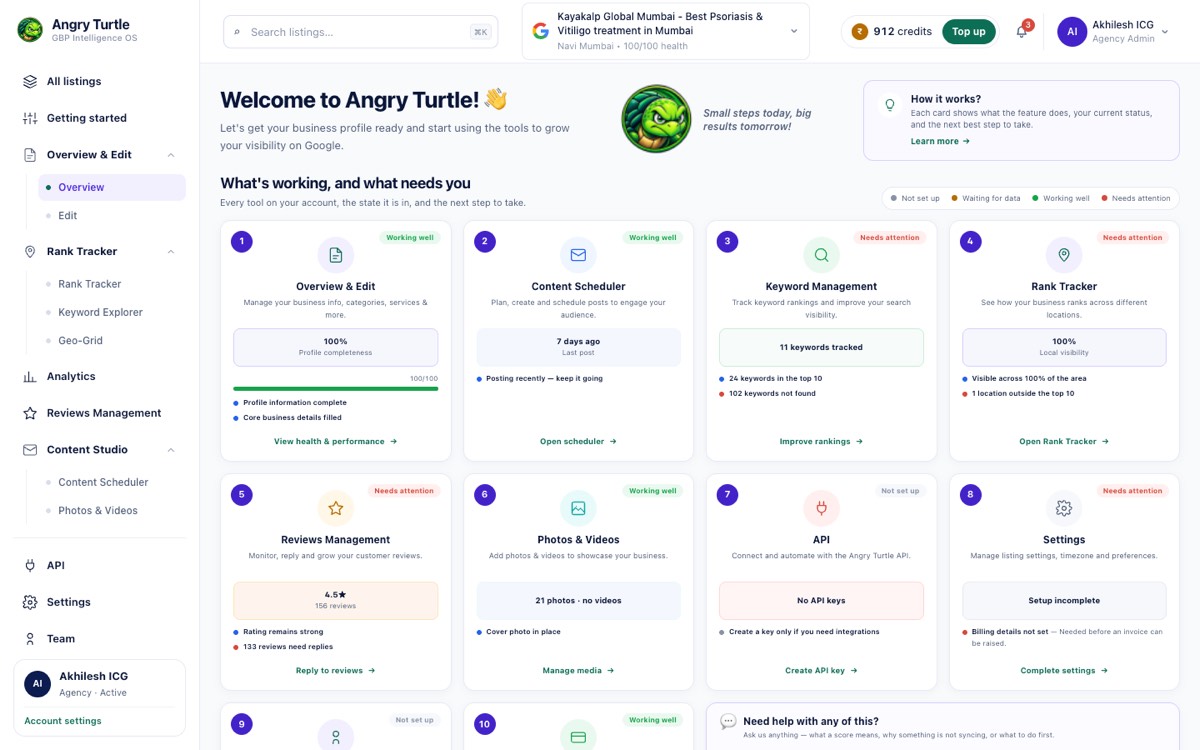
Rank OS gives every profile a 0–100 score built from five weighted dimensions — Relevance, Review Health, Freshness, Entity Authority and AIO Readiness — and the weights are tunable. Underneath it sits a ranked list of the fixes that move the number, each with the point lift it unlocks.
Ready to have this run for you?
Book a free audit — we'll show you where you stand in 48 hours.