 Angryturtle
Multi-location local SEO services
One platform to score, fix and manage every branch's Google presence — run it yourself or hand it to our team.
·
Multi-location local SEO means running Diagnosis, Cost, and Growth, the same DCG sequence used for a single Google Business Profile, across an entire network at once: scoring every branch individually, finding the systematic errors that show up on several listings at the same time, and rolling fixes out in the order that actually moves rank fastest. A 40-branch chain needs both a network-level view and the ability to drill into any one branch, and the sections below cover how Angryturtle runs that, including what a monthly report actually looks like at each level.
What multi-location local SEO actually means here
Multi-location local SEO means managing Google Business Profile visibility for every branch of a brand, not just a flagship listing. Run 2 to 50 locations across Indian cities and each branch competes in its own local pack, carries its own reviews, has its own citation gaps, and can suspend or duplicate independently of every other branch in the network. Angryturtle scores each profile on its own Rank OS, surfaces the highest-value fix for that specific branch, and either you make the fix on the platform or our managed team makes it for you.
This page is built for brands with a real but bounded footprint — a clinic chain with 8 branches, a QSR brand with 25 outlets, a franchise network across 12 cities. Past 50 locations, or if SSO and volume pricing matter, enterprise local SEO is the better fit; everything below still describes how the underlying platform works, just at a bigger scale.
If you found this page searching for multi-location SEO services, a multi location SEO agency, or a multilocation SEO agency, you're in the right spot — these are the same discipline written with different spacing, and the platform and managed team described below cover all of it. Multi location local SEO, the version without the hyphen, means the same thing too.
Why multi-location is a different problem than single-location
A single business has to get one profile right. A chain has to get all of them right at once, without the branches working against each other.
NAP drifts when different managers update their own listings independently, and Google penalizes inconsistency it can detect across a network — the same NAP consistency concept that matters for a single business, just multiplied across every branch simultaneously. Per-location relevance suffers when generic templated copy gets pasted across branches instead of tuning descriptions to each location's actual search behavior — a category that fits a Bengaluru outlet might undersell a Chennai one if the local demand pattern is different. And cannibalization creeps in when two branches in the same metro end up competing for the same searches, splitting clicks and confusing Google about which listing should actually rank for a given query.
None of these are one-time fixes. Watching every branch on a rolling basis is the job — auditing the flagship store once a quarter and hoping the rest follow is exactly where most in-house teams run out of time.
How we actually run this
The same DCG sequence, Diagnosis, Cost, Growth, that runs a single GBP scales to a network, but each stage now produces two answers instead of one: what's true for this specific branch, and what's true across all of them. DCG at multi-location scale covers the mechanics in full; this section is the short version applied to how an engagement with us actually starts and runs.
Diagnosis, month one, scores every branch on its own Rank OS and produces a league table, then aggregates that up to find systematic issues — the same NAP template error appearing on twelve branches rather than twelve unrelated mistakes, for instance. Before any of it, we need a permission model settled: who on your side grants API access for the network, whether individual branch managers keep any edit rights or route everything through a central approver, and how a franchisee's own change request gets handled if the network includes franchised locations. Franchisee and regional governance below covers that model in more depth, and it has to be agreed before Cost work starts, not worked out mid-engagement.
Cost work is sequenced by leverage, not by location order. Systematic fixes go first — a NAP correction applied to ten branches through one bulk API operation clears ten problems in a single action. Branch-specific fixes, an active suspension or a badly wrong category at one location, jump the queue regardless of the bulk schedule, because a branch with zero visibility can't wait its turn in a systematic rollout. The league table's bottom quartile gets the concentrated attention each month, and as that group improves, the next quartile becomes the priority.
Growth then runs centrally and locally at the same time. Review generation flows and citation expansion get coordinated from one place, while posting content and local review response stay tuned to each branch's own tone and neighbourhood. DCG Growth covers the levers this stage runs on; at network scale, they all run per branch and roll back up into the same league table Diagnosis started with.
Choosing a multi-location SEO agency in India
A multi-location SEO agency in India needs to clear a lower bar than the phrase suggests, and a higher one than most vendors actually meet. The lower bar: does the agency's citation and directory work cover JustDial, Practo, Sulekha, and IndiaMART, or does it import a syndication list built for a US or European market and call it done. The higher bar: does the agency's rank tracking treat each branch as its own map-grid entity, or does it report one blended number across the whole chain that hides which specific branches are actually losing ground.
Angryturtle runs as exactly this kind of agency-facing option when a chain wants execution handled rather than run in-house — the managed local SEO side of the business — while the same Rank OS and citation engine sit under white-label local SEO for agencies managing several chains at once through Agency OS. A chain searching for a multi-location SEO agency in India, or typing it as a multi location SEO agency without the hyphen, shouldn't have to choose between an agency that understands the Indian directory stack and one that has decent software; the two are meant to be the same purchase here.
What a competent multi-location agency does that a generalist can't
A generalist SEO agency treats a ten-branch chain as ten separate small clients, or worse, as one client with ten addresses pasted into an otherwise identical template. A competent multi-location agency treats the chain as one entity with a specific coordination problem: keeping every branch relevant to its own neighbourhood while making sure the branches don't cannibalise each other's rank, and making sure a fix that works for one branch's specific gap doesn't get copy-pasted across branches whose gaps are different. That distinction shows up concretely in three places: whether rank tracking happens at each branch's own map grid or gets averaged into one brand number, whether citation work is matched to each branch's actual address on directories like JustDial and Sulekha rather than bulk-uploaded from a template, and whether review response accounts for each branch's own tone and local context rather than a single canned reply rotated across the network.
What to ask before signing
A chain evaluating agencies should ask for evidence, not assurances. Ask to see a sample rank report for a client with a similar branch count, specifically whether it shows per-branch geo-grid data or one blended chain-wide number — a blended number is one of the clearest tells that an agency hasn't actually built for multi-location work. Ask which Indian directories they touch by name, not "a comprehensive directory network," and ask how they'd handle two of your own branches sitting three kilometres apart and competing for the same search. Ask what happens when a branch's local manager wants to change something the brand standard doesn't allow — the answer reveals whether the agency has actually thought about governance, or is assuming every branch behaves like a single-location client. And past a dozen or so branches, ask a more operational question directly: how does the account manager decide which five locations get attention this week out of forty. A vague answer, something like "we check in regularly," usually means there's no scoring behind the prioritization, just habit and whichever branch complained loudest last month.
Franchisee and regional governance
A franchised network raises a governance question the sections above only touch in passing: who's actually allowed to change what, and what happens when a local franchisee edits a listing the brand standard doesn't cover. This is where otherwise competent multi-location engagements quietly fail — not because the SEO work is bad, but because nobody defined the roles before work started, so a franchisee changes a description or category directly and whatever the agency built gets overwritten within a week.
A workable structure separates brand-level ownership from branch-level action. Agency OS's own role split, Agency Admin, SEO, Project Manager, and Client, is one version of that pattern: certain edits require approval up the chain before they publish, others a franchisee or branch manager can make directly, and the distinction is set once at onboarding rather than argued case by case every time something changes. A chain evaluating any agency for a franchised network, not just Angryturtle, should ask the same three things before signing: who on the agency side has write access, who on the brand side approves changes above the branch level, and how does a franchisee's own change request actually get routed once it's submitted. An agency that has never thought through that question will improvise an answer on the call, and it usually shows.
How pricing scales with location count
Pricing for multi-location work generally scales one of two ways: a per-location fee that rises roughly linearly with branch count, or a tiered plan that steps up at specific thresholds — Angryturtle's own structure moves from a Solo single-profile plan to an Agency plan built for ten-plus locations with pooled credits, up to custom Enterprise pricing past fifty. What should make a buyer suspicious is a flat "unlimited locations, one price" quote with no per-branch line item anywhere in it. Multi-location work carries real per-branch costs — citation sweeps, review volume, individual rank tracking — and a price that doesn't flex at all with branch count usually means either the underlying service is thinner than it sounds, or early branches are effectively subsidising later ones in a way that stops working once the chain actually grows.
What moves, and when
At network scale, the same order holds branch by branch, but not on the same calendar. Category and NAP fixes deployed through a bulk API operation can show up across ten or twenty branches within four to eight weeks, since a systematic correction moves as fast as Google reflects it, not as fast as ten separate manual edits would. Review velocity and each branch's own geo-grid share of local voice take longer, typically 60 to 90 days of consistent execution before movement is visible, per DCG Growth, and a branch competing in a saturated metro against branches from three other chains will move slower on the same timeline than one in a quieter market. Competitive commercial phrases in a metro's most contested categories, clinics and QSR chains fighting for the same handful of terms, take the longest, often three to six months.
None of this is guaranteed at any single branch, and a league table position moving up doesn't mean every branch below it moves at the same rate. Anyone promising a fixed rank across your whole network by a fixed date is promising something no platform or agency actually controls.
Self-serve, managed, or both — Rank OS underneath either way
Angryturtle works as a hired team for chains that want it fully off their plate, as a platform they run themselves, or as a mix — some branches self-serve, some managed, switching over time as internal capacity changes. Every path runs through the same system.
Each branch carries its own 0-100 Rank OS score across five weighted dimensions: Relevance, Review Health, Freshness, Entity Authority, and AIO Readiness, at 25, 25, 20, 15, and 15 points. A branch in Pune and a branch in Kolkata can score very differently because their actual data differs, not because the platform assumes uniformity across the network.
A portfolio view lets you filter the whole network by score, review frequency, or which ops manager owns a location, then push edits — hours, categories, descriptions, service areas — across several branches at once without opening each listing individually. Every change still writes back live to Google itself through the API; it isn't a spreadsheet someone has to manually retype into each profile afterward.
Rank tracking for a 30-branch chain only means something if you can see rank at each branch's own map grid rather than one averaged brand number. Every location gets its own geo-grid heatmap and its own Pin Checker. And where the story your GBP description tells doesn't match what customers actually say in reviews — a branch claiming "friendly, fast service" while reviews mention long waits — Brand Identity vs Brand Image surfaces that gap per location, so you're not learning about it from a lost customer.
Review volume across 20-plus locations isn't something a small team can reply to by hand every day. Reviews AI drafts replies carrying each branch's own tone and signature, and sentiment reads as a portfolio view rather than separate tabs per location. See /gbp-management-services for the fuller review workflow this sits inside.
Each branch also needs its own directory listing on JustDial, Sulekha, Practo, or IndiaMART, matched exactly to its own address rather than accidentally pointing to head office. The citation engine finds gaps and duplicates per branch and flags them for fixing — directory listing work, not backlink building, and we don't pretend otherwise.
What we report, and how you check it
A 40-location brand's monthly report has to answer two different questions for two different readers, and collapsing them into one document usually fails both. DCG reporting covers how the underlying Rank OS scoring works stage by stage; DCG at multi-location scale covers how that reporting splits once a network is involved, and this section is the practical version.
At network level, a CMO or ops head sees the league table: every branch's Rank OS score ranked against every other branch, the network average moving month to month, which single dimension is dragging the network down hardest, and whether that's a systematic problem — the same NAP error recurring across a cluster of branches — or scattered underperformance with no common cause. Geo-grid share of local voice rolls up the same way, network average against the top competitor's network average, so you can see whether the market-share gap across your whole footprint is closing or widening.
At branch level, the same report drills to one location: that branch's own Rank OS score and dimension breakdown, its own geo-grid heatmap rather than a blended number, its own review velocity measured against its own local competitors, not the network average. A branch manager in Kolkata sees their branch, not the other 39. A regional lead sees their cluster rolled up. The CMO sees everything, and can click into any single branch's numbers without waiting for someone to pull a separate report.
You don't have to take the summary on faith. The action log lists every edit made per branch that month with a timestamp, the geo-grid data is the same data Pin Checker shows live, and GBP Insights numbers match what's visible inside each branch's own Google Business Profile dashboard. If a report claims a fix went out across twelve branches, the action log names all twelve.
Reporting splits the way the business is organized more broadly too — one white-label report per branch and one consolidated view across all of them, sitting under an agency's own brand through Agency OS where relevant, with no Angryturtle name visible anywhere a client would see it.
Asking questions about the whole network at once
A chain running 20 branches generates far more monthly data than any one person can read closely — 20 rank reports, 20 review feeds, 20 citation audits. Ask Virtual CMO answers direct questions grounded in the actual network's own Rank OS data: which branches are trending down, what a specific competitor did last month across which cities, where the fastest win sits this quarter. It's a way of interrogating your own data rather than waiting for the next scheduled report to explain it.
Demand clusters, per branch
Search demand isn't identical across cities even within one brand. Demand clusters compute industry-aware keyword groups from each location's own first-party GBP data, tracking whether a cluster is scaling, broadening, concentrating, or decaying, with opportunity sizing pulled from Google Ads Keyword Planner. A branch's cluster in Hyderabad won't look the same as a sister branch's cluster in Ahmedabad, because the actual searches happening around each aren't the same either.
Worked scenario: an eight-outlet QSR brand across three NCR cities
An eight-outlet quick-service brand across Gurgaon, Delhi, and Noida works as a useful stand-in here. Each outlet opened within the last three years, and each is currently managed by whichever store manager happens to have GBP login access that week. Two outlets carry duplicate listings from a previous agency's onboarding mistake. One outlet in Noida ranks well for "burger near me," specifically because a competitor two doors down recently closed, not because of anything the brand itself did.
The constraint that matters here is headcount, not budget: there's no dedicated marketing person, just an ops manager who already has a full-time job running the stores. That points toward the managed path for the first quarter — clear the duplicate-listing mess, get citation coverage consistent across all eight, and get review response actually happening daily rather than whenever someone remembers — with a plan to hand routine monitoring to self-serve dashboards once the backlog clears and Rank OS scores stabilize at a level the ops manager can maintain without daily intervention. A brand with the same eight outlets but an in-house marketing hire would make the opposite call and stay self-serve from day one, because the actual constraint here, time, doesn't exist for them.
What actually goes wrong without this
An outlet's Diwali hours get updated on the website and never touched on the GBP, so for four days the map listing says "open" while the store is shut, and every one of those searches becomes a lost order to whichever competitor's listing was accurate that week. A new outlet opens and gets a GBP set up same-day, but nobody adds it to JustDial or Sulekha for six weeks, so half its early search visibility simply doesn't exist yet in the exact window when a new location most needs the traffic. Two outlets three kilometres apart in Gurgaon both get tagged with an identical, generic description, and Google starts showing one or the other inconsistently for the same "restaurant near me" search depending on which the algorithm currently favors, splitting clicks between them instead of capturing both.
What to check before deciding self-serve, managed, or a mix
A few honest questions cut through most of the self-serve-versus-managed debate faster than a sales call will. Does anyone currently check every branch's GBP at least monthly, or does attention only happen when a manager notices a problem? Is there a single person who could name, right now, which branches have duplicate listings or missing citations? If a competitor undercut one specific branch's ranking next week, would anyone notice within a month, or only when a manager mentions falling foot traffic?
A chain that can answer all three with a confident yes is probably fine running self-serve with occasional spot checks. A chain answering no to two or more of them is the actual target market for the managed side of this page, not because self-serve software wouldn't technically work, but because nobody currently has the bandwidth to run it.
The engagement at 5 locations vs. 50 vs. 200
At five locations, the honest scope is usually light: a citation cleanup across JustDial, Sulekha, and Practo, GBP category and description tuning per branch, and a review-response habit put in place — a few weeks of focused work rather than an ongoing heavy retainer, often handled well on a self-serve Agency plan with occasional managed spot-checks. At fifty locations, the work becomes genuinely operational: someone needs to own a portfolio dashboard, review response needs daily throughput rather than a weekly batch, and governance, who can edit what, stops being optional because at that scale someone inevitably will make an unauthorised change. Past roughly two hundred locations, the conversation shifts again, toward SSO, custom volume pricing, and a dedicated account structure rather than a single point of contact managing everything by hand; that's enterprise local SEO territory rather than the bounded multi-location scope this page covers.
India specifics
Angryturtle is built India-first, not adapted from a US product afterward. City-level demand clusters cover Mumbai, Delhi, Bengaluru, Gurgaon, Hyderabad, Kolkata, Chennai, Pune, and Ahmedabad, reflecting how people actually search in each city instead of a generic template applied everywhere. Citation coverage includes the directories carrying real weight here — JustDial, Sulekha, Practo for healthcare, IndiaMART for B2B and retail chains. Category-specific detail for chains in regulated or specialised verticals lives at healthcare local SEO, retail local SEO, and franchise local SEO, and managing multiple locations covers the operational side of the same problem in more depth.
None of this runs in real time. Google's own performance data lags roughly a month, and profile edits can take hours to reflect on the live listing. We tell clients this upfront rather than promise instant results that Google's own infrastructure doesn't support.
Where this isn't the right fit
A two-location business doesn't need the portfolio tooling described above — a single Solo plan profile per location, checked occasionally, covers it, and paying for Agency OS bulk tooling at that scale is buying capacity nobody will use. And a chain whose actual problem is a broken website, not its Google presence, won't fix that problem here either; this platform checks NAP consistency against the site but doesn't rebuild or optimize the site itself. If the honest diagnosis is that the website doesn't convert, that's a different engagement than multi-location local SEO, however closely related the two sound.
How to start
Two ways in, depending on how hands-on you want to be. Self-serve starts with a 15-day trial on Solo, covering up to 2 profiles and 130 credits, enough to see Rank OS scoring on your own listings before committing further. Past 10 locations, the Agency plan adds unlimited seats and 1,000 starting credits. Pricing and plan detail →
Managed starts differently — tell us the location count and cities, and the team runs the audits, sets up the citation sweep, and begins posting and replying on your behalf while you review and approve anything customer-facing before it publishes. Most multi-location clients start managed for the first 60 to 90 days while the citation backlog clears, then decide whether to keep it managed or move some or all branches to self-serve.
Either path, nothing publishes to Google without a human able to review it first, especially anything a customer would see.
Frequently asked questions
How many locations count as "multi-location" for Angryturtle? Roughly 2 to 50 branches fits this page. Below that, a single Solo plan profile is usually enough. Above 50, or if SSO and custom volume pricing matter, enterprise local SEO is built for that scale.
Can I manage all my branches myself, or do I need the managed service? Both work. The Agency plan gives bulk tools, per-branch Rank OS scores, and white-label reporting for running it in-house. Managed exists for teams that would rather hand execution over while keeping approval rights.
Does Angryturtle build backlinks for each location? No. The platform builds and audits local citations — accurate NAP listings on directories like JustDial and Practo — which are not backlinks. A separate managed AEO service does include light digital-PR style brand mentions aimed at AI-citation readiness, a different mechanism from link building.
How does Angryturtle stop branches from competing with each other in search? Per-location relevance tuning and separate geo-grid tracking are the core defenses — each branch's description, categories, and demand clusters set for its own local search behavior rather than copied from a template, cutting the overlap that causes two branches to chase the same query.
Is the data real-time across all locations? No. Google's own performance data lags roughly a month, and edits can take hours to reflect once pushed. That's a limit of Google's own APIs, not something specific to managing many locations at once.
Do you work as a multilocation SEO agency, or is this software-only? Both, and the two aren't sold separately here — the same Rank OS and citation engine sit under a fully managed engagement or a self-serve Agency plan login, depending on how much execution a chain wants handled versus doing in-house.
Is this a fit as an SEO agency for multiple location brands with only three or four branches? Yes, though at that size the case for a managed engagement is weaker — a small franchise or clinic group with three or four branches and someone who can spare a few hours a month often does fine self-serve on the Agency plan, saving the managed relationship for later if the branch count grows.
What's the clearest sign an agency isn't actually built for multi-location work? Two tells cover most of it. It talks entirely in tactics, reviews, posts, citations, without ever explaining how it decides which locations get attention first. And it can't produce a sample portfolio report on request, only single-location reports stapled together. Either one on its own is worth pressing on before signing.
What tends to break first as a business scales past one location? Review response usually goes first — a founder replying personally at one location can't keep up once reviews start arriving daily across five or six branches. NAP consistency breaks next, often within the first year, as directories pull in outdated third-party data and branch managers make small unauthorised edits of their own. Reporting is typically the third failure point: without a tiered structure, head office either drowns in raw branch-level data or has no visibility until a regional manager escalates a problem that's already been building for months.
How does the DCG framework work across a whole network rather than one location? Diagnosis produces a league table and a network-level rollup at the same time, Cost work prioritises systematic fixes that clear multiple branches in one action before moving to branch-specific issues, and Growth runs centrally and per branch simultaneously. See DCG at multi-location scale for the full mechanics.
How long before a 40-branch network sees its league table move? Bulk category and NAP corrections can show up across a group of branches within four to eight weeks. Review velocity and each branch's own geo-grid share of local voice typically need 60 to 90 days of consistent execution, and branches fighting for competitive commercial terms in saturated metros can take three to six months. Movement isn't uniform across every branch on the same calendar, and nobody can guarantee a specific network-wide outcome or date.
Are "multi-location SEO services" and "multi location local SEO" the same thing? Yes. The spacing and hyphenation vary by how someone types the search, but multi-location SEO services, multi location SEO services, and multi location local SEO all point at the same work described on this page — per-branch GBP management, citations, reviews, and rank tracking for a business with more than one location.
Ready to see where your branches actually stand? Start the free trial on up to 2 locations, or talk to us about a managed rollout across the full network.
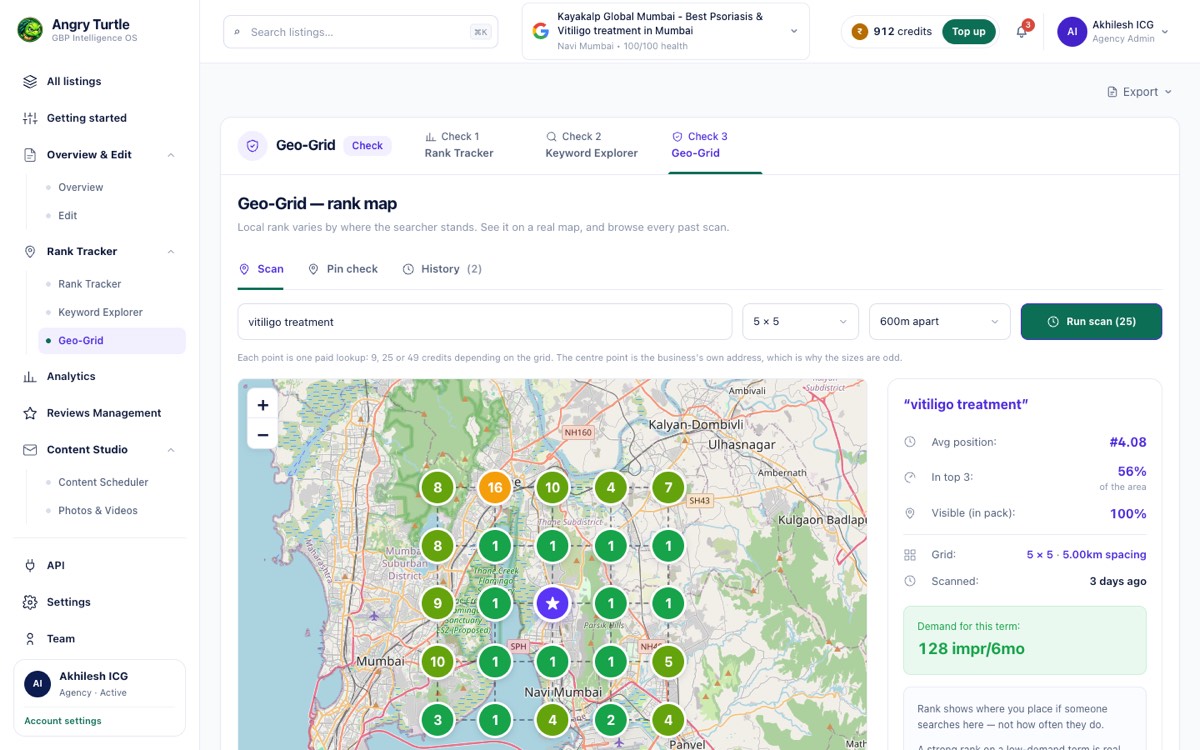
Rank at every point, not one number
A single "you rank #4" figure hides the truth. The geo-grid runs the search from a grid of points across the service area and shows where you actually win, where you fade, and where you are not in the pack at all.
Ready to have this run for you?
Book a free audit — we'll show you where you stand in 48 hours.