 Angryturtle
Prompt-Ready Business Descriptions for AI
How to write GBP descriptions and website content that AI systems can extract and cite. Templates, examples, and the specific structure that makes business descriptions AI-citable.
·
Prompt-Ready Business Descriptions: Writing Content That AI Systems Can Extract
When ChatGPT, Perplexity, or Google's AI Overview needs to describe a business in a local recommendation, it pulls text from two main places: the GBP description and the business's own website content. Most descriptions are written for one audience and fail the other.
A human reader responds to "exceptional care" and "dedicated team." An extraction model needs "board-certified dermatologist" and "treating patients since 2012" — statements it can verify against something, not statements it can only repeat. This guide shows how to write descriptions that work for both audiences at once, without turning your GBP into a spec sheet.
What makes a description AI-extractable
Four properties separate an extractable description from a merely persuasive one.
Entity clarity comes first — a model has to understand what kind of thing it's looking at before it can cite it, so a good description opens by establishing business type, location, and function without ambiguity.
Specificity over generality matters just as much. "Exceptional care" and "best in class" aren't facts a model can extract; they're just assertions. "NABH-accredited" and "treating patients since 2012" are facts, because they point to something checkable.
Claims that reference verifiable credentials carry more weight than unattached superlatives. "Our NABL-accredited laboratory" implies a specific government accreditation body exists behind the claim. "Our best-in-class laboratory" implies nothing that can be checked.
And structured organisation — distinct informational units for what you are, where you are, what you do, and why you're credible — is easier for a model to parse than one flowing paragraph that blends all four together.
The AI-readable GBP description template
GBP descriptions run to 750 characters, so the structure below front-loads the facts a model needs most.
Sentence 1 establishes the entity: "[Business name] is a [precise business type] in [specific area], [city]." For example: "Sharma Skin Clinic is a dermatology clinic in Koramangala, Bengaluru."
Sentences 2-3 cover core services and a differentiator: "We specialise in [top services]. [One specific credential]." For example: "We specialise in acne treatment, laser hair removal, and cosmetic dermatology. Our team of 3 board-certified dermatologists has been serving patients since 2016."
Sentence 4 supplies social proof: "Rated 4.8 stars across 310+ Google reviews. NABH-certified facility."
Sentence 5 covers access: "Appointments available Mon-Sat, 9am-8pm. Book via the link above or call directly."
Strung together, that reads: "Sharma Skin Clinic is a dermatology clinic in Koramangala, Bengaluru. We specialise in acne treatment, laser hair removal, chemical peels, and cosmetic dermatology. Our team of 3 board-certified dermatologists has been treating patients since 2016. Rated 4.8 stars across 310+ Google reviews. NABH-certified facility. Appointments available Mon-Sat, 9am-8pm; book via the link above or call directly." That's well under the character limit and gives an extraction model five distinct, checkable facts.
AI-readable website content
The same logic applies on the website, with more room to work.
An about page written for extraction states the founding year explicitly rather than implying it ("Founded in 2016," not "for years we've been..."), lists team credentials with specific qualifications ("Dr. Priya Sharma, MD Dermatology, Armed Forces Medical College, Pune"), discloses patient or client volume where that's appropriate ("Over 5,000 patients treated since 2016"), names accreditations directly ("NABH-accredited since 2020"), and lists specialisations as specific named services rather than category labels ("Fractional CO2 laser, PRP hair treatment, Hydrafacial").
Service pages benefit from the same discipline. Each should open with a two-sentence definition that names the service and attributes it to a specific business at a specific location: "Laser hair removal is a light-based cosmetic treatment that permanently reduces unwanted hair by targeting the melanin in hair follicles. At Sharma Skin Clinic, we offer Diode and Nd:YAG laser treatments, suitable for all skin types including South Asian skin tones." That single paragraph is immediately citable — it states what the service is and attaches it to a real, locatable business.
Common mistakes in AI-facing descriptions
The most frequent failure is describing the business entirely in adjectives — "trusted," "leading," "premier" — with no accompanying fact a model could check or repeat. A close second is inconsistency: a description on the website that claims something the GBP doesn't mention, or a credential stated on one platform and missing from another. Models weigh conflicting claims about the same entity as a confidence problem, not just a copywriting inconsistency.
A subtler mistake is burying the one useful fact three sentences deep. If your description opens with "We believe every patient deserves personalised attention" and only mentions the NABH accreditation in the final line, an extraction pass that only reads the opening sentence — which happens more often than businesses assume — gets nothing extractable.
Industry-specific description examples
A coaching institute might write: "[Institute name] is a JEE and NEET coaching institute in [area], [city]. Established in [year], we offer [1-year/2-year] preparation courses for JEE Advanced and NEET UG. Our faculty includes IIT and NIT alumni. [X] students have cleared JEE/NEET from our batches since [year]. Rated [rating] on Google with [count] reviews."
A real estate agent: "[Name] is a registered real estate agent in [area], [city], specialising in residential property in [specific micro-markets]. RERA registered ([number]). [X]+ transactions completed since [year]. Available 7 days a week for property viewings and investment consultations."
A restaurant: "[Restaurant name] is a [cuisine type] restaurant in [area], [city]. Serving [X] covers daily since [year]. Signature dishes include [dish 1] and [dish 2]. Open for lunch and dinner, Mon-Sun. Reservations recommended for weekends."
In each case the pattern holds: entity, location, specifics, verifiable proof, access. The variety is in what counts as proof for that category — RERA registration for real estate, faculty pedigree for coaching, NABH accreditation for healthcare.
Frequently asked questions
Should the GBP description and the website about page say exactly the same thing? Not word for word, but they should never contradict each other. Repeat the core facts — founding year, credentials, specialisation — consistently, and let the website carry more detail than the 750-character GBP field allows.
Is it a problem to update the GBP description often? No, as long as the core facts stay stable. Updating seasonal or promotional language is fine; changing founding year, credentials, or specialisation claims frequently is a NAP consistency red flag, not a freshness signal.
Does writing for AI extraction hurt readability for human visitors? It shouldn't, if done well. Specific facts read as more credible to human readers too — "board-certified dermatologist since 2016" persuades a person just as much as it informs a model. The failure mode to avoid is writing so tersely that it reads like a spec sheet with no warmth at all; a short human sentence around the facts fixes that.
What's the single highest-impact change most businesses should make first? Replacing adjective-only claims with one specific, checkable fact in the opening two sentences of both the GBP description and the homepage. That one change does more for extractability than any other single edit on this list.
Angryturtle crafts AI-optimised GBP descriptions for all managed clients, rewriting descriptions and service pages to the extractable structure above as part of ongoing profile management.
Stop guessing where you rank locally.
Rank OS scores your Google Business Profile the way Google's local algorithm does — relevance, review health, freshness, entity authority and AIO readiness — and shows you exactly what to fix.
Book a live demo →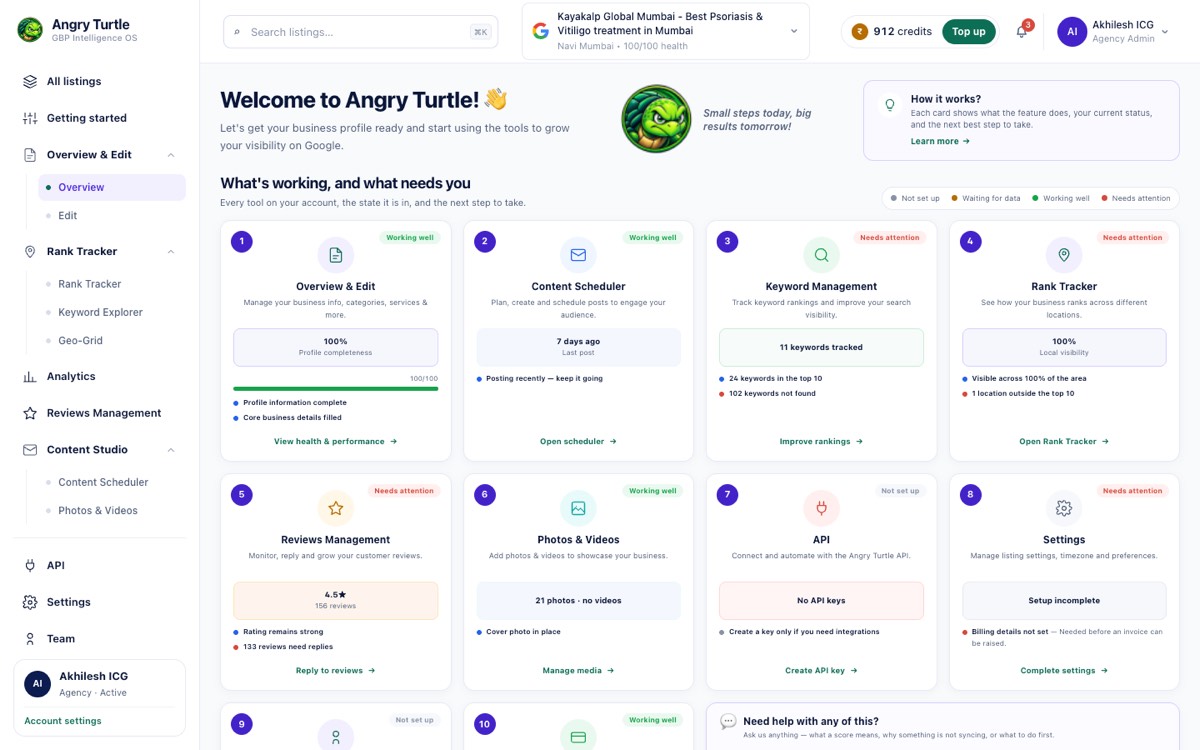

Related reading
Ready to have this run for you?
Book a free audit — we'll show you where you stand in 48 hours.