 Angryturtle
A restaurant owner in Chennai once had ChatGPT tell a customer his place closed at 9pm on Sundays. It closes at 11. Nobody at the restaurant had said anything wrong anywhere online — the model just got it wrong, the way it sometimes does, and there was no obvious single source to blame. This is the part of AI search nobody markets: sometimes the AI is just incorrect, and the correction path is genuinely different depending on why.
Two different failure modes, and why the distinction matters
The first failure mode is a model drawing from a real but wrong source — an outdated directory listing, an old news article, a stale cached version of your GBP data. The fix here is source correction: find and fix the wrong data at its origin, and the AI's answer eventually catches up because it's reflecting a real, correctable input.
The second failure mode is a genuine hallucination, where the model generates a plausible-sounding detail that doesn't trace back to any actual source — an invented phone number, a fabricated award, a made-up founding date. This is harder to fix directly because there's no wrong source to correct. It's the model filling a gap with something statistically plausible rather than something true. This split is one input into the broader picture covered in AI citations across ChatGPT, Perplexity, and Gemini, which explains why these systems behave this way at all.
Knowing which one you're dealing with changes what you do next. Chasing a phantom source for a pure hallucination wastes time; assuming a wrong-but-real source is a hallucination means you never fix the actual origin.
Figuring out which one it is
Search for the specific wrong detail — the phone number, the closing time, the claimed award — across the web and directories the business appears on, the same directories covered in remove duplicate Google listing for a related class of data problem. If the exact wrong detail shows up somewhere real (an old GBP cache, an outdated directory profile, a years-old blog post), that's a sourced error. If the detail appears nowhere except inside the AI's answer, and a direct web search turns up nothing matching it, that's closer to a genuine hallucination with no traceable origin.
This isn't a perfectly reliable diagnostic — you can't always search a browsing model's actual retrieval step — but it's the practical distinction available without access to model internals.
Correcting a sourced error
Start with the actual origin: if it's a stale directory listing, log in and correct it directly, or use the directory's claim/correction process if the listing isn't claimed yet. Business listing sites in India covers where these secondary sources commonly sit and how to claim them. If it's a stale GBP field, correct it in the dashboard or through GBP write-back, and if it's an old cached version, there's an unavoidable lag before crawlers and AI systems pick up the fix — this isn't instant. Exporting and auditing your GBP data is a useful first pass for catching which fields have drifted before an AI system amplifies the error further.
For Google's own AI Overviews specifically, correcting the underlying local pack and GBP data is the practical lever, since these overviews frequently draw on the same source material traditional local search results use. AI Overviews and local SEO and tracking AI Overview impact in Search Console cover that mechanism and how to watch for its effects.
What to do about a pure hallucination
There's genuinely less direct control here, and it's worth saying so plainly rather than promising a fix that doesn't exist. OpenAI, Google, and Anthropic all provide feedback mechanisms inside their consumer products (a thumbs-down or "report" option on a response) that flag an answer as incorrect, which can influence future model behavior over time but doesn't correct anything immediately or guarantee the same wrong answer won't appear again for a different user's query. For a business, the more productive use of effort is usually building out a stronger, more specific, more current public information footprint everywhere else, since a business with better source material generally has a lower rate of the models filling gaps with invented detail in the first place. Thin, contradictory, or absent information anywhere online seems to correlate with more fabrication, though this is inference from how these systems tend to behave, not a formally published finding.
Structured data as a fabrication-reduction measure
A model that can find your hours, phone number, and services stated clearly in structured form has less need to guess. This doesn't eliminate hallucination risk, since these systems can still fabricate details even when accurate source data exists, but it removes some of the guesswork that produces it. Local business schema, schema markup for AI search, and implementing sameAs links correctly cover the structured-data side of reducing that gap-filling behavior.
When it's worth escalating versus letting it resolve on its own
A wrong closing time is annoying but low-stakes; correcting the source and waiting for propagation is usually enough. A fabricated claim that could mislead customers on something safety- or money-related (a wrong price, an invented certification, a false claim about a medical service) is worth actively flagging through the AI provider's feedback mechanism as well as fixing at the source, precisely because the downside of an uncorrected wrong answer is higher.
Building resilience rather than chasing every instance
Trying to catch and correct every AI mention of a business isn't realistic given how many models and query variations exist. A more sustainable approach is keeping the underlying source data (GBP, website, directory profiles, schema) as complete and current as possible on an ongoing basis, which reduces the rate at which any of these systems has a gap to fill with something wrong. Entity SEO and the knowledge graph covers the broader entity-strength framing this fits inside. Angryturtle's platform keeps that underlying GBP and entity data current through write-back that publishes edits live, which is the mechanism that actually reduces the odds of a stale or thin source feeding a wrong AI answer in the first place.
How do I get ChatGPT or Google to fix wrong information about my business? There's no direct submission process for correcting an AI's memory of your business. If the wrong detail traces to a real source (an old directory listing, stale GBP data), fix it there and wait for propagation. If it's a pure hallucination with no traceable source, use the AI product's built-in feedback option, though this doesn't guarantee an immediate or permanent fix.
Why did an AI assistant invent a detail about my business that isn't anywhere online? Models sometimes fill informational gaps with plausible-sounding details rather than acknowledging uncertainty. This tends to happen more when a business's real public information footprint is thin or contradictory, though it can happen regardless.
Is a wrong AI answer about my business the same as a wrong Google Business Profile listing? Not necessarily. A wrong GBP listing is a direct, correctable data error. A wrong AI answer might be pulling from that same GBP data, from some other stale source entirely, or from nothing traceable at all — the fix depends on which.
Should I worry about every AI answer that gets a small detail wrong? No. Prioritize corrections where the wrong detail could mislead a customer on something that matters (pricing, safety, certifications) over minor details like an off-by-an-hour closing time, and focus ongoing effort on keeping source data accurate rather than chasing every mention.
Related: measuring AI search visibility covers the broader monitoring context this correction work sits inside.
Stop guessing where you rank locally.
Rank OS scores your Google Business Profile the way Google's local algorithm does — relevance, review health, freshness, entity authority and AIO readiness — and shows you exactly what to fix.
Book a live demo →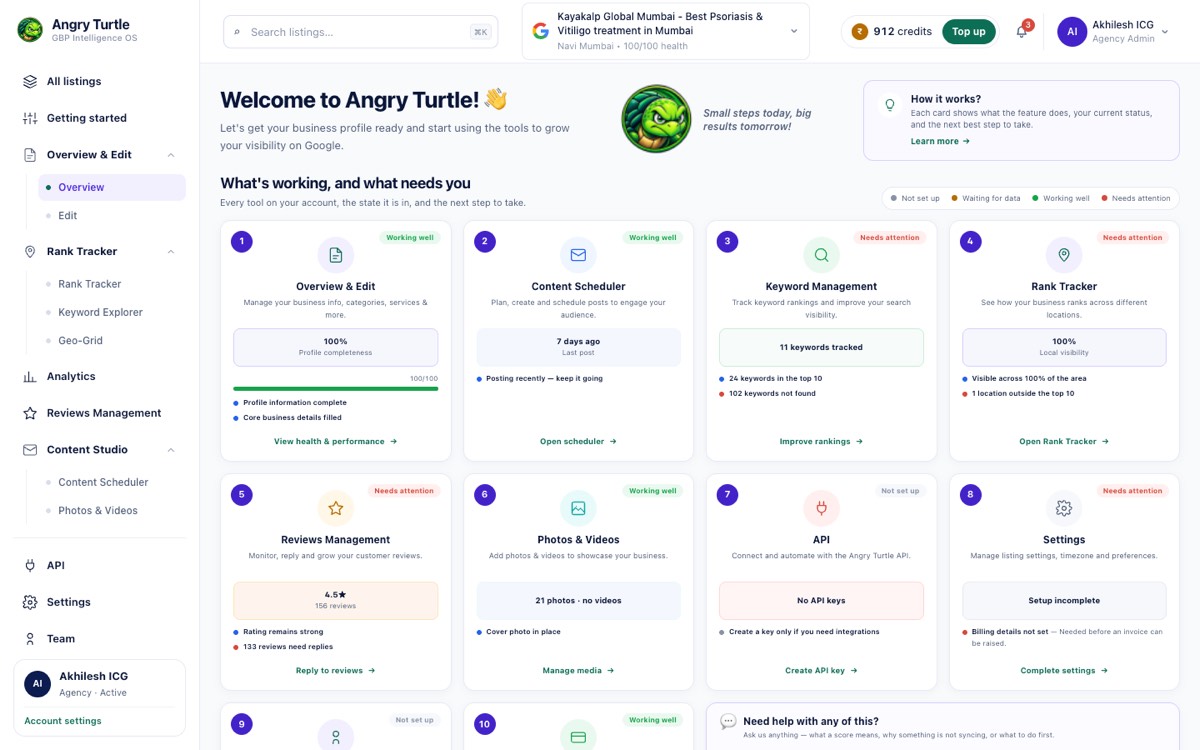

Related reading
Ready to have this run for you?
Book a free audit — we'll show you where you stand in 48 hours.