 Angryturtle
How ChatGPT Decides Which Local Business to Recommend
·
ChatGPT doesn't have a database of every business in India. When someone asks it "which dermatologist should I see in Koramangala," it isn't looking up a ranked list the way Google Maps does. It's doing a live web search through its browsing tool, reading what comes back, and writing an answer that sounds confident whether or not the underlying sources actually agree with each other.
That distinction matters more than most advice about "getting recommended by ChatGPT" admits. This piece covers what's actually observable about how ChatGPT arrives at a local business mention, and it's deliberately narrower than a lot of what gets written on this topic, because OpenAI hasn't published a local-ranking algorithm and nobody outside the company has one to hand you.
The mechanism, as far as it can be described
When ChatGPT is asked a question with local intent, it typically triggers a web search rather than answering purely from its training data — training data goes stale and doesn't know your hours changed last month. That search behaves something like a normal search engine query: it retrieves a handful of pages, weighs how directly they answer the question, and synthesizes from what it finds.
What it finds depends heavily on what's actually indexable and legible on the open web. A Google Business Profile isn't a web page ChatGPT can crawl directly — it's a walled dataset that Google, not OpenAI, controls access to. So ChatGPT's local answers lean more on your website, on directory listings, on review platforms, and on any third-party coverage that's crawlable, than on your GBP itself. This is one of the clearest differences from how Google's own AI Overviews work, which do have direct access to Business Profile data. The fuller comparison of how AI citations differ across ChatGPT, Perplexity and Gemini covers this gap in more depth.
What makes a business easy for ChatGPT to describe correctly
A business with structured data on its site — a proper LocalBusiness schema with the address, hours, and category machine-readable — gives any AI system a clean fact to extract instead of a paragraph to interpret. That's true whether the system is Google's or OpenAI's, but it matters more for ChatGPT specifically because it doesn't have the GBP shortcut Google has.
Consistency across sources counts for a lot too. If your website says one phone number, your GBP says another, and a directory listing says a third, an AI system synthesizing from multiple sources has no clean way to know which is current — see what NAP consistency actually means if the term is new. The gap between what your GBP says and what your website says is a real source of confusion for these systems, not a theoretical one.
Review platforms that ChatGPT's browsing can actually reach — sites that don't block crawlers, that have real crawlable review text rather than content locked behind JavaScript rendering — end up as a bigger part of the picture than most business owners expect. Whether AI engines actually read review text and how they weight it is one of the more common questions here, and the honest answer is that specific, descriptive review language ("fixed our AC same day, didn't try to upsell a new unit") gives an AI system something concrete to paraphrase, where a string of five-star ratings with no text gives it nothing to work with.
Correcting the record when ChatGPT gets it wrong
Because ChatGPT doesn't hold a persistent database entry for your business the way Google does, you can't file a correction request the way you can with a Business Profile. Fixing wrong information in ChatGPT mostly comes down to fixing the sources it's drawing from — your website, your listings, whatever's actually publishing the wrong hours or the wrong address — and waiting for the next time it searches live rather than editing a stored record. There's no submission form that updates ChatGPT's answers directly.
This also means a competitor showing up in an answer where you expected to see yourself isn't a bug you can appeal. If ChatGPT recommends a competitor instead of you, the fix is closing whatever gap made the competitor's sources easier to retrieve and trust, not filing a complaint.
Where citation tracking stands right now
There's a real appetite to know, in something close to real time, whether your business is being mentioned in ChatGPT answers across a set of queries — a "share of AI voice" concept. Be skeptical of anyone claiming to sell you live, comprehensive tracking of this today. Angryturtle's share-of-AI-voice tracking is built around sampling representative prompts rather than pretending to see every conversation any user has ever had with ChatGPT — no vendor can see that, because ChatGPT conversations aren't public data. What's realistic is periodic sampling against a defined prompt set, tracked over time, not a live feed.
For actual mechanics of how this kind of tracking works today, measuring AI search visibility walks through the sampling approach and its honest limits.
Rank OS and the AIO Readiness dimension
Rank OS scores a listing across five weighted dimensions, and AIO Readiness — worth 15 of the 100 points — is specifically about whether a profile is set up to be a legible, citable source for systems like ChatGPT, not just Google. It isn't a ChatGPT-specific score, because no single number can honestly claim to predict OpenAI's retrieval behavior. It's a readiness check on the things within a business's control: structured data, entity consistency, description quality, and category accuracy. How to measure AI search visibility is a reasonable next read if you want to see how that readiness translates into something you can actually track over time.
The India-specific gap
Most guidance on AI citation is written for a US web, where the assumption is that a business has a crawlable, indexed website with schema. A large share of Indian small and mid-size businesses run primarily on JustDial, IndiaMART, or a WhatsApp Business number, with a thin or nonexistent standalone website. That's a structural disadvantage for ChatGPT visibility specifically, since a directory profile that's mostly rendered client-side or gated behind a login is harder for ChatGPT's browsing tool to use than a plain static page. The AEO playbook for India goes into what that gap means in practice and what a business without a strong website can still do.
Frequently asked questions
Does ChatGPT use my Google Business Profile at all? Not directly. ChatGPT's browsing tool retrieves from the open web, and a GBP is Google's own walled data — it isn't a page ChatGPT can crawl the way it can crawl your website or a directory listing.
Will more reviews guarantee a ChatGPT mention? No. There's no confirmed review-count threshold. Review volume with specific, descriptive text tends to help because it gives the system something concrete to synthesize from, but it's a gradient, not a gate.
Can I see every time ChatGPT mentions my business? Not comprehensively, and no tool — ours included — can claim otherwise honestly. ChatGPT conversations are private by default. What's possible is sampling a defined set of representative prompts over time and tracking whether your business appears in the answers to those specific prompts.
Is optimizing for ChatGPT the same work as optimizing for Google AI Overviews? Mostly overlapping but not identical. Both reward structured data, consistency, and specific review text. The difference is that Google has direct GBP access and ChatGPT largely doesn't, which shifts more weight onto your website and third-party crawlable sources for the ChatGPT side specifically.
Stop guessing where you rank locally.
Rank OS scores your Google Business Profile the way Google's local algorithm does — relevance, review health, freshness, entity authority and AIO readiness — and shows you exactly what to fix.
Book a live demo →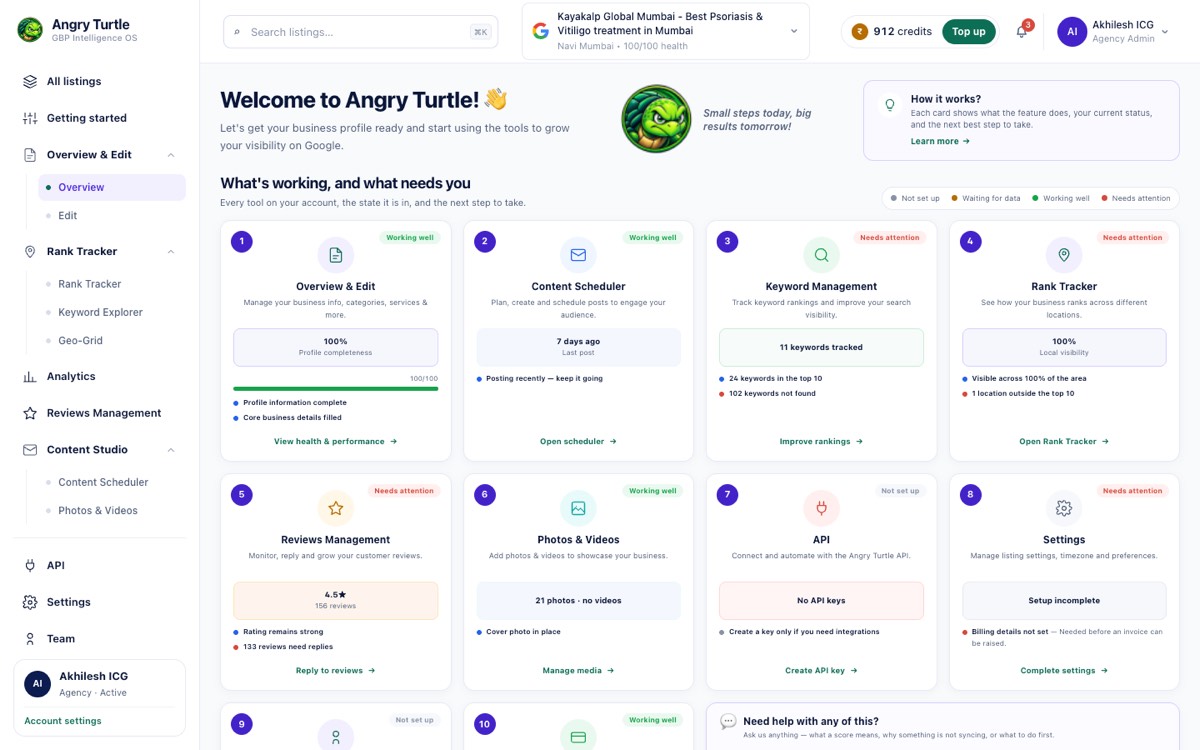

Related reading
Ready to have this run for you?
Book a free audit — we'll show you where you stand in 48 hours.