 Angryturtle
Do reviews affect AI search visibility? The complete guide for Indian GBP owners
Why review text matters more than star rating for AI citations — plus the practical Google review mechanics owners actually ask about.
·
Disclaimer: the signal-side sections of this guide (how AI engines seem to use review data) describe observed patterns in how retrieval and generation systems work, not a disclosed Google, OpenAI, or Perplexity ranking specification. None of these companies publish an exact review-weighting formula. Where a specific number or threshold would normally go, we've marked the gap instead of guessing.
Reviews affect AI search citations in two separate ways, and most guides collapse them into one. There's the AI-visibility question — does what's written in your Google reviews change whether ChatGPT, Perplexity, or Google's AI Overviews mention your business — and there's the plain mechanics question, which has nothing to do with AI at all: can you delete a review, why isn't a review showing up, how do you get a review link to send customers. Both have real search demand on their own. This guide answers both, in full, in one place.
The first half covers what actually happens when an AI system encounters a review: whether it reads the text, whether a bad review can bury you, whether posting fast helps, whether responses matter, and what's different for a business running in Hindi or a regional language. The second half is the practical Google review playbook — deleting, missing reviews, review links — for anyone who landed here just to fix one thing on their profile. If you're the second kind of reader, jump straight to the mechanics section below; you don't need the AI theory first.
Angryturtle's own review management layer is what generates the product context behind a lot of this guide — it's built to handle both sides, generation and response, for businesses running either self-serve or through a managed team. If you want the underlying terminology defined in one place first, the review signals glossary entry is a shorter companion read.
How AI engines actually use review data
AI Overviews and chat answers pull from the same retrieval layer that already indexes your Google Business Profile. Reviews are part of what gets retrieved, not a separate signal bolted on afterward. When someone asks an AI engine "best dentist in Andheri" or "is this clinic good," the system isn't running a parallel reviews-only lookup — it's pulling from whatever text is attached to that business entity, and review text is one of the densest, most frequently updated blocks of text most GBP profiles have.
That's the split this whole guide runs on. Some questions are about the signal itself — does review content actually shape what gets cited, does a bad review hurt you, does posting often help. Others are pure mechanics — how do you delete a review, why isn't one showing, how do you get people a link to leave one. They're different problems with different fixes, and a business owner searching "why can't I delete this review" doesn't want an AEO lecture first. So this guide keeps the two apart, clearly labeled, all the way through.
One structural point worth understanding before anything else: retrieval systems favor specific text over generic ratings. A star rating alone is a number with no content. A sentence like "fixed my AC in 40 minutes on a Sunday" is a fact a model can extract and reuse. That distinction — specificity over score — reappears in almost every section below. Angryturtle's Ask Maps AIO readiness dimension tracks exactly this kind of retrievability, and the LLM citation glossary entry covers the underlying mechanic in more depth than fits here.
Do AI engines actually read your reviews?
Retrieval-augmented systems don't "read" a webpage the way a person does. They break content into passages, convert those passages into vectors, and match a user's query against the passages whose meaning is closest. A Google Business Profile with fifty reviews isn't one document to these systems — it's fifty (or more) separate passages, each competing on its own to be the one that gets pulled into an answer.
That changes what "reading reviews" even means in practice. A five-star rating with no text is a single low-information data point. A three-sentence review naming a specific procedure, a specific price range, or a specific outcome is several retrievable facts stacked in one place. Once the passage is grounded — meaning the model has an actual snippet of text to point to rather than a summary it generated on its own — it's far more likely to end up quoted or paraphrased in an answer. This is also why review text with named services tends to outperform vague praise, and why a review mentioning "root canal" is more retrievable than one that just says "great service, highly recommend."
None of this requires special formatting on the reviewer's end. Nobody writes a Google review thinking about vector embeddings. The retrievability advantage comes from ordinary detail, not keyword stuffing — a reviewer who happens to mention what they came in for is doing, by accident, exactly what makes that review useful to a retrieval system later. For a longer technical breakdown of how retrieval-augmented generation actually works, the RAG glossary entry and the local citation glossary entry go further than this guide needs to.
Google's own developer documentation on AI features and how they surface content confirms the general principle without publishing an exact weighting: content that's specific, well-structured, and genuinely informative is what AI Overviews are built to select from, and there's no separate schema or trick required beyond that.
Do GBP reviews and review content affect AI search results?
Star rating alone carries very little weight. What actually pulls a review into an AI answer is the text inside it — specific services, specific outcomes, specific language a customer used. A profile sitting at 4.9 stars with two hundred reviews that all say some version of "great, would recommend" is, from a retrieval standpoint, thinner than a profile at 4.4 stars where a chunk of reviews mention exact procedures, product names, or resolved complaints.
This surprises a lot of business owners, because rating has been the visible metric for so long — it's the number shown next to the pin on Maps, so it feels like the number that matters. But the rating is a summary statistic computed by Google. The review text is raw material an AI system can quote from directly. Both matter, just not in the way most owners assume: rating affects whether a human clicks, text affects whether an AI system has anything usable to cite.
There's a practical implication here for anyone managing GBP reviews. Encouraging a customer to say what specifically they liked, rather than just leaving a star rating, does more for AI visibility than chasing the rating number up half a point. That's a strategic point this guide comes back to under review generation later, with more tactical detail. For the underlying markup that can accompany review content, see the Google reviews glossary entry and review schema glossary entry — schema doesn't create review content, it just describes it more precisely to a crawler.
Do negative or fake reviews block AI citations?
One or two critical reviews rarely move anything. What actually changes an AI-generated summary is a cluster of reviews repeating the same specific complaint — that's a pattern, and patterns are what get summarized. A single review saying the parking was bad is noise. Ten reviews across eight months all mentioning the same billing issue is a pattern a retrieval system can surface, and a human reading an AI summary would probably want to know about it too.
There's no published review-count or ratio threshold for when negative feedback starts affecting AI-generated answers — no source states that three bad reviews out of fifty is safe but five isn't. The honest framing is gradient, not gate: more repetition of the same complaint increases the odds it surfaces somewhere, less repetition means it mostly stays buried under everything else on the profile.
Fake reviews are a related but different problem. They don't usually get filtered by an AI system reading review text — they get filtered, when they get filtered at all, by Google's own review-quality systems flagging and removing them before an AI layer ever sees the profile. A business dealing with a batch of obviously fake negative reviews should report them through Google's standard flagging process rather than trying to out-post them with real reviews, because the fake reviews staying live is the actual problem, not their downstream effect on an AI summary. The fake and negative review handling guide walks through the flagging process and what Google typically asks for as evidence.
Does review velocity change AI visibility?
Review velocity is just reviews-per-month, tracked as a rate, not a total. A profile with forty reviews added steadily over two years reads differently to a retrieval system than forty added in one week, even though the total is identical. Steady velocity looks like an ongoing, active business. A spike looks like a campaign, and a spike immediately after a listing goes live or right before a competitor review-bombs a rival looks like exactly what it is.
There's no published ideal number of reviews per month, and any guide that gives you one is inventing it. What's defensible is the direction, not the number: steady is safer than spiky, and a business generating five real reviews a month for a year is in a stronger position than one that got sixty reviews in a single weekend push and then went quiet. Velocity also interacts with freshness more broadly — a profile that hasn't had a new review in eight months reads as less active regardless of its historical total, which is one more reason the "get reviews once and stop" approach undersells itself. More on the underlying mechanic at the review velocity glossary entry.
Does responding to reviews improve AI citations?
A customer leaves a two-star review about wait times. The owner has two choices: ignore it, or reply with what changed. Only one of those produces new text on the profile for anything, a retrieval system or a human, to read later. An unanswered negative review just sits there as a data point. A reply that says "we added a second technician after the July rush" is new, specific, dated text tied to the same complaint — and it's the kind of detail that can shift how an AI summary characterizes the business, because now there's a resolution attached to the problem, not just the problem.
The value isn't limited to negative reviews. Replying to positive reviews with specifics, thanking a customer by naming what they mentioned rather than a generic "thanks for the feedback," adds more of the same kind of retrievable text the earlier sections describe. Owners who reply to everything with the identical stock line aren't getting much benefit from replying at all, because a copy-pasted response contains no new information for anything to extract.
This is where Angryturtle's confirmed GBP write-back capability matters concretely, not as a talking point. A reply drafted in the platform pushes through to the actual Google Business Profile — it isn't a note stored somewhere else that has to be manually copied over. For businesses managing dozens of locations, that's the difference between review responses actually existing on Google versus existing in a spreadsheet nobody ever transcribes. The responding to reviews guide covers tone and what to say; the write-back product page covers how the reply actually reaches Google.
What does review sentiment analysis actually optimize?
Sentiment analysis isn't about the star rating. It's about whether the language in the review text is specific and positive about a named service, which is what a language model actually extracts. A review that reads "amazing, 10/10" scores as positive sentiment in the crudest sense but gives a retrieval system almost nothing to work with. A review that reads "the orthodontist explained every step before starting, no surprise charges" is positive and specific — sentiment and substance in the same sentence.
This is where a lot of "get more positive reviews" advice runs thin. The goal isn't maximizing the count of five-star ratings; it's maximizing the count of reviews where positive sentiment is attached to a specific, nameable thing about the business. Two businesses can have identical average ratings and completely different AI-citation odds, because one has reviews full of vague praise and the other has reviews full of named specifics that happen to also be positive. See the review sentiment glossary entry for how sentiment scoring typically works at the text level, separate from the star-rating aggregate Google displays.
Do reviews on other platforms feed AI engines too?
A clinic has two hundred reviews on Practo and twelve on Google. An AI engine answering "best dermatologist near me" in that city is drawing from whichever profile it can actually retrieve, which is why platform spread matters independently of review count. If the AI system in question weights Google Business Profile heavily and barely touches Practo, that clinic's actual reputation strength is mostly invisible to it regardless of how good the Practo reviews are.
This is a genuinely India-specific consideration, not a generic point with a country name stapled on. The directory landscape here is fragmented in a way the US market mostly isn't: JustDial and IndiaMART carry weight for services and B2B respectively, Practo dominates healthcare bookings, Zomato is where most restaurant review volume actually lives, and Sulekha covers a chunk of local-services categories none of the others fully own. A business with strong reviews concentrated on one of these but a thin Google profile is betting that whichever AI system answers the query happens to draw from the platform it's strong on — which is not a bet worth making on purpose.
Consistency matters as much as spread. If the business name, address, or category differs across Google, Practo, and JustDial, that's a separate problem covered under NAP consistency — reviews scattered across inconsistent listings for what's technically the same business tend to get treated as weaker signals for the same entity, or occasionally as signals for what looks like a different entity altogether.
A practical review-generation strategy for AEO
What makes a review retrievable is specificity: a named service, a named outcome, specific language rather than generic praise. Any generation strategy that doesn't produce that kind of text is optimizing for the wrong output, even if it produces a lot of reviews. Volume without specificity gets you a higher count and roughly the same AI-citation odds as before.
What to actually ask for
The single highest-leverage change most businesses can make is what they ask customers for. "Please leave us a review" produces star ratings and one-line praise. "Let us know what you came in for and how it went" produces the kind of text this guide keeps describing as retrievable. Timing the ask matters too — right after the service is completed, while the specifics are still fresh, produces more detail than an ask sent a week later through a generic follow-up email.
Where the ask happens
Point-of-sale requests, SMS or WhatsApp follow-ups with a direct review link, and QR codes at physical locations all work, and none of them require special tooling to set up correctly. What tends to fail is asking too generically or too infrequently — a single mass email blast to an old customer list produces a short burst of thin reviews rather than the steady, specific flow this guide has already described as the healthier pattern. The review generation engine guide covers the operational side of running this as an ongoing process rather than a one-time campaign.
Do regional-language reviews affect AI citations in India?
English-only reviews aren't a blocker on their own. The exception is a business whose actual customer queries are in Hindi or a regional language and whose reviews are all in English — that mismatch is where retrieval has less to match against. If most of a clinic's actual searchers type in Hindi or a code-mixed mix of Hindi and English, and every review on the profile is written in formal English, there's a gap between how the business is being searched for and how it's being described.
This is genuinely more relevant in India than in most markets this kind of guide gets written for. A large share of local search queries here are vernacular or code-mixed — "acha dentist paas mein," not "good dentist nearby" — and a review base that's entirely in English gives a retrieval system less to match phonetically or semantically against those queries. Encouraging reviews in whatever language a customer is comfortable writing in, rather than nudging everyone toward English, closes that gap directly rather than working around it. The vernacular search glossary entry covers how query matching handles Hindi, Hinglish, and regional-language input more generally.
None of this means English reviews are wasted. A mixed review base, some in English, some in Hindi, some in regional languages that match the actual customer base, is closer to how the business is genuinely being searched for than any single-language approach would be.
Can you delete a Google review?
You can't delete someone else's review yourself. You can flag it for removal if it violates Google's policies, or ask the reviewer to edit or delete it themselves. Google removes reviews for specific policy violations, not for being unflattering — a review that's rude but accurate almost never qualifies for removal, while one that's fake, off-topic, contains hate speech, or was posted by someone with no plausible connection to the business usually does.
To flag a review, open the review on your Business Profile, select the flag or report option, and choose the violation category that actually applies. Google's review process from there isn't instant and doesn't guarantee removal even for a valid flag. If the review doesn't meet a policy violation but is still wrong on the facts, replying publicly with the correct information is often more useful than waiting on a flag that may never resolve. Google's own Business Profile help documentation on editing your profile covers the current flagging interface directly, since Google occasionally changes the exact menu path. For claiming and verification issues that sometimes get confused with review-management problems, see the claiming and verifying your GBP guide.
Why is a Google review not showing up?
The most common cause is moderation delay, not a technical fault. New reviews go through automated screening before they appear publicly, and that can take anywhere from a few minutes to a few days depending on volume and whether the review triggered any policy flags automatically. A review that's genuinely stuck past a week is a different problem than one that's just still in the normal queue.
Beyond delay, the other frequent causes are: the reviewer left the review while signed into a different Google account than the one they're checking with later, the profile itself isn't fully verified so reviews aren't syncing correctly, or the review actually did get filtered by Google's spam/policy system without notifying anyone. There's also a simpler explanation worth ruling out first — checking the listing on desktop Google Search versus the Google Maps app versus an incognito browser sometimes shows different review counts temporarily as caches update at different speeds across surfaces. Profile verification status, covered in the GBP verification glossary entry, is worth checking before assuming a review has been removed.
How to create a Google review link
A Google review link is a direct URL, built from the business's Place ID, that opens straight to the review-writing screen instead of the general business listing. Sending a customer this link instead of just saying "please review us on Google" removes several steps between the ask and the action, which is most of why it converts better.
To generate one:
- Search for the business on Google and open its Business Profile panel, or open Google Maps and find the listing directly.
- Click "Share," then "Ask for reviews," which generates a shareable review link automatically if the profile is claimed and verified.
- Copy that link and send it through SMS, WhatsApp, email, or a printed QR code, whichever channel actually reaches the customer fastest after the service is done.
Businesses managing several locations run into a version of this that's harder to do manually: generating a correct, unique review link for each location and getting it into the right hands without mixing locations up. That's part of what the GBP write-back product handles for multi-location accounts, since a wrong review link sent to the wrong branch's customers doesn't just fail, it actively adds a mismatched review to the wrong profile.
FAQ
Do AI chatbots read Google reviews? Yes, indirectly. Chat-based AI systems retrieve indexed content related to a business, and review text on a Google Business Profile is part of what's indexed and available to pull from, alongside the rest of the profile and any web pages about the business.
How many reviews do I need before AI engines cite my business? There's no published threshold. No source states a specific review count that guarantees or unlocks AI citation. What the evidence points to is a gradient: more specific, text-rich reviews increase the odds of being cited, but there's no confirmed number where citation switches on.
Can a single bad review hurt my AI visibility? Rarely on its own. A pattern of several reviews repeating the same specific complaint is what tends to surface in an AI-generated summary, not one isolated negative review.
Do I need reviews in Hindi for AI search in India? Only if your actual customers search in Hindi or a regional language and your current reviews are entirely in English. Matching the review language to how customers actually search closes a real retrieval gap; it isn't a requirement for every business regardless of audience.
Does Angryturtle reply to reviews on my behalf and push that to Google? Yes. The review management layer drafts and can publish responses directly to the live Google Business Profile through confirmed write-back, whether the account is run self-serve or through a managed team, so a reply exists on Google itself rather than only inside a dashboard.
Related terminology: Share of AI Voice.
Stop guessing where you rank locally.
Rank OS scores your Google Business Profile the way Google's local algorithm does — relevance, review health, freshness, entity authority and AIO readiness — and shows you exactly what to fix.
Book a live demo →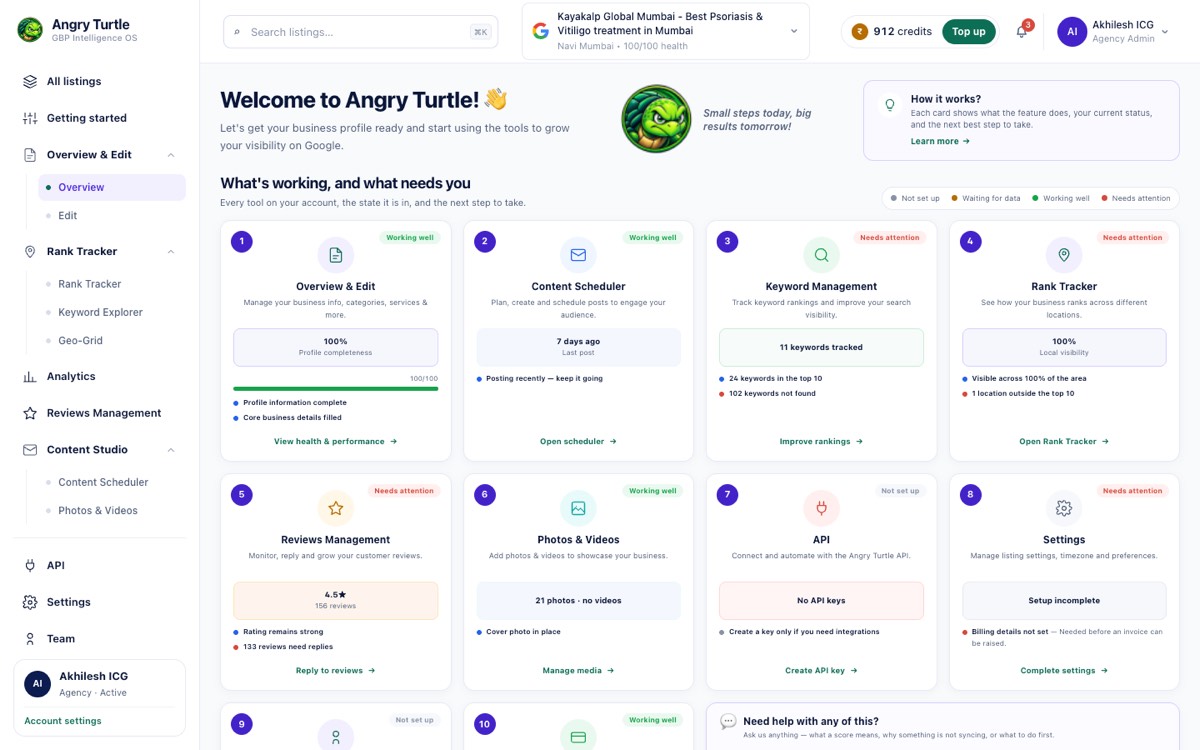

Related reading
Ready to have this run for you?
Book a free audit — we'll show you where you stand in 48 hours.