 Angryturtle
Best Local SEO for Franchise Businesses in India
How Indian franchise networks rank each unit higher on Google Maps. GBP governance, per-unit review management, brand consistency, and rapid new unit onboarding.
·
Local SEO for Indian franchise networks: solving the HQ vs. unit tension
Franchise local SEO carries a structural problem unique to the model. The franchisee closest to their own customers holds the most relevant local knowledge, but HQ holds the brand standards, the legal obligations, and the reputation risk when a franchisee's GBP goes rogue. The franchises that rank best have already solved this tension with a governance model that keeps brand consistency at the profile level while still allowing local flexibility at the content level.
What HQ has to control, non-negotiably
Business name format needs one exact template applied to every unit — "Brand Name [City/Area]" or "Brand Name — [Franchisee Name]" — with no variations, no additions, and no keyword-stuffing by an individual franchisee trying to help their own listing.
Primary category has to reflect the real business, checked and corrected by HQ when a unit drifts — a QSR franchise where individual units start adding "Restaurant" as an inappropriate secondary category needs that caught and fixed centrally, not left to each franchisee's judgment.
The core description runs from a brand-standard template with a small local insert — one to two sentences covering what the brand is and its key differentiators, with the insert covering the local neighbourhood, years of operation, and any local achievement worth naming.
And suspension monitoring has to sit with HQ or HQ's local SEO agency, checking every unit profile daily. Individual franchisees, in practice, are not reliable suspension detectors — a suspended profile can sit invisible for weeks before a franchisee even notices the drop in enquiries.
What franchisees contribute within the guardrails
Local photos — team shots, local events, interior detail specific to that unit — submitted for brand approval before anything goes live. Local posts covering offers and events, submitted through a defined channel and published by HQ or the managing agency rather than posted directly by the franchisee. And local hours, including festival and regional holiday variations the franchisee is closest to, reported up to HQ for the actual update.
The naming inconsistency that breaks more franchise GBPs than anything else
The single most common franchise GBP error in India is franchisees creating profiles independently, each landing on a different name format. One unit becomes "Brand Name Gurgaon." Another becomes "Brand Name - Gurgaon DLF." A third becomes "Brand Name Gurugram (Gurgaon)." A fourth becomes "[Franchisee Personal Name] Brand Name." Each variation seemed reasonable to the person who set it up, and together they fragment brand recognition, create citation authority problems, and occasionally trigger Google's duplicate-listing flags outright.
The fix is a one-time remediation, not an ongoing process: establish a canonical format — "Brand Name — [Locality]" — and update every existing unit to match it. Claiming and renaming profiles that already exist takes real effort up front, but it pays off in exactly the brand consistency that was missing.
Keeping review counts from becoming unequal across units
Some franchisees naturally generate reviews — they're customer-facing by temperament, they ask, and their customers respond enthusiastically. Others generate almost none, not from bad service necessarily, just from never asking. The result across a network is often a wide variance in review count that creates real rank inequality between otherwise comparable units.
The fix is centralised, systematic generation run from HQ across all units at once — WhatsApp flows triggered by transaction data where it's available, or by franchisee reporting of eligible customers where it isn't, a monthly review-velocity target set per unit, and a league table that turns the whole thing into healthy internal competition rather than a scattered, inconsistent effort.
When a unit hits a genuine review crisis — a service failure, a food quality incident, a staff behaviour complaint that draws a cluster of negative reviews — the response has to be coordinated rather than left entirely to the franchisee. The public response should come from HQ or the brand account, keeping a consistent voice, while the actual resolution is managed by the franchisee with HQ oversight rather than either party acting alone.
Getting a new unit visible from day one, not week four
Franchise networks open new units on a regular cadence, and each one needs GBP presence live from opening day, not a month later once someone finally gets around to it. A 30-day launch process handles this systematically: week one creates the GBP profile under the brand's Location Group, populates it with brand templates plus the local insert, and initiates verification with the franchisee's help on the video. Week two completes verification, uploads brand-standard photos alongside three local photos from the franchisee, and starts citation building on JustDial, Sulekha, IndiaMART, and any vertical-specific directory relevant to the category. Week three activates review generation, publishes the first GBP post as a launch announcement, and seeds the Q&A section with five common questions. Week four establishes a first geo-grid baseline, dispatches the first round of review requests, and hands the unit over to ongoing monthly management.
Reporting that works for three different audiences at once
Franchisees need a monthly report on their own unit specifically — rank via geo-grid, review count and velocity, and a log of GBP activity — enough to keep them informed and accountable without requiring direct GBP access they might mishandle. HQ needs a league table ranking every unit by review count, review velocity, GBP completeness, and local pack rank, shared monthly and used directly in franchisee performance conversations. And the executive layer needs a quarterly aggregate view: network-wide review count and velocity, an overall citation score, the percentage of units sitting in the top 3 for their primary keyword, and city-level rank performance across the network as a whole.
Where write-back keeps this consistent at scale
None of the governance model above holds up if every branded update has to be manually re-entered per unit by whoever happens to have GBP access that week. Angryturtle's platform publishes brand-template updates, posts, and review responses directly to each unit's live GBP (write-back to Google is confirmed working), which is what actually makes a canonical naming fix, a synchronised holiday-hours update, or a coordinated crisis response possible across dozens or hundreds of units at once rather than in theory only.
Common mistakes in franchise local SEO
Letting franchisees set up their own GBP naming without a template, then trying to fix the resulting inconsistency years later instead of at launch. Publishing a crisis response from the franchisee's personal account instead of the brand voice, creating an inconsistent public record. Treating review generation as each franchisee's individual responsibility rather than a centralised, monitored system. And onboarding a new unit's website and marketing before its GBP, when the profile is usually the faster path to first customers.
Should a franchisor also run its own service-area business GBP alongside unit profiles? Generally no, if the franchisor's SAB coverage overlaps significantly with existing unit territories — that overlap tends to cannibalize the units it should be supporting rather than adding new reach.
How much local flexibility should a franchisee actually have in GBP content? Enough for genuine local relevance — local photos, local events, local hours — but the name, category, and core description should stay centrally controlled to avoid the fragmentation problem above.
What's the fastest way to fix inconsistent naming across an existing network? Audit every unit's current name against a canonical format, then claim and rename each one systematically rather than waiting for franchisees to fix their own listings individually.
Does GBP suspension at one unit affect the rest of the network? Not directly, but it's a signal worth investigating network-wide, since whatever triggered one suspension — a policy violation in a shared template, for instance — may be present across other units too.
Related reading: franchise GBP management covers the naming and governance mechanics in more operational depth, and multi-location local SEO strategies covers the broader discipline this sits inside. For the industry hub, see franchise local SEO. On the review-consistency problem specifically, see review velocity and local SEO and keyword cannibalization in local SEO for the franchisor-vs-unit overlap risk. For bulk operations across many units, see Google Business Profile API.
Angryturtle manages franchise local SEO networks across India →
Stop guessing where you rank locally.
Rank OS scores your Google Business Profile the way Google's local algorithm does — relevance, review health, freshness, entity authority and AIO readiness — and shows you exactly what to fix.
Book a live demo →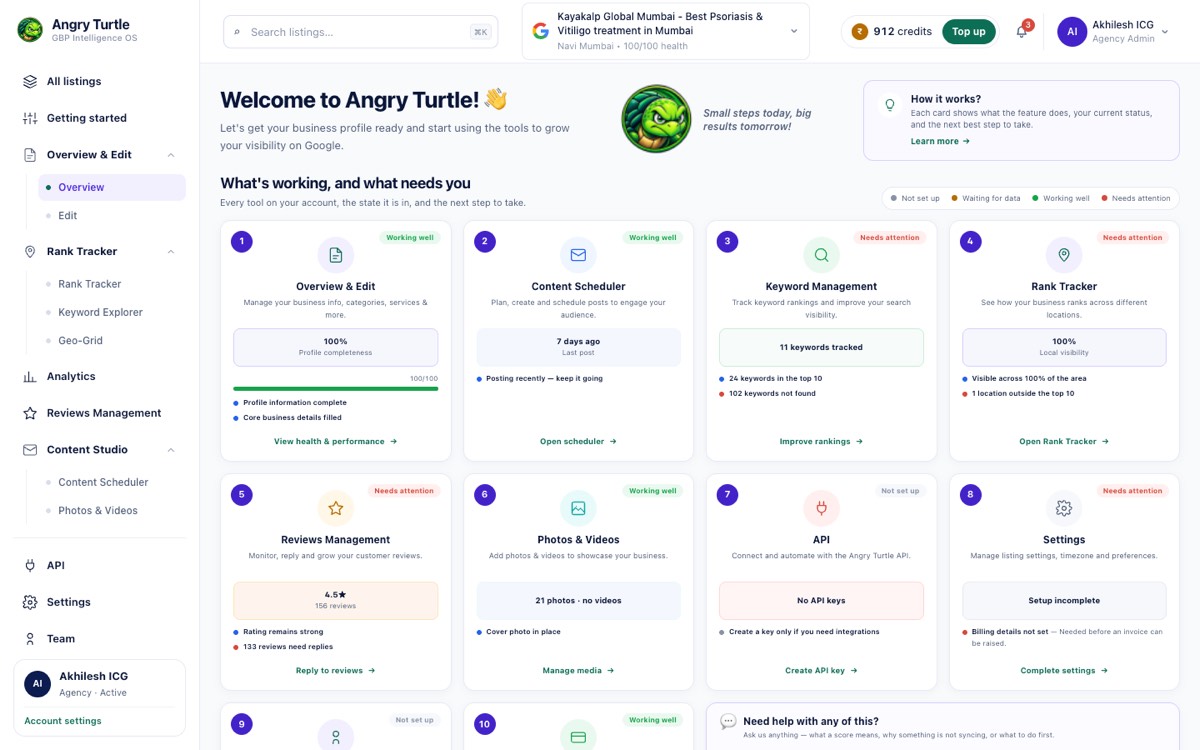

Related reading
Ready to have this run for you?
Book a free audit — we'll show you where you stand in 48 hours.