 Angryturtle
Avoiding Keyword Cannibalization Across Location Pages
How multi-location brands avoid cannibalising their own local search rankings. GBP cannibalisation, location page conflicts, and how to structure content to prevent it.
·
Local SEO keyword cannibalization: when your own locations compete against each other
Keyword cannibalization in local SEO happens when two assets from the same business compete for the same search query — usually two GBP profiles or two location pages targeting the same keyword in the same geography, splitting rank instead of stacking it.
To avoid keyword cannibalization in location pages specifically: give each page genuinely distinct content (different local context, team, service emphasis, not just a swapped city name), match NAP exactly to the corresponding GBP, and use canonical tags where pages legitimately overlap at different levels of geographic specificity rather than letting all of them compete unmarked. That's the short version; the rest of this page covers why each piece matters and how to diagnose the problem once it's already happened.
In single-location SEO, this problem doesn't exist. In multi-location local SEO, it's one of the most common structural issues we see, and one this site's own architecture has run into directly.
The four types of local cannibalization
GBP-to-GBP cannibalization happens when a business has two profiles close together — two clinic branches 800 metres apart in the same neighbourhood — both targeting the same keyword, "dermatologist Koramangala," with near-identical profiles. Google shows one or the other inconsistently, and neither ranks as strongly as a single well-established profile would on its own.
Location page-to-location page cannibalization happens on the website side: two pages, say /locations/mumbai/bandra/ and /locations/mumbai/bandra-west/, with copy that's identical except for the area name. They compete with each other and dilute whatever authority either would have accumulated alone.
GBP-to-website cannibalization is subtler — the GBP for a location and that location's website page both target the same keywords, but the NAP between them doesn't match. Instead of reinforcing each other, they fragment authority between two slightly different versions of the same entity.
Franchise profile cannibalization shows up specifically in networks where the franchisor runs a service-area business GBP covering the same geography that individual franchisee unit GBPs already cover. The franchisor's own profile ends up competing with the units it's supposed to be supporting.
How to actually spot it
For GBP profiles, search your primary keywords on Google Maps directly. If two of your own profiles show up for the same keyword in the same search, that's cannibalization — check whether their service areas or physical locations overlap significantly, because that overlap is usually the root cause.
For location pages, Google Search Console does the work. Filter by queries, then look for the same keyword appearing against more than one page in the Pages report. Two of your own pages surfacing for one query means they're competing with each other for it.
The clearest symptom in practice is inconsistent ranking — one week the Bandra branch shows for "clinic in Bandra," the next week it's the Andheri branch instead, even though nothing about either profile changed. That inconsistency is Google itself being unsure which page or profile is more relevant, which is exactly what cannibalization produces.
How to avoid keyword cannibalization in location pages
For nearby GBP branches, optimise each one for its specific micro-locality rather than the broader area both technically sit in — a Bandra branch targets Bandra West specifically, a Juhu branch targets Juhu and Santacruz West, and the non-overlapping focus keeps them from directly competing.
For location pages, genuinely unique content per page is the only real fix. Different local context, a different team photo, different service emphasis by area — two pages with identical copy and only the city name swapped will cannibalize regardless of how well-intentioned the page structure was; two pages with 70% or more distinct content send genuinely different signals.
Where multiple pages genuinely target overlapping geography at different levels of specificity — a state page, a city page, an area page — canonical tags tell Google which page is authoritative at each level, rather than leaving all three to compete unmarked.
And NAP has to match exactly between a location page and its corresponding GBP. A mismatch here doesn't just look sloppy, it actively fragments authority that should have been reinforcing a single entity.
What's actually acceptable overlap
Not every overlap is a problem worth fixing. A city-level page and an area-level page under it will naturally share some keywords — that's expected, because they serve different levels of geographic specificity and different search intents. A user searching "local SEO Mumbai" and one searching "local SEO Bandra" want related but distinct things, and both pages can legitimately serve their own query without competing.
The problem is specifically when two pages sitting at the same level of geographic specificity carry identical content and target identical keywords — that's the case with no legitimate reason to exist, and it's the one worth actively hunting for.
A live example: how this site consolidated its own /qa/ pages
This isn't a purely theoretical problem. A recent internal audit of this site's own /qa/ question-and-answer pages found roughly 76 URLs duplicating intent that a smaller set of dedicated pillar pages already covered more thoroughly — multiple thin Q&A pages competing with each other and with the pillar for overlapping AI-search and AI-overview queries. The fix was consolidation: retiring the duplicate /qa/ URLs with 301 redirects into the absorbing pillar pages, rather than trying to differentiate 76 near-identical pages one at a time. That's the same principle at work as the location-page fix above, just applied to topic clusters instead of geography — when several URLs chase the same query with overlapping content, consolidating into one stronger page usually beats trying to make all of them individually distinct.
Common mistakes in fixing cannibalization
Assuming the fix is to delete one of the competing pages outright, when a canonical tag or a genuine content rewrite often preserves useful pages while still resolving the competition. Rewriting only the H1 and leaving the rest of the body copy identical between two location pages, which doesn't meaningfully change the underlying overlap. Treating GBP cannibalization and location-page cannibalization as unrelated problems, when they frequently reinforce each other in the same multi-location business. And ignoring franchise-level cannibalization because it seems like an internal HQ-vs-franchisee issue rather than an SEO one — it shows up in rankings exactly the same way the other three types do.
How do I avoid keyword cannibalization in location pages? Write genuinely distinct content per page rather than swapping the city or area name over identical copy, match NAP exactly to each page's corresponding GBP, and add canonical tags where pages legitimately overlap at different geographic levels so Google knows which one is authoritative.
Can two location pages ever legitimately rank for the exact same keyword? Rarely by design — if they're both ranking for an identical query, it's usually a signal to differentiate content or add a canonical tag rather than something to leave alone.
Does merging two GBP profiles lose accumulated reviews? Merging isn't typically how this gets resolved — geographic re-optimisation of each profile's target keywords is more common than merging, which does carry review-transfer risk.
How do I know if my franchise network has cannibalization? Compare the franchisor's service-area coverage against individual unit GBP locations on a map — overlapping coverage in the same city is the flag to look for.
Is a small amount of keyword overlap between city and area pages a real problem? No — that's expected hierarchy, not cannibalization, as long as the area page adds genuinely local specificity the city page doesn't have.
Related reading: multi-location local SEO strategies and NAP consistency at scale cover the broader operational discipline this sits inside. For franchise-specific cannibalization, see local SEO for franchise networks and franchise GBP management. On location-page architecture specifically, see location pages SEO and city landing pages SEO. For the enterprise reporting side of catching this early, see enterprise local SEO reporting.
Angryturtle manages multi-location content architecture to prevent cannibalization →
Stop guessing where you rank locally.
Rank OS scores your Google Business Profile the way Google's local algorithm does — relevance, review health, freshness, entity authority and AIO readiness — and shows you exactly what to fix.
Book a live demo →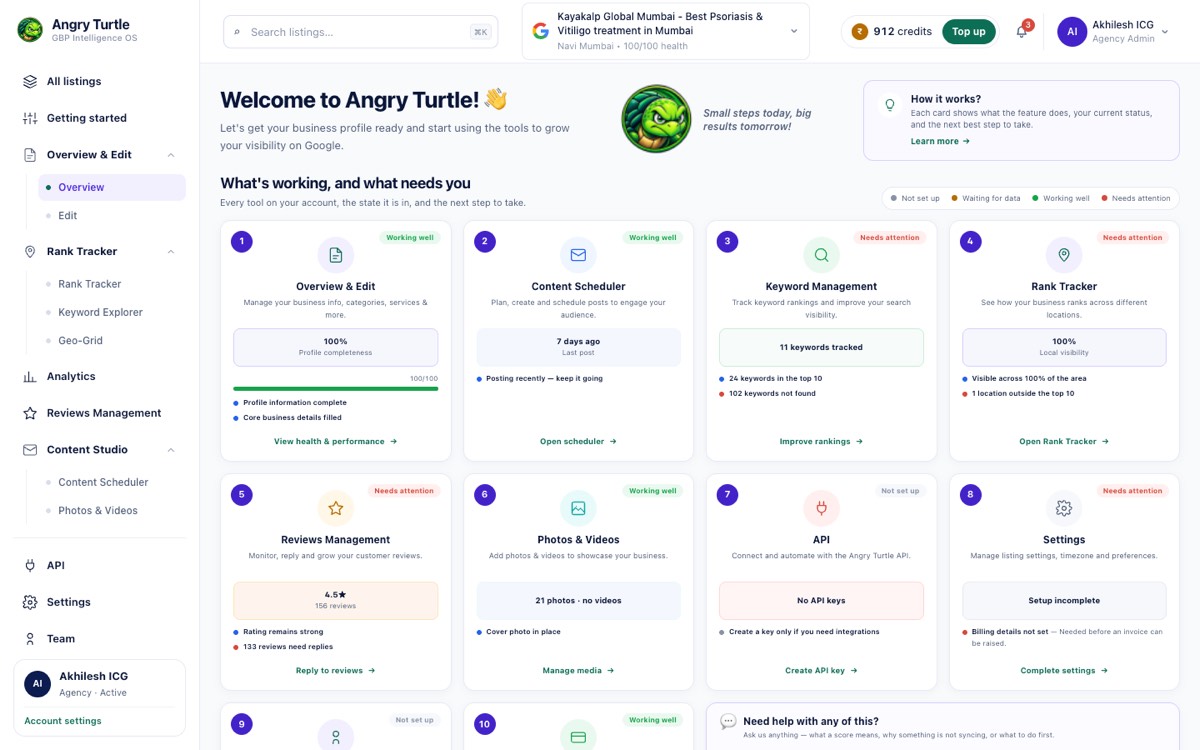

Related reading
Ready to have this run for you?
Book a free audit — we'll show you where you stand in 48 hours.