 Angryturtle
Restaurant SEO in Bangalore
The delivery-platform layer versus the Google listing, menu and hours accuracy, and review response, for restaurants, cafes and cloud kitchens in Bangalore.
·
Bangalore's early closing rules put a hard ceiling on how a restaurant plans its evening, and a Google listing that doesn't reflect that ceiling accurately sends a diner out the door at 10pm for a kitchen that's already shutting down. That single quirk, licensed hours ending earlier here than in most Indian metros, changes enough about restaurant SEO in Bangalore that a template built for Mumbai or Delhi genuinely doesn't transfer. This page covers what restaurant SEO services in Bangalore actually need to include, and what to expect from a restaurant SEO agency in Bangalore that has worked this market versus a restaurant SEO company in Bangalore running a national playbook with the city name changed.
Layout, block, cross and main: Bangalore's addressing hits food search hardest
Bangalore's cross-main-block addressing convention causes more damage to restaurant discovery than to almost any other business category, because a hungry diner comparing three venues on the same road, at night, with limited patience, picks whichever pin actually matches where they're standing rather than waiting for a wrong one to sort itself out. A missing cross number in Indiranagar's numbered grid, or a Koramangala address that leaves out the block, can put a listing's pin several hundred metres from the actual door. In a category where the decision window is measured in seconds, that's often the whole game.
MG Road and Brigade Road addresses read closer to conventional street addressing, but the sheer density of venues packed into a short stretch there means even a technically correct address leaves three or four eligible destinations inside the same pin radius, which is where a clear entrance photo, not the address text, actually resolves the ambiguity for someone standing on the pavement.
Indiranagar, Koramangala and Whitefield are three different dinner decisions
Whitefield's food search runs on a lunch-hour, tech-park-anchored pattern: "quick," "buffet," "near [tech park name]," from a working crowd on a fixed break choosing fast. Indiranagar's runs on an evening leisure pattern instead, "rooftop," "live music," "best cocktails" from a crowd choosing where to spend the next three hours, not the next twenty minutes. A restaurant group running the same profile description across outlets in both areas is writing for a customer that exists in neither.
Koramangala complicates this further with its own block numbering, where a 5th Block search and a 1st Block search for the same cuisine category can return genuinely different result sets, since the two are a real drive apart even though they share one neighbourhood name on paper. A restaurant that lists only "Koramangala, Bangalore" without its block number is competing in the wrong pool for a meaningful share of the searches that should find it.
The Zomato and Swiggy layer, and how it fights the Google listing
A large share of Bangalore's dining discovery, particularly across the Koramangala and Indiranagar scene, routes through Zomato or Swiggy before a diner ever opens Google Maps, and that platform-native habit runs deeper here than in most other Indian cities given how young and how tech-comfortable the city's core dining audience skews. Each platform carries its own review pool, its own menu, and its own hours, none of which sync automatically with what's live on Google. Many of the same diners who order through an app still type something like "best rooftop restaurant Bangalore" or "hotels near MG Road" into Google first, to confirm a place is real before committing, and they return to Google rather than the delivery app when deciding about a repeat visit.
A name that reads "Byg Brewski Brewing Company" on Zomato and something subtly different on Google, or a phone number on Swiggy that rings a disconnected line, is a small but real credibility gap that costs orders quietly. NAP consistency across the citation layer needs checking against all three on a schedule, not just after a customer complains.
Cloud kitchens sharing one address
Bangalore's cloud kitchen density, concentrated around the delivery-heavy pockets near Koramangala, HSR Layout and the Whitefield-Marathahalli corridor, runs into the same problem it does in every dense Indian market: several delivery-only brands operating from one kitchen, each wanting its own Google Business Profile at an identical address. Google's own systems treat multiple businesses sharing a single location as a possible spam pattern, since that's also how illegitimate address-stuffing listings get built, and a genuine multi-brand kitchen has to actively prove it isn't one.
Each brand needs its own FSSAI registration reflected in its listing, a phone number that actually routes to that brand's order line rather than one shared kitchen number, and photography specific to that brand's food and packaging instead of a single reused kitchen shot across every profile at the address. Skip this and the risk isn't a ranking dip, it's a suspension review that can leave a brand with no visible Google presence for weeks while the kitchen keeps operating. Duplicate listing cleanup covers the general mechanics; the goal for a shared-kitchen operator is proving four listings at one address are four real, distinct businesses rather than one gaming the map.
Kannada and Hinglish in the same search box
Bangalore's food search mixes Kannada, English and Hinglish, and which one dominates depends heavily on category and area. A neighbourhood darshini or a tiffin place in Jayanagar or JP Nagar sees a real share of Kannada-transliterated queries alongside English ones. A café or cocktail bar in Koramangala, serving a largely non-Kannadiga tech workforce, sees almost none of that. Category and services fields in a GBP listing match regardless of query language, so nothing changes there, but a business description and FAQ content written entirely in polished English leaves a meaningful slice of real local demand unanswered, particularly for the more residential, less tech-corridor-adjacent parts of the city.
Menu, attributes, and what gets filtered on here
An outdated menu on a Google listing does real damage in a city with this much dining turnover; a customer who orders based on GBP menu information and finds it wrong at the table leaves annoyed and reviews accordingly. Attribute accuracy matters more than the address text implies: outdoor seating (genuinely relevant across Bangalore's more temperate climate, more so than in most Indian cities), dine-in versus delivery-only, alcohol service, and vegetarian flags all function as real search filters rather than nice-to-have detail. A cloud kitchen that shifted from a dine-in concept to delivery-only and never unchecked "dine-in" is misleading the exact filter a customer used to find it.
Photos that solve Bangalore's density problem
Dish photography drives the ordering decision the way it does everywhere, but Bangalore's block-cross-main density gives entrance and storefront photography a second, practical job: helping a diner standing among three or four eligible venues on the same short MG Road or Brigade Road stretch match what's on their phone to what's actually in front of them. A clear frontage photo resolves ambiguity the address text alone often can't in these denser commercial pockets.
Hours, and the early-closing constraint that shapes everything else
Bangalore's licensing rules cap how late alcohol service can run measurably earlier than in Mumbai or Delhi, and a restaurant's actual last-order and closing times need to reflect that limit accurately rather than a generic late-night hours block copied from a template built for a different city. Getting this wrong sends a diner across a traffic-heavy stretch of the city for a kitchen that's already closing, which produces exactly the kind of one-star review that has nothing to do with the food. Weekend hours in areas like Indiranagar and Koramangala, where demand runs later than the citywide average even within the licensing ceiling, need separate accuracy from weekday hours rather than one blanket schedule.
Review response, split by area and by channel
Review content splits by area in Bangalore more visibly than in most cities: Indiranagar and Koramangala reviews talk about ambience and crowd, Whitefield reviews talk about speed and lunch-hour value, MG Road and Brigade reviews, drawing more first-time visitors, talk more about findability than either. None of that changes the mechanics of responding well, but it does mean a single templated reply script across every outlet in a multi-location group misses the specific thing each area's customers actually complain or praise. Delivery-platform complaints and dine-in complaints need distinct responses too, and daily response beats a monthly batch, since a complaint left unanswered for two weeks reads worse to the next searcher than the original issue did.
Where this isn't the right fit
A single Koramangala or Indiranagar restaurant that's full every night with no plan to open a second outlet doesn't need managed restaurant SEO services in Bangalore. Claim the listing, keep hours accurate against the actual licensing limit, ask regulars for reviews, and that covers most of the value available at that scale. If tables are full but revenue still isn't, that's a pricing, staffing or menu constraint, not a visibility one, and no amount of listing work reaches that deep. This also doesn't extend to Zomato or Swiggy commission structures or their internal ranking systems, which sit entirely outside what a Google Business Profile controls.
What Angryturtle does for Bangalore restaurants
Rank OS scores relevance, review health, freshness, entity authority and AIO readiness against named nearby competitors, corridor by corridor, rather than one averaged city figure. Geo-grid tracking shows rank separately across Indiranagar, Koramangala and Whitefield instead of blending three genuinely different markets into a single misleading number. For groups running outlets across more than one of these corridors, or a cloud kitchen operating several brands from one facility, write-back to Google and managed GBP services keep hours, category and menu updates consistent across every listing at once.
Bangalore's other sectors sit on the Bengaluru hub, and the hospitality-wide method, including the property-versus-café listing decision for hotels with their own dining outlet, is covered on the Bengaluru hospitality page and the hospitality local SEO playbook. The national restaurant local SEO playbook covers category and review fundamentals that apply everywhere, worth reading alongside this page, and cloud kitchen local SEO goes deeper on the shared-kitchen model specifically. Pricing and a demo are the fastest way to see a Rank OS score against real nearby competitors, or get in touch with specifics about a listing.
FAQ
Does it matter whether I search "restaurant SEO Bangalore" or "restaurant SEO Bengaluru"? No. Google resolves both spellings to the same city entity, and category, review and NAP work already covers demand under either name without any separate optimisation.
Why does Bangalore's early closing time matter for a Google listing specifically? Because licensed alcohol service caps out measurably earlier here than in most Indian metros, and a profile showing generic late-night hours copied from a different city's template sends diners out for a kitchen that's already shutting down.
How many Google listings can a cloud kitchen run from one Bangalore address? As many as there are genuinely distinct, separately registered brands, each with its own FSSAI documentation, its own routing phone number, and brand-specific photography. Sharing a kitchen line or reusing photos across profiles is what triggers a spam review.
Do I need to include my block number for a Koramangala restaurant listing? Yes. Koramangala's blocks function close to separate neighbourhoods for search purposes, and a listing without the block number is effectively invisible to searches that include it.
Is restaurant search in Bangalore mostly in English? It depends heavily on area and category. Tech-corridor cafés and cocktail bars skew close to entirely English; neighbourhood eateries in more residential areas like Jayanagar carry a real share of Kannada-transliterated search that an English-only profile misses.
Does Angryturtle manage Zomato or Swiggy listings directly for Bangalore restaurants? No. Work covers the Google Business Profile and the citation ecosystem that stays consistent with what's live on those platforms, not the platform listings or their internal ranking systems.
Stop guessing where you rank locally.
Rank OS scores your Google Business Profile the way Google's local algorithm does — relevance, review health, freshness, entity authority and AIO readiness — and shows you exactly what to fix.
Book a live demo →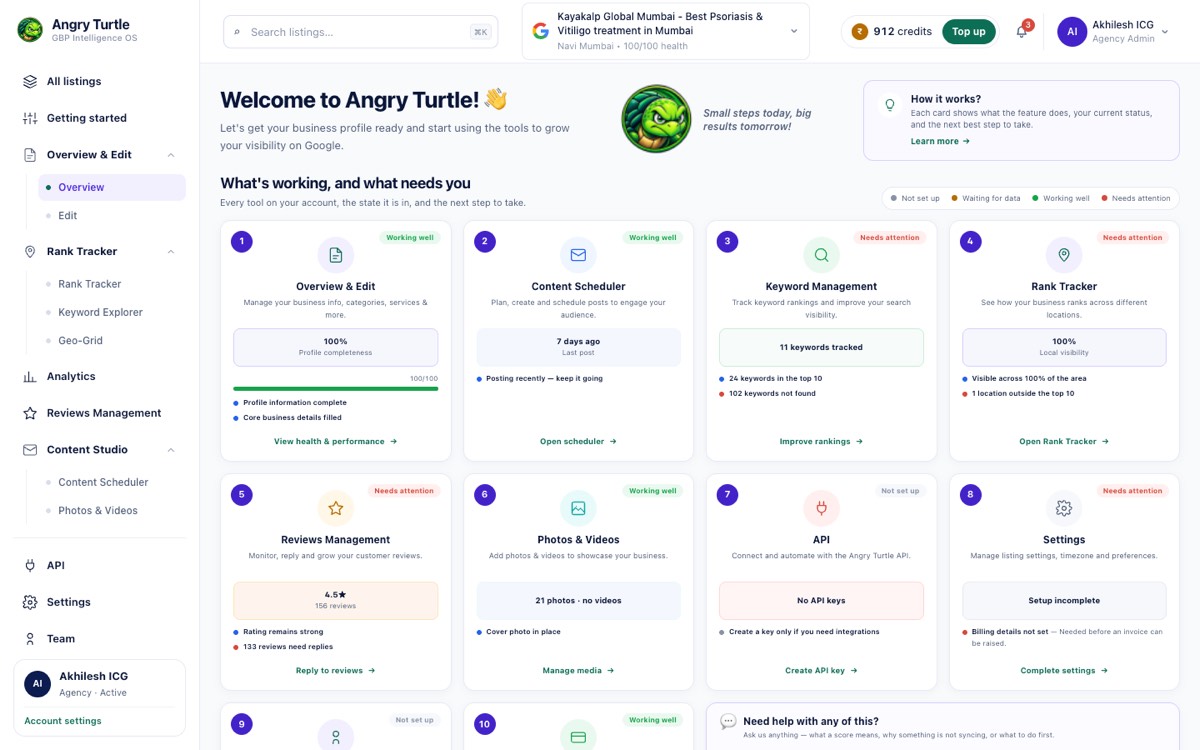

Related reading
Ready to have this run for you?
Book a free audit — we'll show you where you stand in 48 hours.