 Angryturtle
Hospitality Local SEO: A Playbook for Hotels and Restaurants
Managed local SEO for hotels, resorts, restaurants and cafés in India. GBP management, review velocity, multi-outlet operations and monthly rank reporting. Book a free audit.
The Discovery Journey for Diners & Travellers in India
Hospitality is one of the highest-intent local search categories in India. "Best rooftop restaurant in Bandra." "Budget hotels near Connaught Place." "Cafe with wifi in Koramangala." These searches happen on mobile, in real time, with immediate intent to visit or book.
The local pack — the three business listings that appear above organic results on Google Maps — captures the majority of these clicks. A restaurant in position 1 for "Italian restaurant near me" in its neighbourhood receives dramatically more table bookings, calls, and direction requests than the same restaurant in position 4.
Yet hospitality remains inconsistently managed from a local SEO perspective. Hotel chains invest in OTA presence (MakeMyTrip, Goibibo, Booking.com) but neglect GBP. Restaurant groups publish content on Zomato and Swiggy but leave GBP photos outdated. Cafés collect reviews on Google without responding to a single one.
The gap between a well-managed GBP and an average one in hospitality is wider than in almost any other Indian industry — and the return on closing it is measured in tables filled and rooms booked.
GBP for Hotels, Resorts, Restaurants & Cafés
Each hospitality sub-category has specific GBP requirements:
Hotels and resorts:
- Category: "Hotel," "Resort," "Boutique hotel," or "Bed and breakfast" — the correct primary category affects which traveller search queries trigger the listing
- Attributes: star rating, amenities (pool, gym, spa, restaurant, parking, pet-friendly, wedding venue), check-in/check-out times, price range
- Photos: exterior, lobby, room types, pool, restaurant, spa — minimum 30 photos, updated quarterly
- GBP booking link: direct to the hotel's own booking engine (avoiding OTA commission where possible) or MakeMyTrip/Booking.com link
- "Check in" / "Check out" times: fill in these structured fields — they appear directly on Google Search results for hotel queries
Restaurants and cafés:
- Category: "Restaurant," "Café," "Fast food restaurant," "Fine dining restaurant" — subcategory precision matters
- Menu: GBP menu upload is a high-conversion feature. Customers who see the menu in the GBP panel before clicking are higher-intent visitors
- Reservations link: Dineout, EazyDiner, or direct booking integration
- Food ordering link: Swiggy/Zomato integration for delivery (these appear as action buttons in the GBP panel)
- Attributes: outdoor seating, live music, LGBTQ+ friendly, serves alcohol, accepts credit cards, good for groups, good for kids
- Photos: dishes (minimum 20 dish photos), ambience, bar, exterior — updated monthly with new seasonal dishes
Menus, Reservations, Photos & Attributes
The hospitality GBP panel is the most information-dense of any local category. Customers make visit/booking decisions based on what they see in the panel — before they visit the website. Every element that can be filled in, should be.
Menu management: Menus change. Seasonal menus, festival specials, price revisions — GBP menus need to stay current. Angryturtle manages menu updates monthly, ensuring the GBP menu reflects current offerings. An outdated GBP menu showing discontinued items or pre-revision prices damages conversion and generates negative reviews.
Photo management: For restaurants, dish photos are the highest-engagement GBP photo category. User-uploaded photos (which Google accepts without brand approval) are often low quality. Angryturtle manages the photo layer: monthly uploads of professional dish photography (client-provided), flagging and reporting low-quality user-uploaded photos that misrepresent the brand.
Attribute completeness: Google regularly adds new attributes to hospitality GBP categories. We audit attributes quarterly and add any newly available options that apply — these signal relevance for filter-based searches ("restaurants with outdoor seating near me").
Review Velocity & Response at Scale
Reviews are the primary ranking factor and conversion signal in hospitality. A restaurant with 4.5 stars and 800 reviews dominates one with 4.6 stars and 80 reviews — both in rank and in customer trust.
Review generation for hospitality:
- QR code table cards or receipt inserts directing to the Google review page — passive, always-on, and highly effective in restaurant settings
- WhatsApp review request messages sent to repeat customers via the restaurant's CRM or POS customer list
- Post-stay WhatsApp requests for hotel guests (sent 24–48 hours after checkout)
- Zomato and Swiggy delivery order follow-up review requests (platform-managed, but we advise on timing and message)
Review response at scale: For restaurant groups with 5–20 outlets, review response becomes an operational challenge. Angryturtle manages responses across all locations — every review, within 48 hours, with brand-voice templates calibrated for the hospitality tone (warm, personal, never defensive on negative reviews).
Handling negative reviews in hospitality: Negative reviews in restaurants typically fall into: food quality, wait time, staff behaviour, and billing disputes. Our response framework for each category acknowledges the experience, apologises without admitting fault on disputed points, and offers a resolution path (discount on next visit, direct contact for billing concerns) — turning a public complaint into a visible demonstration of service recovery.
Multi-Outlet / Chain Management
Hotel chains and restaurant groups operating 5+ outlets need a different operational model for local SEO:
- Centralised brand profile management: Core brand elements (logo, primary category, description template) are managed centrally, with location-specific customisation (hours, address, local photos, local menu items)
- Outlet-level review management: Each outlet has its own review stream; our team manages all streams simultaneously
- Consolidated reporting: Monthly report rolls up all outlets with individual location performance and brand-level aggregates
- New outlet onboarding: We have a 30-day new-outlet GBP launch process: profile creation, photo upload, category setup, citation building, review pipeline activation
OTA + Local Search Interplay
A common misconception in hospitality marketing is that OTA presence (MakeMyTrip, Goibibo, Booking.com, Agoda) and GBP local search are separate channels. They are not — they interact:
- OTA listings are citation sources. Consistent NAP between GBP and MakeMyTrip/Booking.com profiles strengthens local authority.
- Google increasingly pulls hotel data (pricing, availability, star rating) from OTA feeds and displays it directly in the GBP panel via the "Google Hotel Search" integration. Hotels that have claimed and optimised their GBP control more of this display.
- Direct booking links on GBP (pointing to the hotel's own engine) reduce OTA dependency for customers who discover the hotel on Google first.
Angryturtle manages the local search layer in coordination with existing OTA presence — not in competition with it.
Reporting: Bookings, Calls, Directions
Hospitality local SEO reporting focuses on the actions that precede revenue:
- Direction requests per outlet: Strongest footfall-intent signal
- Calls from GBP: Reservation and enquiry calls directly attributable to local search
- Booking link clicks: Direct booking intent — hotel engine or restaurant reservation link
- Menu views: Engagement signal; high menu views with low calls indicate friction in the conversion path (prompts a menu content review)
- Photo views: Engagement and brand impression volume
- Geo-grid rank per category keyword: "Restaurant in [neighbourhood]," "Hotel near [landmark]," "Cafe with wifi [city]" — tracked and reported monthly
Frequently Asked Questions
Does GBP rank affect Zomato and Swiggy visibility? Not directly — Zomato and Swiggy use their own ranking algorithms. However, a restaurant with strong GBP signals (reviews, completeness, engagement) also tends to perform well on food delivery platforms, as the underlying signals (customer satisfaction, operational consistency) are correlated. We focus on Google Maps and GBP; food delivery platform optimisation is a separate discipline.
We have 12 restaurant outlets — can you manage all of them? Yes. Restaurant groups of this size typically operate on our Growth or Enterprise plan. Each outlet has dedicated management within our centralised team structure. See multi-location plans →
How do you handle the GBP menu update process? We request updated menus from your team monthly (or when you notify us of changes). Menu updates are processed within 2 business days. We handle the upload, formatting, and item categorisation in the GBP menu interface.
How important are photos for restaurant local SEO? Very important. Restaurants with 50+ GBP photos receive significantly more direction requests and calls than those with fewer. Dish photos are the highest-engagement photo type — they appear in the image panel when customers search for the restaurant. We manage monthly photo uploads from your photography library.
What's the best way to generate reviews for a new restaurant opening? For a new opening: QR cards from day one, WhatsApp requests to early-visit customers, and a soft review ask from the floor staff. First 30–50 reviews are the hardest to generate and the most important. We prioritise rapid review generation in the first 60 days of a new outlet onboarding.
Do you manage TripAdvisor and Google as well? Standard scope covers Google reviews. TripAdvisor and Zomato review management are available as add-ons. Ask about multi-platform reputation management during the audit call.
Book a hospitality local SEO audit →
See also: hospitality industry overview for the managed service and what it covers, plus GBP management services, managed local SEO, multi-location local SEO, and book a demo.
A score you can argue with, not a black box
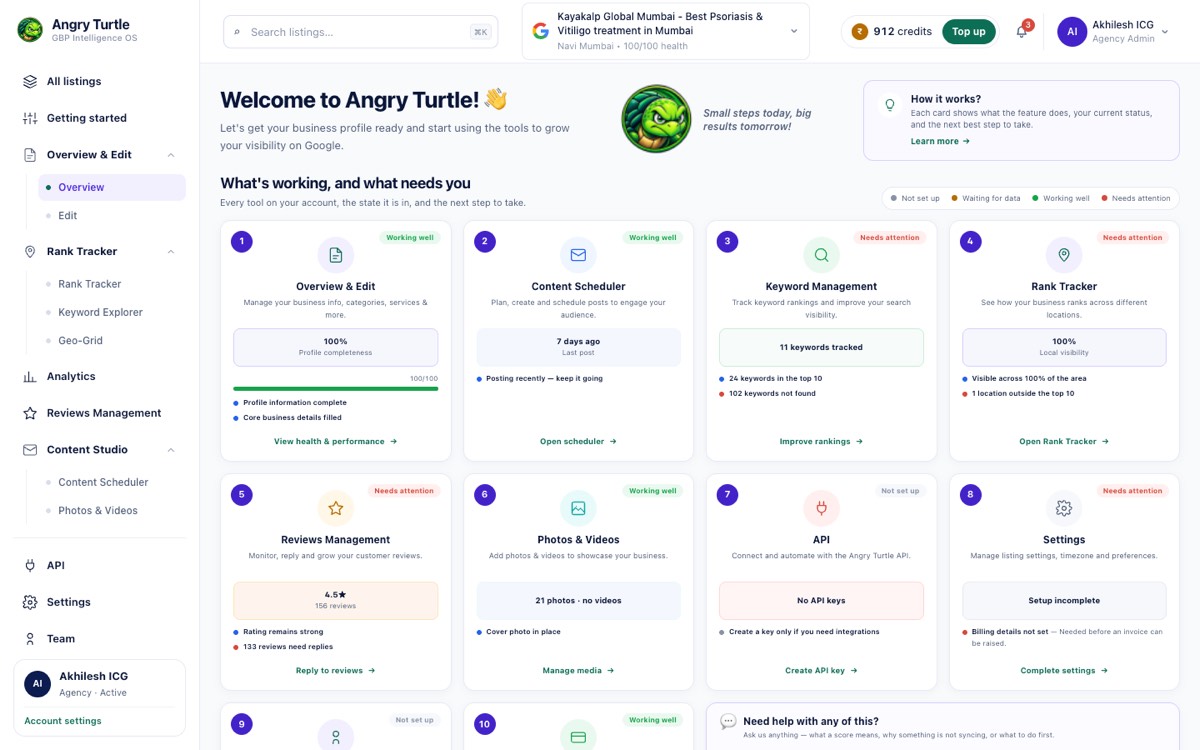
Rank OS gives every profile a 0–100 score built from five weighted dimensions — Relevance, Review Health, Freshness, Entity Authority and AIO Readiness — and the weights are tunable. Underneath it sits a ranked list of the fixes that move the number, each with the point lift it unlocks.
Ready to have this run for you?
Book a free audit — we'll show you where you stand in 48 hours.