 Angryturtle
Answer Engine Optimization for Healthcare Businesses in India
AEO for healthcare in India means building AI search visibility across Google AI Overviews, ChatGPT, Perplexity, and Gemini for category queries ("best dermatologist in [city]"), service queries ("IVF clinic with good success rates"), and informational queries ("how much does a root canal cost in Mumbai"). The primary levers are Google reviews above category threshold, complete GBP with medical category precision, MedicalClinic schema, Practo presence, and NMC-compliant FAQ content.
Why AI Search Matters More in Healthcare Than Any Other Category
Healthcare is India's highest-stakes local search category. A patient choosing a dermatologist, IVF clinic, or orthopaedic surgeon is making a decision that will affect their health outcomes, their finances, and potentially their family.
These patients research extensively before deciding. In 2025–2026, an increasing proportion of that research happens via AI assistants — asking ChatGPT "which IVF clinic in Bengaluru has good reviews," asking Gemini "best dermatologist for acne near Koramangala," or asking Perplexity "how much does laser hair removal cost in Mumbai."
AI citations in healthcare are not just digital marketing — they are trust signals that influence life decisions. A healthcare business that earns consistent, accurate, authoritative AI citations is not just winning marketing; it is becoming a trusted recommendation in the most trusted channel available.
The Healthcare AI Search Landscape in India
Primary AI systems used by Indian healthcare consumers:
Google AI Overviews — triggered for "best [specialty] in [city]" and "highly rated [clinic type] near me" queries. Draws directly from GBP data and indexed web content.
Gemini — accessed via Google app and increasingly via Google Search. Has privileged access to GBP, Google Maps, and YouTube. Healthcare video content on YouTube is an emerging Gemini citation pathway.
ChatGPT (with browsing) — browses Practo (the dominant healthcare AI source for India), JustDial, and clinic websites. Heavy usage among tech-adjacent urban Indian healthcare consumers.
Perplexity — crawls live sources in real-time. Practo pages dominate Perplexity's healthcare citations for Indian queries.
Most-cited AI sources for Indian healthcare:
- Practo (highest DA healthcare directory — primary source for ChatGPT and Perplexity)
- Google Maps / GBP (primary source for AI Overviews and Gemini)
- Lybrate, 1mg (secondary healthcare directories)
- Clinic/hospital websites (when ranking in local search)
- Times of India Health, NDTV Doctor (for informational AI citations)
The DCG Framework for Healthcare AEO
Diagnosis — Audit your current AI search state:
Before investing in schema or content, diagnose the actual gaps. For most Indian healthcare businesses, the primary AEO gap is a review profile that's weak relative to whoever is currently winning the local pack and the AI citations in that specialty and city — not a fixed number missed. Investing in schema before fixing reviews is the wrong sequence.
The 6-pillar AI Search Readiness Audit (see AI Search Readiness Audit →) gives a quantified AIO Readiness Score across Entity, Schema, Reviews, Content, Citations, and Crawlability.
Cost Optimization — Fix gaps in priority order:
Priority 1: GBP verification and category precision. "Dermatologist" not "Doctor." "IVF Clinic" not "Medical Center." Category precision is free and delivers immediate AI eligibility improvement.
Priority 2: Review count relative to the local competitive set. There's no published number that unlocks AI citation. What matters is standing: search your specialty and city in AI Overviews, ChatGPT, and Perplexity, note the review counts of whoever gets named, and treat that as your working target. In a dense metro category (dermatology, IVF, dentistry in Mumbai, Bengaluru, Delhi) that bar sits much higher than in a Tier 2 market with a thinner field.
Priority 3: Practo profile completion. Credentials, fees, services, patient reviews on Practo. This is the primary ChatGPT and Perplexity healthcare citation source.
Priority 4: MedicalClinic schema with medicalSpecialty and MedicalProcedure entries. Formalises the entity declaration that GBP provides in an AI-browseable website context.
Growth — Build ongoing AI citation signals:
Monthly: 10–20 new Google reviews, 2–4 GBP posts, Practo review accumulation.
Quarterly: New FAQ content targeting recent informational health queries, schema audit, NAP consistency check.
Annually: Full content refresh, competitive SAV benchmarking, pillar page reviews.
Healthcare-Specific AEO Requirements
NMC Compliance in AI-Citable Content
The Medical Council of India's advertising guidelines (applicable through NMC Act provisions) restrict healthcare advertising that makes specific outcome claims, uses patient testimonials implying guaranteed results, or makes comparative claims without substantiation.
Every piece of AI-citable healthcare content must be NMC-compliant:
✅ Compliant: "Most patients undergoing laser acne scar treatment see significant improvement after 3–5 sessions, depending on scar depth and skin type." ❌ Non-compliant: "We guarantee acne scar removal in 3 sessions."
✅ Compliant: "Our team of 3 board-certified dermatologists has been practising in Koramangala since 2016." ❌ Non-compliant: "Bengaluru's best and most award-winning dermatology team."
Include "NMC Section 6 compliance" awareness in all healthcare content production workflows.
Practo as the Primary B2C Healthcare AI Source
For healthcare businesses, Practo is as important as GBP for AI citations. Here's the strategic Practo framework:
Individual doctor profiles — each specialist at the clinic has their own Practo profile with: full credential string (MBBS, MD, subspecialty), years of experience, primary specialisation, secondary specialisations, consultation fee, clinic address (matching GBP exactly).
Clinic profile — separate from individual doctors, covering: all available services, clinic hours, location, facilities, and fee range.
Reviews on both — build Practo reviews alongside Google reviews. Both profiles should be competitive with the other clinics AI systems are actually citing in the same specialty and city, not just present.
Healthcare FAQ Content — The Highest AI Citation Opportunity
Healthcare informational queries are extremely high-frequency AI search queries. Patients ask AI systems:
"How much does [procedure] cost in [city]?" — ₹ range answers "How many sessions does [treatment] take?" — specific timeline answers "Is [procedure] safe for Indian skin types?" — specific evidence-based answers "What's the difference between [option A] and [option B]?" — comparison answers
Each of these query types is best served by dedicated FAQ pages with FAQPage schema, answer capsules, and specific, evidence-based answers written in customer language.
Healthcare Sub-Category AEO Matrix
| Specialty | Primary GBP Category | Review Signal Note | Primary Non-GBP AI Source |
|---|---|---|---|
| Dermatology | Dermatologist | Metro categories are dense — check the top 3 in your city before setting a target | Practo |
| IVF/Fertility | Fertility Clinic | Metro categories are dense — check the top 3 in your city before setting a target | Practo |
| Dentistry | Dentist | Competitive in most cities — benchmark against local top 3 | Practo, JustDial |
| Orthopaedics | Orthopedic Clinic | Benchmark against local top 3 | Practo |
| Ophthalmology | Eye Care Center | Benchmark against local top 3 | Practo |
| Cardiology | Cardiologist | Generally less crowded than dermatology/IVF — check local top 3 | Practo |
| Gynaecology | Gynecologist | Generally less crowded — check local top 3 | Practo |
| Oncology | Cancer Treatment Center | Generally less crowded — check local top 3 | Practo, Hospital website |
| Paediatrics | Pediatrician | Competitive in most cities — benchmark against local top 3 | Practo, JustDial |
| General Practice | General Practitioner | Usually the least crowded category — check local top 3 | JustDial, Practo |
Measuring Healthcare AEO Success
Primary KPI — Share of AI Voice (SAV): Define a 25-query prompt set covering your specialty and geography. Include recommendation queries, service-specific queries, and informational queries. Track SAV monthly across all four AI engines.
Secondary KPIs:
- Monthly new Google reviews vs target velocity
- Practo profile completeness score (Practo's own metric)
- AI-referred sessions in GA4 (chatgpt.com, perplexity.ai, gemini referrals)
- Branded search volume in GSC (proxy for AI-assisted brand discovery)
- GBP call volume (correlated with AI Overview citations for local recommendation queries)
FAQ Section
Q: Is AEO for healthcare different from regular SEO? A: The foundation is the same — entity authority, content quality, review signals. AEO adds: structured data (FAQPage, MedicalClinic schema), direct answer formatting (answer capsules), AI bot access configuration, and Share of AI Voice measurement. Healthcare AEO also requires NMC compliance review on all AI-citable content.
Q: Does AI search replace Practo for healthcare discovery in India? A: No — they work together. Practo is increasingly a source that AI systems cite, not a competing channel. A healthcare business with a strong Practo presence is more AI-citable, not less. The growth trajectory: AI search becomes more prominent while Practo remains a primary source that AI systems browse.
Q: How do hospital chains manage AI search across 20+ facilities? A: Per-location AI management is required. Each facility needs independent GBP management, review building, and Practo profiles for each specialist. Central brand authority (press, accreditations, website) supports all locations, but local AI citations are earned location by location.
Q: What is the healthcare AEO budget range? A: For a single-location specialty clinic in a metro: ₹15,000–35,000/month for managed AEO (GBP management, review generation, content production, schema, tracking). For multi-location hospital networks: ₹50,000–2,00,000/month depending on location count and competitive intensity.
Get healthcare AEO from Angryturtle →
Internal links: Healthcare Local SEO · GBP AI Optimization · AEO Services · AI Search Readiness Audit · MedicalClinic Schema glossary
Healthcare & AI Search — Questions Answered
Q1. How do I get my clinic cited in Google AI Overviews for "best doctor near me"?
Answer capsule: To get your clinic cited in AI Overviews for "best doctor near me": build Google reviews to a level that's competitive with the clinics currently getting cited in your specialty and city, use the most specific GBP category ("Dermatologist" not "Doctor"), complete Practo profile with credentials and fees, and implement MedicalClinic schema on your website location page.
Expanded answer: The "best doctor near me" AI Overview citation has three sequential requirements:
First, a competitive review profile. AI systems treat review count and recency as a legitimacy signal for "best" recommendation queries, weighed against whoever else is currently ranking for that specialty and city. There's no published number that guarantees citation — the working method is to search the query yourself, see who's cited, and check their review count against your own.
Second, category precision. GBP primary category must match the specialty precisely. "Dermatologist" matches "best dermatologist" queries. "Doctor" or "Medical Center" doesn't. If your category is too broad, update it to the most specific applicable Google category.
Third, local pack presence. AI Overviews for local healthcare queries frequently draw from local pack results. Getting into the top 3 local pack for your target category + area query is the strongest predictor of AI Overview citation.
Schema (MedicalClinic with medicalSpecialty) and Practo presence amplify citation probability once the above three conditions are met.
→ See How to Optimize GBP for AI Overviews
Q2. How many Practo reviews does a clinic need for AI citations?
Answer capsule: There's no published Practo review number that guarantees AI citation. What matters is Practo review volume relative to the other clinics AI systems are actually citing for your specialty and city — a Practo profile with a thin review history behind well-reviewed competitors contributes less to ChatGPT and Perplexity citations, even if the clinic has strong Google reviews.
Expanded answer: Practo reviews operate separately from Google reviews for AI citation purposes. When ChatGPT or Perplexity browses "best dermatologist in Bengaluru" and crawls the Practo results page, it reads the Practo-specific ratings and reviews for listed clinics — not the Google review data.
A clinic with 200 Google reviews but 5 Practo reviews presents a very different entity profile on Practo than one with 200 Google reviews and 80 Practo reviews.
For Indian healthcare businesses, the recommended approach: build Google reviews first, benchmarked against your local top 3, then build Practo reviews simultaneously as the secondary priority. Request Practo reviews from patients who discovered the clinic via Practo — this is the most natural and highest-conversion Practo review trigger.
→ See Practo AI Recommendations
Q3. What should I put in a healthcare GBP description for AI extraction?
Answer capsule: A healthcare GBP description for AI extraction should open with: "[Clinic Name] is a [specific specialty] clinic in [specific area], [city]." Follow with 3 specific services, one credibility fact (NABH certification, board-certified team, years in operation), and one access note (appointment availability, booking method). Avoid generic marketing language throughout.
Expanded answer: The GBP description's primary purpose for AI is entity definition — declaring precisely what this entity is. The AI system extracting this description will cite the first 1–2 sentences as its primary entity characterisation.
Healthcare description template: "[Clinic Name] is a [dermatology/IVF/dental] clinic in [specific area], [city], established in [year]. We specialise in [Service 1], [Service 2], and [Service 3]. Our team of [N] board-certified [specialists] holds [specific credentials]. NABH-certified facility. Appointments available [days/hours] via [booking method]."
What to remove: "We are dedicated to providing compassionate, patient-centred care..." — this contains no AI-extractable information.
NMC compliance: No outcome claims. No comparative superlatives. Factual credentials and factual service descriptions only.
→ See How to Write GBP Description for AI
Q4. Does NMC compliance limit AI search visibility for healthcare?
Answer capsule: NMC compliance limits the type of content that can be AI-cited but doesn't limit AI search visibility overall. Compliant content (factual credentials, service descriptions, process explanations, cost ranges) is fully AI-citable. Non-compliant content (outcome claims, testimonials implying guaranteed results) should be avoided regardless — it creates regulatory risk without proportional AI citation benefit.
Expanded answer: The most valuable AI-citable healthcare content is also the most NMC-compliant: factual information that genuinely helps patients make decisions.
"Our dermatology team includes 3 MD-qualified dermatologists with subspecialty training in acne and laser procedures" — NMC compliant AND highly AI-citable (specific credentials).
"Laser hair removal at our clinic uses Diode laser technology, requiring 6–8 sessions for most patients. Individual results vary based on hair type and skin tone." — NMC compliant AND highly AI-citable (specific process, honest caveat).
The content that's NMC non-compliant ("We cure acne in 4 sessions") is also poor AI content — it's a claim without substantiation that AI systems can't verify and may not cite confidently.
Compliance and good AEO practice are aligned, not competing, for healthcare.
Q5. How do multi-specialty hospitals do AEO differently from single-specialty clinics?
Answer capsule: Multi-specialty hospitals do AEO at two levels: hospital-level (brand entity, general reputation, bed count, accreditations) and department-level (each specialty as a separate entity with its own Practo doctors, specialty-specific FAQ content, and sub-category GBP attributes). Department-level AEO is where most multi-specialty hospital AI citations are actually won.
Expanded answer: A multi-specialty hospital's AI search presence is the sum of its department-level presences. When a patient asks "best cardiology department near me," the hospital's overall brand reputation helps, but the cardiology department's specific signals — cardiologists on Practo with credentials, cardiology-specific FAQ content, cardiology-specific reviews — are what earn the AI citation.
Multi-specialty hospital AEO framework:
Hospital level:
- Main GBP with Hospital category
- Overall review count building (all departments contribute)
- Accreditations prominently listed (NABH, JCI, NABL)
- Hospital website with hospital-level entity schema
Department level:
- Individual doctor Practo profiles per specialty (cardiologist, orthopaedic, gynaecologist)
- Specialty-specific landing pages with department FAQ content
- Department-specific review building (direct cardiac patients to review the cardiology department)
Q6. Is the review bar for healthcare AI citation the same in every Indian city?
Answer capsule: No — there's no fixed threshold, published or otherwise. What matters is your review count relative to the businesses AI systems are actually citing in your specialty and city. In dense metro categories, the bar the top few competitors have set is simply much higher than in a Tier 2 city with a thinner field, so a review count that would dominate in one market barely registers in another.
Expanded answer: Tier 2 healthcare AI search is an opportunity that many local businesses are missing. Here's why:
In Bengaluru or Mumbai, a dermatology clinic is competing with several well-reviewed rivals, and the AI citation competition is intense.
In a Tier 2 city like Indore, a dermatology clinic with a comparatively modest review count may already be among the most-reviewed dermatologists in the city. AI systems citing the most established, well-reviewed healthcare entities in a local market will consistently recommend the better-reviewed clinic over less-reviewed competitors, regardless of what the absolute number is.
Tier 2 healthcare AEO strategy: Check the review counts of the top 3 dermatology clinics actually cited for your city, set your target above that, complete GBP and Practo, publish 3–5 specialty FAQ pages. This is a comprehensive AEO program that positions the clinic as the dominant AI-cited healthcare entity in its specialty and city.
→ See AI Search Readiness Audit
Q7. Should healthcare businesses allow AI crawlers to access their website?
Answer capsule: Yes — healthcare businesses should allow major AI crawlers (GPTBot, PerplexityBot, Google-Extended) to access their website. Blocking AI crawlers prevents AI systems from reading and citing your website content. The only content that should be protected from crawlers is genuinely private patient information — which should be behind authentication walls (login-required pages), not blocked by robots.txt.
Expanded answer: A common healthcare IT mistake: blocking all crawlers in robots.txt as a general security measure. This blocks AI systems from accessing the public website content that should be AI-citable.
The correct approach:
- Public website pages (service descriptions, FAQ, About, team pages): ALLOW all crawlers
- Patient portal (behind authentication): automatically inaccessible to crawlers (login required)
- No need to block via robots.txt what is already behind authentication
robots.txt addition:
User-agent: GPTBot
Allow: /

User-agent: PerplexityBot
Allow: /

User-agent: Google-Extended
Allow: /
This simple addition opens the public website to AI citation while maintaining security of authenticated patient data.
Q8. How do I optimise for "doctor with online consultation near me" AI queries?
Answer capsule: Optimise for "doctor with online consultation near me" AI queries by: enabling the "Online care" or "Teleconsultation" attribute in GBP, seeding GBP Q&A with "Q: Do you offer online consultations? A: Yes — teleconsultations available [days/hours] via [platform]. Book at [link]," listing teleconsultation as a specific GBP service, and adding an FAQ answer to your website: "Does [Clinic Name] offer teleconsultation?"
Expanded answer: "Online consultation near me" is a query type with a structural oddity — "near me" is typically proximity-based, but online consultation has no proximity requirement. AI systems handle this by interpreting the query as "doctor in my general area who also offers online options" — maintaining the local entity focus while adding the online attribute filter.
Three-step optimisation:
Step 1 — GBP attribute: Enable "Online appointments" (or "Teleconsultation" — exact attribute name depends on GBP category). This is the primary attribute signal for AI systems answering this query.
Step 2 — GBP Q&A: Seed and answer the question about teleconsultation availability. Specific details: platform (Practo video, Zoom, WhatsApp video call), days and hours available, fee for online vs in-person.
Step 3 — Practo online consultation: Enable Practo's online consultation feature. This creates a specific attribute on the Practo profile — "Online Consultation Available" — that AI systems read when browsing Practo for online consultation queries.
Q9. How should healthcare businesses handle negative AI citations?
Answer capsule: Handle negative AI citations (AI systems describing your clinic with negative framing based on reviews or content) by: identifying the source (which review platform, which page is generating the negative framing), addressing the underlying service issues, building positive review velocity to dilute negative sentiment, and — for factually incorrect AI descriptions — updating the source content and submitting correction requests.
Expanded answer: Negative AI citations arise from two sources:
Negative review patterns: If AI systems browsing Practo or Google reviews consistently find negative themes ("long wait times," "doctor was rushed"), these themes get extracted as entity characteristics. The AI may describe your clinic as having "mixed reviews with some patients noting long wait times."
Fix: Address the operational issue (actual wait times). Generate positive reviews that mention positive appointment management. Respond professionally to negative reviews addressing the specific complaint.
Outdated or incorrect source content: AI may cite an old article, outdated JustDial listing, or incorrect information from a directory with old data.
Fix: Update the incorrect source. If an article has factually wrong information, contact the publisher for correction. If a directory listing is wrong, update it.
What not to do: Don't try to "suppress" AI citations by creating large volumes of promotional content. This doesn't work and may be perceived as manipulation. Address the source of the negative framing at its root.
→ See Fix Wrong Business Information in ChatGPT
Q10. What is the ROI timeline for healthcare AEO investment?
Answer capsule: Healthcare AEO ROI timeline: 60–90 days to see initial AI Overview citations as review standing improves relative to local competitors; 90–120 days to see AI-referred sessions in GA4; 4–6 months for measurable Share of AI Voice improvement; 6–12 months for full compounding benefit where AI citations consistently drive new patient acquisition. Healthcare AEO is a 12-month investment with increasing returns.
Expanded answer: The healthcare AEO ROI timeline follows a predictable curve:
Month 1–2 (Diagnosis and Foundation): Review building initiated. GBP optimised. Schema implemented. No visible AI citations yet for most clinics starting behind their local competitive set.
Month 3–4 (Competitive parity): If review building is effective, the clinic closes the gap with the businesses currently getting cited. First AI Overview citations appear for "best [specialty] near me" queries. First measurable AI-referred sessions in GA4.
Month 4–6 (Citation normalisation): AI citations become consistent. Perplexity and ChatGPT citations supplement AI Overview citations. Branded search in GSC starts increasing (users seeing AI citations then searching the clinic name directly).
Month 6–12 (Compounding growth): Review count and quality now lead the local competitive set — quality of AI citation description improves (AI has more review content to extract). FAQ content maturing — informational AI citations supplement recommendation citations. New patient acquisition surveys start attributing 5–15% of new patients to AI discovery.
Full ROI measurement at 12 months: compare total AI-attributable new patient acquisition against AEO investment.
A score you can argue with, not a black box
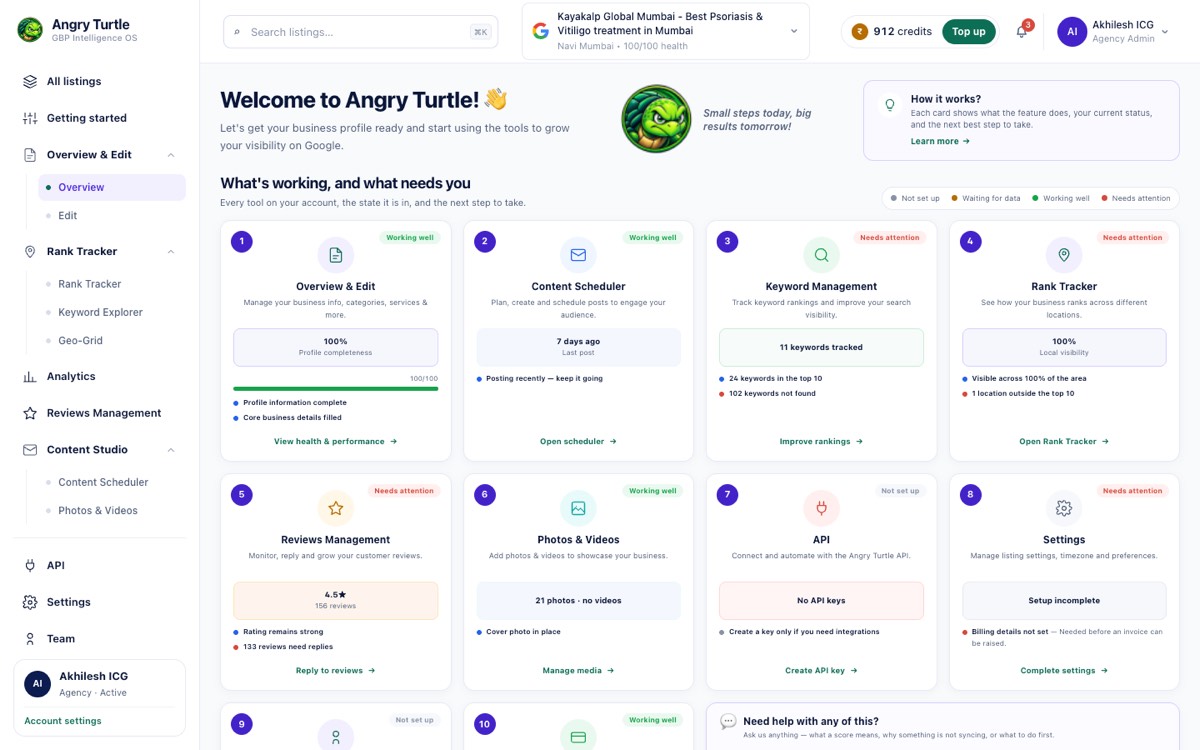
Rank OS gives every profile a 0–100 score built from five weighted dimensions — Relevance, Review Health, Freshness, Entity Authority and AIO Readiness — and the weights are tunable. Underneath it sits a ranked list of the fixes that move the number, each with the point lift it unlocks.
Ready to have this run for you?
Book a free audit — we'll show you where you stand in 48 hours.