 Angryturtle
Pin accuracy is how closely the map marker Google places for a business on Google Maps matches the business's actual physical location, and it's a separate thing from the text address field on the profile. The two can disagree — a listing can show a perfectly correct written address while the pin itself sits on the wrong building, the wrong side of a road, or an entirely different block, and Google treats the pin as the location signal that actually drives distance-based ranking.
Why the pin and the address diverge
Google places the pin using its own geocoding process, which converts the entered address into map coordinates by matching it against Google's underlying map data. That match isn't always precise, especially in areas where Google's map data is incomplete or where the address format doesn't map cleanly onto how the location is actually structured — a shop inside a large mixed-use complex, a unit number within a building Google's map data hasn't fully resolved, or a location on a road Google's data associates with a slightly different segment than the actual building sits on. The address field, by contrast, is just text the business entered and Google displays as-is; it doesn't get re-verified against the pin's actual coordinates unless someone manually checks.
A business owner reading only the text address on their own profile has no way to tell the pin is wrong without separately opening the map view and checking where the marker actually sits.
Why pin accuracy matters for ranking
Distance is one of Google's three named local ranking factors, and distance is calculated from the pin's coordinates, not from the text address. A pin sitting even a few hundred metres off, on the wrong side of a busy road or in the wrong section of a large complex, can measurably change which searches the business is treated as being close enough to compete for, particularly in dense areas where being on the correct side of a specific street affects a searcher's genuine walking distance. This connects directly to proximity → as a ranking pillar and to the broader local ranking factors → model, where an inaccurate pin quietly undermines a signal the business otherwise has no reason to think is wrong.
Pin placement also affects the customer-facing "directions" experience directly — a searcher who taps directions to a mis-pinned location gets routed to the wrong building or the wrong side of the road, which is a bad first impression regardless of what the ranking impact turns out to be.
How to check and fix pin accuracy
Checking requires opening the business's actual Maps listing, not just the dashboard's text address field, and visually confirming the pin sits on the correct building. If it doesn't, Google allows the business owner to drag the pin to the correct location directly within the GBP dashboard's map editor, a change that typically takes effect faster than most other profile edits since it doesn't require re-verification in most cases. For businesses inside large complexes or buildings Google's map data doesn't clearly delineate, adding more specific address detail — floor, unit, or landmark information in the address lines — sometimes helps Google's geocoding resolve the location more precisely on future updates, though it doesn't retroactively move an already-placed pin.
Common mistakes
Assuming a correct text address guarantees a correct pin is the most common and most consequential mistake, since the two are checked and set through entirely separate mechanisms and nothing in the dashboard actively warns an owner when they've drifted apart. A second is fixing the pin once after a relocation but forgetting that the original, pre-move pin sometimes persists on an old, unmerged duplicate listing, discussed further under duplicate listings → — a customer searching can be routed to either the corrected new pin or the stale old one depending on which listing Google surfaces. A third, specific to multi-location businesses →, is checking pin accuracy for the flagship location only and assuming other branches were geocoded with the same accuracy, when each address was independently processed by Google's geocoder and can carry its own separate error.
India-specific note
Pin inaccuracy is a materially bigger problem in India than in markets with more standardised address systems, because Google's underlying map and address data is less complete in many Indian cities, particularly for newer developments, mixed-use complexes, and areas without formal postal addressing. A business in a large commercial complex with dozens of similarly-addressed units is a common case where the geocoder places the pin somewhere in the general vicinity of the complex rather than on the specific unit, and manual pin correction, checked directly against the map rather than assumed correct, is often the only reliable fix.
FAQ
Can a business fix a wrong pin location itself? Yes, in most cases the owner can drag the pin to the correct spot directly within the GBP dashboard's map editor without needing to go through re-verification.
Does a wrong pin affect ranking even if the written address is correct? Yes. Distance in Google's local ranking model is calculated from the pin's coordinates, not the text address field, so a mis-pinned location can be measured as further from a searcher than it actually is even with a perfectly accurate written address.
Why would Google place the pin incorrectly in the first place? It's usually a geocoding limitation — Google's map data for the specific address didn't resolve precisely, which happens more often in areas with incomplete map data, large mixed-use complexes, or non-standard address formats.
Related terms: Proximity → · Local ranking factors → · Duplicate listings → · GBP verification → · Service area business → · Map pack → · Multi-location SEO → · Geo-grid →
How Angryturtle handles this: GBP management services → checks pin placement against actual premises location as part of profile setup and ongoing audits, rather than assuming a correct written address means a correct map location.
Related glossary terms
A score you can argue with, not a black box
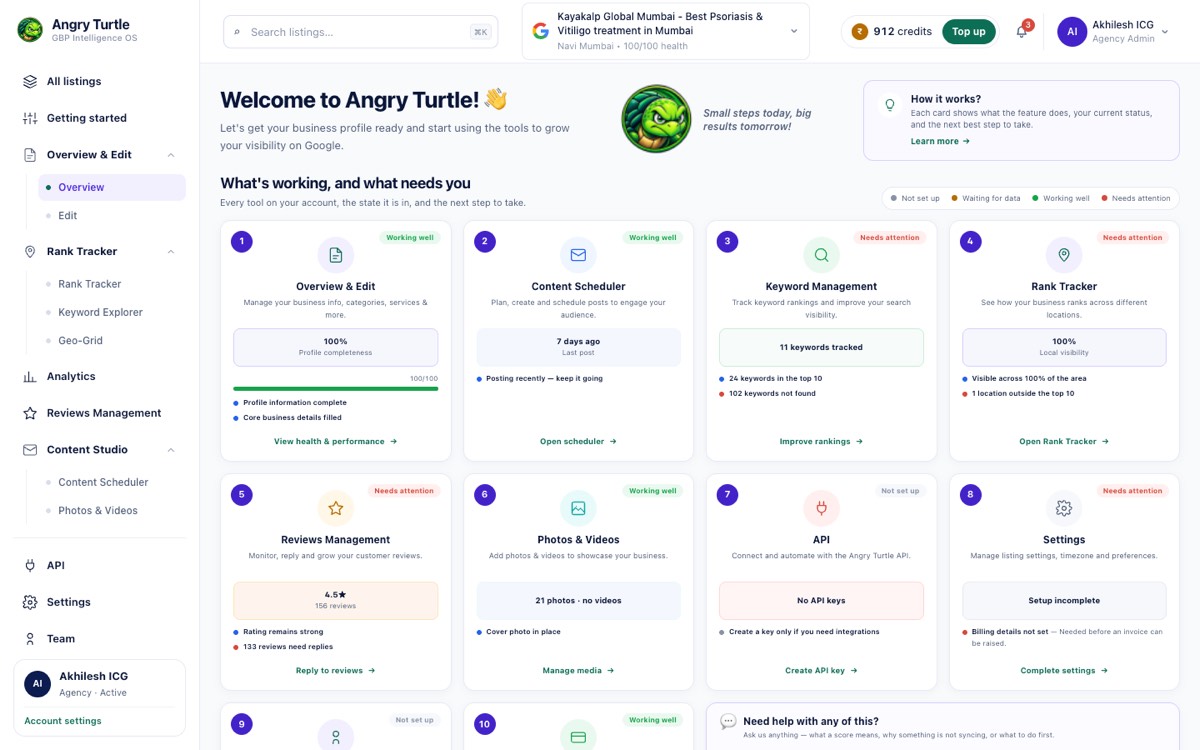
Rank OS gives every profile a 0–100 score built from five weighted dimensions — Relevance, Review Health, Freshness, Entity Authority and AIO Readiness — and the weights are tunable. Underneath it sits a ranked list of the fixes that move the number, each with the point lift it unlocks.
Ready to have this run for you?
Book a free audit — we'll show you where you stand in 48 hours.