 Angryturtle
Retail Local SEO: A Playbook for Multi-Store Chains
Managed local SEO for retail chains, showrooms and D2C stores in India. GBP management, store locator SEO, product catalogue and seasonal campaigns. Book a free audit.
Footfall-Driven Local Search for Indian Retail
Retail is where local search converts most directly into physical footfall and immediate revenue. "Nike store near me." "Electronics showroom in Lajpat Nagar." "Furniture store open today Whitefield." A customer searching these terms is within minutes or hours of visiting — and the store that appears in the local pack captures the visit.
The opportunity in Indian retail local SEO is significant — and the gap is wide. Most Indian retail chains have inconsistent GBP management: store hours that aren't updated during festivals, product catalogues that lag new launches by weeks, photos from the store's 2019 fit-out, and review response rates below 20%.
Brands that manage their retail GBPs with the same operational discipline they apply to store ops — updated hours, current products, consistent photos, rapid review responses — outrank and outconvert brands that don't.
GBP for Multi-Store Retail & Showrooms
Category selection: The right GBP category is more specific than most retail marketers realise. "Clothing store," "Electronics store," "Furniture store," "Jewellery store," "Shoe store" — each triggers different search queries and different local search filters. Using the closest available specific category (rather than the generic "Store") is one of the easiest wins in retail local SEO.
Store-specific attributes: Google's retail attribute options include: in-store pickup, in-store shopping, curbside pickup, delivery, buy online pick up in store, appointment required, accepts credit cards, NFC payments, parking options. Completing every applicable attribute makes your store appear for filter-based searches — "stores with in-store pickup near me" — that broad-category listings miss.
Store hours precision: Retail hours have the most seasonal variation of any category. Diwali extended hours. End-of-season sale hours. Sunday closures during certain months. GBP special hours updates should be published 1–2 weeks before every variation — not on the day, and certainly not left showing incorrect hours that send customers to a closed store. Incorrect hours are the most common source of negative reviews for retail GBPs.
Photos: Exterior (storefront signage, entrance), interior (key product displays, ambience), product photography (hero products, new arrivals), staff photos (optional but positive for trust). Updated monthly for fast-moving retail; quarterly for category retail.
Product Catalogue, Inventory & "In-Store" Signals
Google's product catalogue feature for retail GBPs is under-used by Indian retailers — and it's one of the highest-value GBP features available.
GBP product catalogue: Upload your product catalogue to GBP and products appear in the "Products" tab of your listing, with photos, descriptions, and prices. For fashion, electronics, furniture, and jewellery retailers, this is a direct sales surface within Google Search.
"In-store" product signals: Google increasingly surfaces "in-stock nearby" signals for product searches — "Nike Air Max in stock near me." Retailers connected to Google's Merchant Centre with local inventory feeds benefit from this. Angryturtle advises on Merchant Centre setup for retail clients and manages the GBP product catalogue layer.
New launch and seasonal product posts: GBP posts are the fastest way to signal new arrivals and seasonal collections to local searchers. For fashion retail, new season arrivals posts during September (festive) and February (spring) are high-engagement periods. For electronics, new model launch posts tied to product release dates capture high-intent local searches immediately.
Store Locator & Location Page Architecture
For retail chains with 10+ stores, the website's store locator and individual store location pages are local SEO assets as important as the GBP profiles themselves:
Store locator SEO:
The store locator page should be indexed, not hidden behind JavaScript. Each store should have its own URL (/stores/delhi/lajpat-nagar/), with a full NAP block, Google Maps embed, and local content (neighbourhood context, nearby landmarks, parking info).
Location page content: Each store page should have unique content — not a copy-paste of the same template. Store-specific inventory highlights, local team photos, local event mentions, and neighbourhood-specific copy all contribute to local relevance signals.
NAP alignment: The store's NAP on the website location page must match the GBP exactly — same phone number, same address format, same business name. This is the single most common technical local SEO error in Indian retail.
Reviews Per Store
For multi-store retail, review performance varies significantly by location. The flagship Bengaluru store may have 450 reviews; the Mysuru outlet may have 18. This gap translates directly to rank gaps — and footfall gaps.
Angryturtle manages per-store review generation and response across all locations:
Generation:
- QR code receipt inserts or shopping bag inserts at point of sale
- Digital receipt review request link for e-commerce-enabled stores
- WhatsApp broadcast to customer list for new store openings and post-purchase follow-ups
- Loyalty programme touchpoint review requests (if applicable)
Response: Every review across every store responded to within 48 hours. Brand-voice templates for product feedback, service compliments, and complaint categories. Escalation path for serious service complaints.
Seasonal & Festival GBP Campaigns
Indian retail has the richest seasonal promotional calendar of any market. Diwali. End-of-season sales. Republic Day sales. Holi. Back-to-school. Dussehra. Onam. Pongal. Christmas.
Angryturtle plans the annual GBP post calendar for retail clients at the start of each year — every major promotional window has a post sequence planned 2–3 weeks in advance:
- Offer post: "Flat 30% off for Diwali — in store now" with offer redemption code or validity dates
- Event post: "Join us for our Diwali preview event — 10 Oct, 6pm" with RSVP link
- What's New post: "New festive collection now in store" with product photography
Festival campaigns on GBP consistently drive higher engagement and footfall than non-promotional periods — the stores that show up in local search with current, festival-relevant offers outperform those with generic evergreen posts.
Reporting: Store Visits, Calls, Directions
Retail local SEO reporting focuses on pre-visit signals:
- Direction requests per store: Strongest footfall-intent metric
- Calls per store: Enquiry and availability calls
- Website clicks: Online research before in-store visit
- Post engagement: Offer/event post views and click-throughs
- Product catalogue views: In-GBP product discovery
- Geo-grid rank per category keyword: "[Category] store near me," "[Brand] [city]" — tracked per store, per keyword
- Review velocity per store: League table format for multi-store reporting
Frequently Asked Questions
How do you manage GBP hour updates across 30 stores during a festive sale? Bulk GBP API operations allow us to push hour updates across all stores simultaneously. For Diwali extended hours, for example, we update all 30 stores in a single operation — 24 hours before the extended period begins.
Should each franchise / company-owned store have its own GBP? Yes — each physical store location should have its own GBP. Customers search in the immediate vicinity of where they are, not brand-wide. Each store's GBP captures local pack visibility in its own neighbourhood.
How do you handle the product catalogue for a fashion retailer with a constantly changing inventory? We manage a curated selection of evergreen and hero products in the GBP catalogue (not full SKU inventory, which changes daily). For new season launches, we update the product catalogue within the first week of the new range arriving. Fast-changing promotions are handled via GBP posts rather than product catalogue entries.
We have stores in Tier 2 cities with almost no reviews — where do we start? Tier 2 city stores often face lower competition, so even 20–30 reviews can establish top-3 rank quickly. We prioritise aggressive review generation for low-review stores and typically see rank improvement within 6–8 weeks in Tier 2 markets.
Can you integrate with our store's POS for review requests? We advise on the integration approach and set up the review request triggers. The actual POS integration requires technical access on your end; we provide the specification for your tech team.
Book a retail local SEO audit →
See also: retail industry overview for the managed service and what it covers, plus multi-location local SEO, GBP management services, enterprise local SEO, and book a demo.
A score you can argue with, not a black box
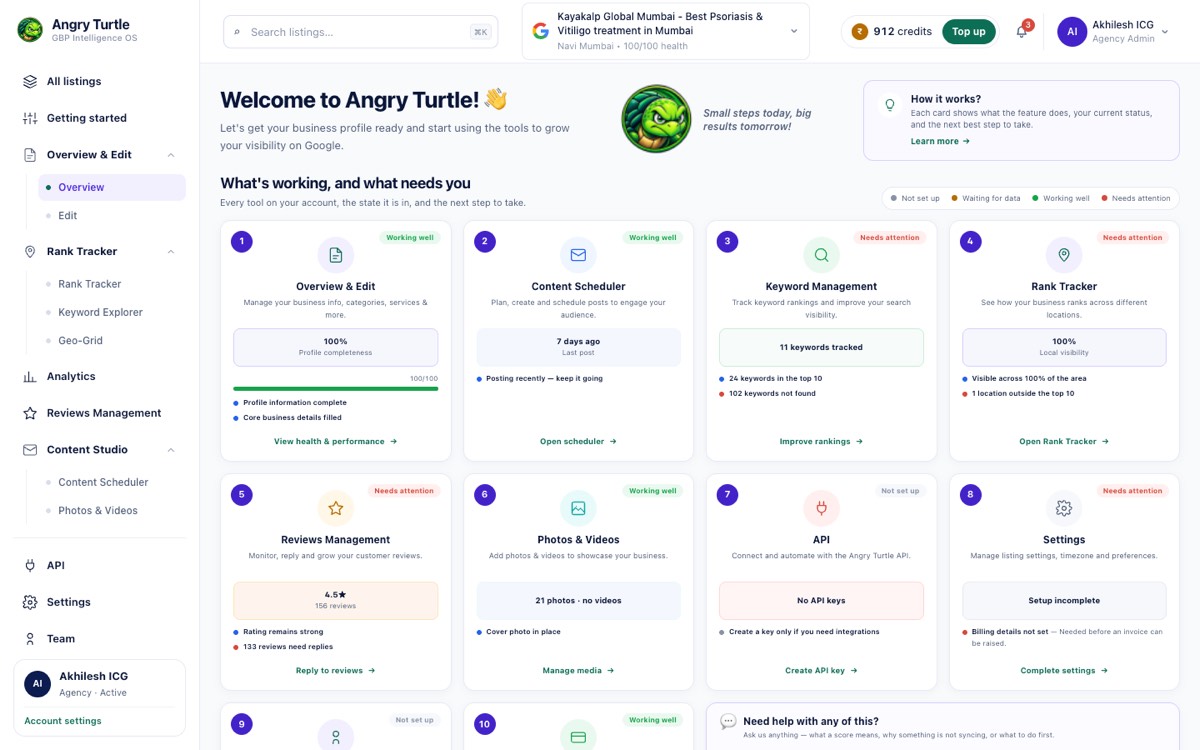
Rank OS gives every profile a 0–100 score built from five weighted dimensions — Relevance, Review Health, Freshness, Entity Authority and AIO Readiness — and the weights are tunable. Underneath it sits a ranked list of the fixes that move the number, each with the point lift it unlocks.
Ready to have this run for you?
Book a free audit — we'll show you where you stand in 48 hours.