 Angryturtle
Managing Multiple Locations
How to manage Google Business Profile for multiple locations. Location Groups setup, bulk operations, per-location review management, and governance best practices.
Lesson 6: Managing multiple GBP locations
A brand with twenty branches doesn't have one GBP to manage. It has twenty, each needing its own verification, its own citation set, its own review stream, and its own monthly attention. Without a system built for that scale, some locations get looked after and most quietly don't — and the ones that don't fall behind in local search while the business assumes "we're on Google" covers all of them equally. It doesn't.
What every individual location actually needs
Each location carries its own claimed and verified profile — the process from claiming & verifying your GBP repeated at every address — its own set of citations across Indian directories, its own accumulating review stream, and its own monthly management cadence — posts, review responses, profile updates. None of this is shared or inherited from a parent brand entity the way a website's domain authority might be. A location that opened eighteen months ago and has never received a single GBP post is, from Google's perspective, indistinguishable from a location that's neglected because it's failing, even if the branch itself is thriving.
Location Groups: the infrastructure that makes scale possible
A Location Group, sometimes called a Business Account, is an organisational container inside Google Business Profile that holds multiple individual multi-location SEO profiles under one roof. It's what makes managing twenty locations from a single dashboard possible, rather than logging into twenty separate accounts.
Setting one up happens at business.google.com under Business account settings, creating or accessing a Location Group and adding every existing location profile into it. The one detail that matters more than the mechanics: the Location Group needs to sit under the brand's own owned Google account, never an agency's account, so ownership stays with the business regardless of what happens to any particular agency relationship down the line.
A Location Group is also the prerequisite for GBP API access, which becomes close to essential once a portfolio crosses roughly ten locations — manual, one-by-one management simply doesn't scale past that point, a threshold covered further in handling suspensions & appeals since suspension risk also compounds with unmanaged scale.
Who gets what access
Three roles cover most structures. Owner has full access — deleting profiles, managing billing, adding or removing managers — and should sit with the brand itself, not an agency. Manager can edit all profile data across the group, respond to reviews, and publish posts, and is the right level for an agency or a central operations team. Site Manager is scoped to one assigned location only, with read-only visibility into everything else — the correct level for a franchisee who should control their own branch without touching anyone else's.
For franchise structures specifically, franchisees sit at Site Manager level for their own location, while headquarters or the managing agency holds Manager or Owner access at the Location Group level, keeping brand-wide consistency enforceable from the centre, a pattern covered further in franchise local SEO.
What actually benefits from being done in bulk
Once inside a Location Group with API access, several operations that would otherwise take hours become genuinely fast. Festival and holiday hours can deploy to every location simultaneously — what takes three hours updating location by location manually takes about five minutes as a bulk push. Description updates for a brand-wide messaging change push to all profiles at once rather than being copy-pasted twenty times. New brand photography deploys network-wide. And a brand-wide promotional post can publish across every location with location-specific details — the branch name, the city, the local phone number — inserted automatically rather than manually edited per listing, the same publishing mechanism covered in GBP posting & content cadence.
Without API access, businesses in the five-to-twenty location range can still work through the Business Profile Manager dashboard's multi-select functionality, which is slower than API-driven bulk operations but meaningfully faster than handling each profile entirely separately.
Reviews don't pool across locations
Reviews accumulate strictly per location, never at the brand level, which means every single branch needs its own active review generation running — WhatsApp requests, QR codes at the counter — its own monthly velocity tracking, and its own response management within a consistent turnaround. A league table approach works well operationally here: a monthly report ranking every location by review count and velocity, shared with location managers, with additional review generation support directed at whichever locations are visibly falling behind the pack.
Bringing a new location online correctly
Every new location deserves the same structured 30-day process, ideally starting before the doors open rather than after. GBP creation and verification should begin roughly four weeks ahead of opening. Profile completion should combine brand-standard content with genuinely local details. Citation building across Tier 1 and Tier 2 directories, per NAP & citations 101, should start immediately. The review pipeline — WhatsApp flow and QR cards ready at the counter from day one — should activate at launch, not weeks later. And a first geo-grid rank baseline at day 30, using something like Angryturtle's geo-grid rank tracking, gives a reference point for tracking progress from that point forward.
Starting this process after opening rather than before typically costs four to eight weeks of local search visibility that could otherwise have been building during the pre-opening period.
A worked example: a diagnostics chain scaling from 3 to 15 locations
A diagnostics chain with three well-managed locations opens twelve more across two cities within a year. Without restructuring, this becomes fifteen separate logins, no consistent NAP standard, and review generation running informally at three locations and nowhere else.
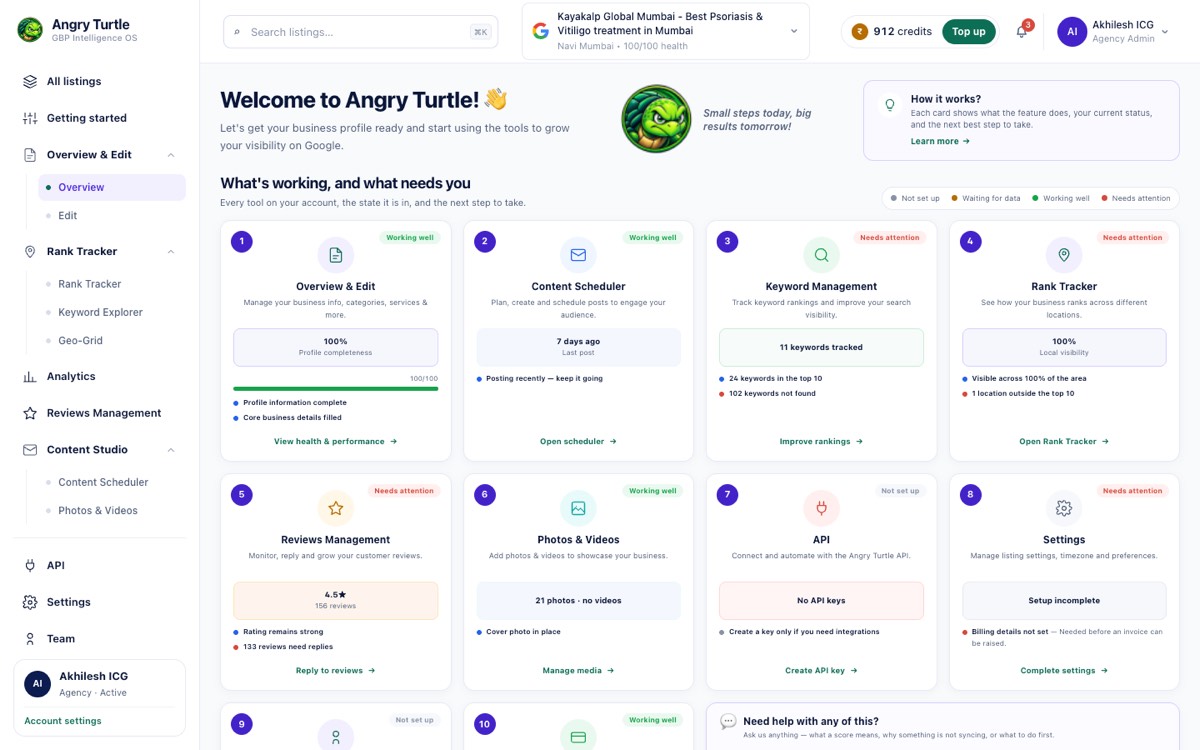
Setting up a proper Location Group under the company's own Google account, assigning Manager access to a central operations team of two, and Site Manager access to each branch's front-desk lead, turns the sprawl back into something manageable. Bulk hours updates for the next festival season, previously requiring an afternoon per location, take under ten minutes across all fifteen. Review generation, standardised as a WhatsApp template every branch uses identically, closes the gap between the well-managed original three and the newer twelve within about two months. Angryturtle's agency operating system and portfolio-wide insights and performance view were built for exactly this scale problem, whether the fifteen locations sit inside one company or across an agency's book of clients.
FAQ
At what point does multi-location management actually require an API, not manual work? Roughly ten locations is where manual, one-by-one dashboard work starts genuinely breaking down; below that, the Business Profile Manager's multi-select tools are usually sufficient without API access.
Should a franchisee ever have Owner-level access to their own location? Generally no — Site Manager access covers everything a franchisee legitimately needs day to day, while Owner access carries deletion and billing permissions that should stay concentrated with headquarters or the managing agency.
Do all locations need to post the same content, or can they vary? A hybrid works best in practice — brand-wide campaigns push identically with local variables inserted (branch name, city, phone), while individual locations can still publish their own local content on top, covered further in GBP posting & content cadence.
What happens to a Location Group if we switch agencies? Nothing, provided the Location Group was set up under the brand's own Google account from the start with the agency holding only Manager-level access — this is exactly why ownership structure matters more than it might seem at setup time.
How does enterprise-scale management differ from a 10-15 location agency client? The mechanics are similar, but enterprise portfolios typically add SSO and stricter role governance on top of the same Location Group foundation — see enterprise local SEO for what changes at that larger scale.
Next lesson: Reading GBP performance data →
A score you can argue with, not a black box
Rank OS gives every profile a 0–100 score built from five weighted dimensions — Relevance, Review Health, Freshness, Entity Authority and AIO Readiness — and the weights are tunable. Underneath it sits a ranked list of the fixes that move the number, each with the point lift it unlocks.
Ready to have this run for you?
Book a free audit — we'll show you where you stand in 48 hours.