 Angryturtle
13 AEO/AIO Optimisation Tips for Local Search
13 tactics to get your local business cited in Google AI Overviews, ChatGPT, Perplexity, and Gemini. AEO for local SEO — practical, India-specific, actionable.
·
13 AEO and AI Overview Optimisation Tips for Indian Local Businesses
Google AI Overviews, Perplexity, ChatGPT, and Gemini are answering local discovery queries directly — "best dermatologist in Bengaluru," "which IVF clinic has the best success rate," "recommended hotels near Connaught Place." The businesses named in these AI answers get exposure before the local pack even loads, and often before the user clicks anything at all.
Below are 13 tactics that move the needle on AI citation probability, followed by the mechanics of why each one works and where Indian businesses most often get this wrong.
Why AI citation is different from ranking
Traditional local pack ranking rewards proximity, relevance, and prominence signals that Google has measured for over a decade. AI citation rewards something adjacent but not identical: how confidently a language model can extract a clean, verifiable fact about your business from structured and unstructured sources. A business can rank #1 in the local pack and still be absent from the AI Overview answering the same query, because the model didn't find enough extractable, specific information to cite it with confidence.
That gap is the opportunity in this list.
Tip 1: build a review profile that's competitive with who's actually being cited
There's no published review-count number that guarantees AI citation, and anyone quoting an exact figure is guessing. What's defensible is the direction: a steadily growing base of recent reviews that name specific services is one of the strongest readiness signals a local business can build. Review volume functions as a legitimacy check — a model is more willing to state something confidently about a business with an established review history than one with six reviews from 2022. What counts as "established" is relative to the local competitive set, not a fixed number — a category with a thin field needs far fewer reviews to look established than a saturated one.
Action: search your own target queries in AI Overviews, ChatGPT, and Perplexity, note the review counts of whoever gets cited, and prioritise review generation until you're past that working benchmark. Then hold a steady monthly velocity rather than a single push.
Tip 2: complete your GBP to 100%
AI systems pull structured data directly from GBP fields. A profile missing services, attributes, or a description gives a model less to extract — and less confidence in what it does extract.
Action: audit against every available field in the dashboard. Fill in everything applicable, not just the required minimum.
Tip 3: add LocalBusiness schema to your website
Schema markup in JSON-LD makes your business data machine-readable, which matters because AI systems that crawl the web extract schema fields directly rather than parsing prose.
Action: add complete LocalBusiness schema — name, address, phone, hours, category, aggregate rating — to every page. Multi-location businesses need per-location schema on their location pages, not one generic block reused everywhere.
Tip 4: build a real FAQ page
FAQ content, structured as clear question-answer pairs, is among the most citable formats there is. AI Overviews frequently lift FAQ content wholesale to answer a user's query.
Action: build an FAQ page around the questions customers actually ask. Keep answers tight — 50 to 100 words, factual, specific to your business, not generic industry boilerplate. FAQPage schema follows automatically from clean question-answer formatting.
Tip 5: answer the question in your first sentence
Models are trained to extract the most direct answer available. A page that opens with three paragraphs of scene-setting before answering anything is less citable than one that states the answer immediately.
Action: on every service page, open with a one or two sentence direct answer to the implicit question — what is this service, who is it for, where. Save the elaboration for after.
Tip 6: phrase H2/H3 headings as questions
Headings that mirror how people actually search — "What does a dermatologist treat?" rather than "Our Services" — are directly extractable because they match the query shape a model is trying to answer.
Action: rework service page headings to mirror the questions your own customers ask at the front desk or over the phone.
Tip 7: build entity consistency across every platform
AI systems cross-reference multiple sources before citing an entity. A business listed as "Dermatologist" on Practo and "Skin Doctor" on JustDial, with a slightly different address on each, gives the model conflicting signals about what it's even looking at.
Action: audit NAP consistency across GBP, your website, Practo, JustDial, and any other relevant directory. Any variation in name, category, or specialisation claim reduces citation confidence.
Tip 8: earn press and media coverage
AI systems weigh credible third-party sources — news articles, industry press, government databases — more heavily than a business's own marketing copy. A mention in a mainstream or trade publication moves citation probability meaningfully.
Action: look for realistic press angles — a clinical milestone, a community initiative, expert commentary a local journalist might want. This doesn't need to be national coverage to matter; local and trade press count too.
Tip 9: claim and optimise your Knowledge Panel
Where a business has a Google Knowledge Panel, AI Overviews draw heavily on Knowledge Graph data for entity facts. An unclaimed or inaccurate panel is a missed extraction source.
Action: search your business name on Google. If a panel exists, claim it and verify every field.
Tip 10: build reviews across multiple platforms, not just Google
Perplexity and ChatGPT draw on Practo, Zomato, JustDial, and other platform review data — not only Google's. High review volume in more than one place builds multi-source confidence that a single-platform strategy can't.
Action: monitor and respond on every platform relevant to your category. A healthcare business should be actively building Practo reviews alongside Google ones, not treating Google as the only channel that counts.
Tip 11: write specific, credentialed content about your specialty
"We offer dermatology services" carries no extractable fact. "Our clinic specialises in laser treatment for adult acne, with board-certified dermatologists practising this specifically for eight years" carries several.
Action: write content around your actual specialties with real credentials attached, not generic category language.
Tip 12: maintain a factual, structured about page
Neutral, structured "about" content — founding year, credentials, key personnel, accreditations — is the foundation AI systems draw on for entity description, in roughly the way a Wikipedia infobox works.
Action: include founding year, named credentials and certifications, the principal team with qualifications, notable accreditations, and a clear specialisation statement.
Tip 13: get listed in high-authority association directories
NABH for hospitals, IMA for doctors, CREDAI for real estate, ICAI for CA firms — these are directories AI systems treat as authoritative within their category, well beyond what a general business directory carries.
Action: identify the two or three most authoritative associations for your industry and make sure your listing there is current, not just present.
Frequently asked questions
How long does it take to see AI citation results from these changes? There's no fixed timeline, and Google doesn't publish one. Structural changes like schema and FAQ content can be crawled within weeks; review-count and entity-consistency gains build over months, not days.
Do these tips replace local SEO or sit alongside it? Alongside. Nearly every signal that strengthens AEO — complete GBP, review velocity, consistent citations — also strengthens local pack ranking. They reinforce each other rather than compete for attention.
Should a single-location business bother with all 13, or focus on a few? Start with GBP completeness, review velocity, and a real FAQ page — those three cover most of the readiness gap for a smaller business. The press coverage and association-directory tips matter more once the foundational three are in place.
Angryturtle builds AI Overview readiness as part of managed local SEO, covering the schema, FAQ structure, and entity-consistency work most Indian businesses haven't gotten to yet.
Stop guessing where you rank locally.
Rank OS scores your Google Business Profile the way Google's local algorithm does — relevance, review health, freshness, entity authority and AIO readiness — and shows you exactly what to fix.
Book a live demo →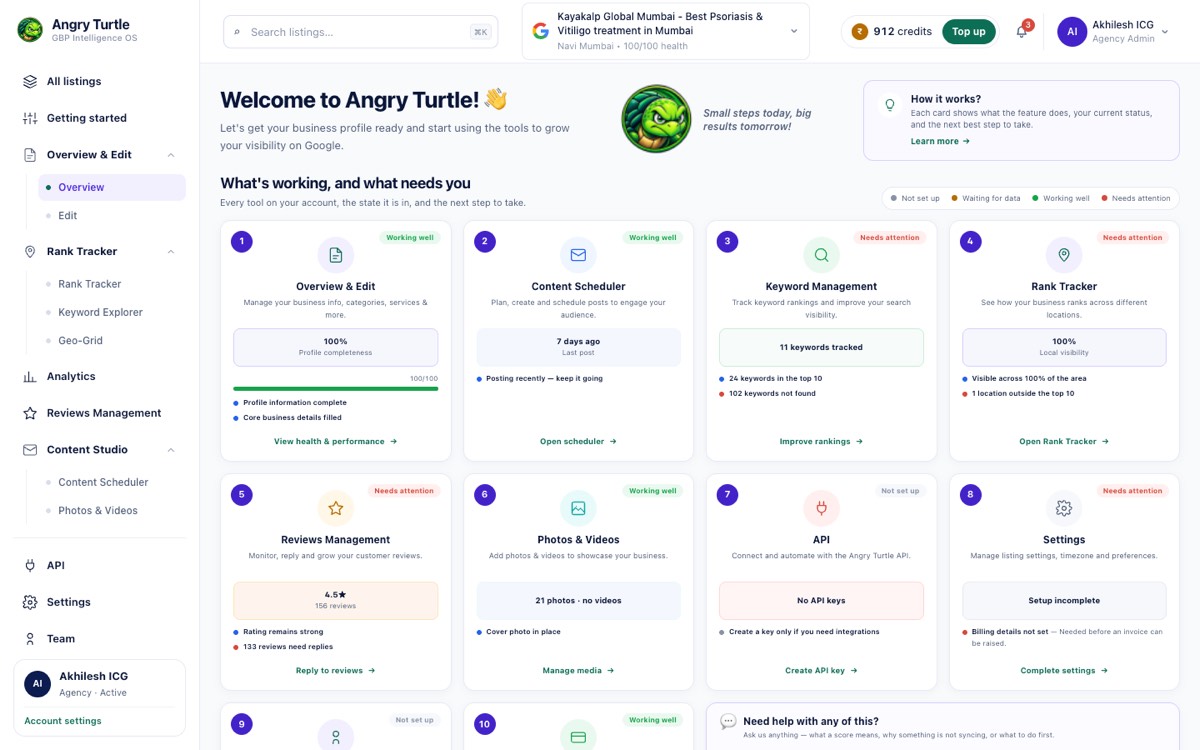

Related reading
Ready to have this run for you?
Book a free audit — we'll show you where you stand in 48 hours.