 Angryturtle
Answer Engine Optimisation (AEO) for Local Businesses
What AEO means for Indian local businesses, why it matters now, and the specific tactics that get your business cited in AI-generated answers. Practical, India-specific guide.
·
Answer Engine Optimisation for Local Businesses: The 2026 Guide
A growing share of local queries on Google now surface an AI-generated answer before the local pack, before organic results, before any link at all. When someone searches "which dermatologist in Koramangala has the best reviews" and an AI Overview names a specific clinic, that clinic gets brand exposure before the searcher clicks anything.
Answer Engine Optimisation, or AEO, is the practice of structuring a business's digital presence so it gets named in exactly that kind of answer.
AEO vs. traditional SEO vs. local SEO
Traditional SEO aims for a page-one organic ranking, built mainly on backlinks, content depth, and technical health. Local SEO aims for a spot in the local pack, built mainly on GBP quality, reviews, and citation consistency. AEO aims for a named citation inside an AI-generated answer, built on entity authority, content structure, and trust signals a model can verify.
The user behaviour differs across all three too — a searcher clicks through from an organic result, calls or gets directions from a local pack listing, and often just reads the AI answer without clicking anything at all. AEO doesn't replace the other two; the signals that build strong local SEO — high review count, a complete GBP, consistent citations — also feed AEO readiness. Getting one right makes the other easier, not harder.
How AI Overviews choose which local businesses to cite
For local queries specifically, a model draws on a handful of source types. Structured GBP data — categories, services, attributes, hours — is something Google has direct access to, so complete, accurate profiles give the model clean, machine-readable facts to cite with confidence.
Review signals matter too, though not as a fixed number. Businesses with a thin or stale review history are cited far less often for competitive local queries than ones with an established, actively growing record — the review count works as a rough legitimacy filter rather than a precise threshold.
Website content plays a role as well: specific, well-structured pages about actual services extract more cleanly than thin or generic copy. And third-party citations — consistent NAP across directories, mentions in credible publications, listings in authoritative vertical directories like NABH for hospitals, CREDAI for developers, or ICAI for CA firms — all add to the entity authority a model weighs before citing.
AEO for local: the five pillars
Entity completeness comes first — a fully defined business across every digital touchpoint: complete GBP, NAP consistency across the relevant Indian directories, a website with clear name, address, category and services, and LocalBusiness schema carrying every attribute that applies.
Review authority follows — building past a solid review base and holding steady monthly velocity rather than treating reviews as a one-time task.
Content structure is the third pillar: FAQ pages with concise question-answer pairs, headings phrased as questions, opening sentences that answer the implicit question of the page directly, and specific factual claims — percentages, credentials, statistics — instead of generic marketing language.
Topical authority is fourth. A clinic with fifteen genuinely specific blog posts about acne treatment is more likely to be cited for "acne treatment in Bengaluru" than one with a single generic services page trying to cover everything at once.
External validation rounds it out — press mentions, association memberships, accreditations like NABH, NABL, or ICAI, and any government-listed credential — all of which a model treats as more trustworthy than a business's own self-description, precisely because it comes from somewhere else.
AEO content tactics for Indian local businesses
Write direct, factual introductions on every page. "Welcome to our laser hair removal services page" tells an extraction model nothing. "Laser hair removal is a light-based treatment that permanently reduces hair growth. At Sharma Skin Clinic in Koramangala, we offer both Diode and Nd:YAG laser treatments, with results visible after 4-6 sessions" gives it several facts in one paragraph.
Build a real FAQ section, structured as a precise question followed by a concise 50-100 word answer, with an optional expansion after. For example: "How many sessions of laser hair removal are needed? Most patients require 6-8 sessions, spaced 4-6 weeks apart, for 80-90% permanent hair reduction. The exact number depends on hair type, skin tone, and treatment area. Our dermatologists assess this at the initial consultation."
Use specific numbers and named credentials wherever they're genuinely available. "Our team of 4 board-certified dermatologists" and "4.8 stars from 340 Google reviews" both extract more confidently than "our experienced team" and "highly rated" — specificity is what signals reliability, not enthusiasm of tone.
Measuring AEO performance
AEO measurement is genuinely harder than tracking local pack rank — there's still no direct "AI Overview position tracker" built into Search Console as of 2026, and third-party tools cover this unevenly.
The practical workaround is a set of proxy measurements: manually tracking which of your key queries trigger an AI Overview naming your business, watching branded search impression trends in GSC for shifts that suggest AI citations are driving awareness even without a click, and tracking direct traffic to specific service pages — an AI citation that doesn't produce a click can still show up later as a branded direct search once someone remembers the name.
Common mistakes
The most frequent mistake is treating AEO as a separate project layered on top of existing local SEO work rather than an extension of it — duplicating effort instead of reusing the same GBP and content improvements for both goals. A second is chasing an exact review-count number instead of building steady velocity. And a third is writing FAQ content that answers a question nobody actually asks, rather than pulling real questions from front-desk calls, WhatsApp messages, or existing GBP Q&A.
Frequently asked questions
Is AEO the same thing as GEO (generative engine optimisation)? They overlap heavily and the terms are often used interchangeably. AEO tends to emphasise the answer-format content structure; GEO is sometimes used more broadly to cover optimisation for any generative AI surface, including outside search.
Does AEO require a website, or can a business rely on GBP alone? GBP alone gets a business some way, since it's the most reliable structured source available. A website with FAQ content and service-specific pages gives a model considerably more to extract from, and most competitive categories now need both.
How often should FAQ content be updated for AEO purposes? Whenever the underlying facts change — pricing, credentials, service offerings — rather than on a fixed schedule. Stale FAQ answers that contradict current GBP data create the same consistency problem as outdated NAP data.
Can a brand-new business with no review history do AEO at all? Yes, to a degree — schema, FAQ structure, and a specific about page can be built from day one. Review-based signals will simply lag behind until the business has time to build a genuine review history.
Angryturtle builds AIO/AEO readiness into every managed local SEO programme, covering schema, FAQ structure, and entity consistency alongside standard local SEO work.
Stop guessing where you rank locally.
Rank OS scores your Google Business Profile the way Google's local algorithm does — relevance, review health, freshness, entity authority and AIO readiness — and shows you exactly what to fix.
Book a live demo →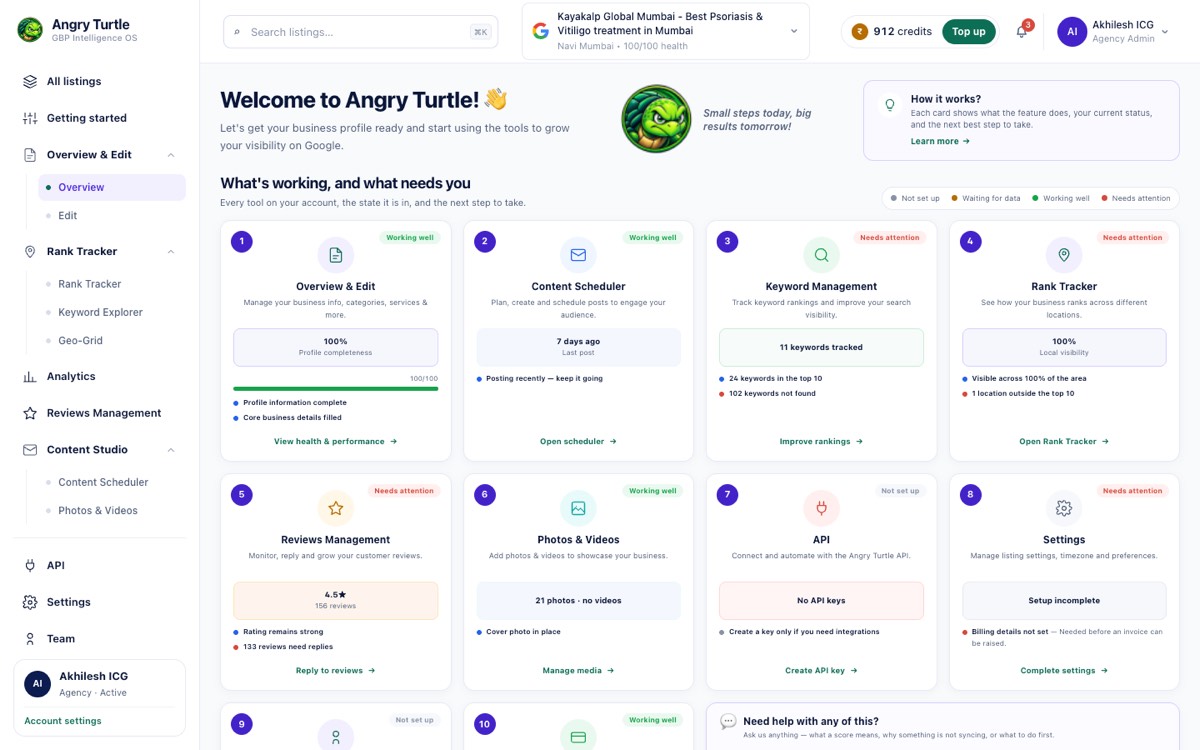

Related reading
Ready to have this run for you?
Book a free audit — we'll show you where you stand in 48 hours.