 Angryturtle
AI-Native Local SEO Workflows
How AI tools are transforming local SEO workflows in 2026. Review response automation, content generation, competitive analysis, and where human judgment is still essential.
·
AI-Native Local SEO: How AI Is Changing the Way Local SEO Gets Done
AI is changing what local SEO optimises for — AI Overviews, generative engines, entity-based citation — but it's also changing how the work itself gets done. Review response drafting, content generation, competitive analysis, geo-grid interpretation, citation auditing: each of these now has an AI-assisted version that didn't exist five years ago.
This guide covers where AI genuinely helps in local SEO operations, where it still needs a human in the loop, and how that split plays out in practice across five common workflows.
Workflow 1: AI-assisted review response
Consider a restaurant getting 80 reviews a month. Every one needs a response within 48 hours, and writing 80 unique, appropriately personalised replies by hand eats a meaningful chunk of someone's week.
A language model can draft each response from the review text, the business's brand voice guidelines, a response template library, and any personalisation signal available — the reviewer's name, a specific dish mentioned. A human then reviews and approves before anything publishes. The time saving is real: review-and-approve typically runs 1-2 minutes per response instead of the 5-8 minutes a fully manual draft takes.
Human judgment stays essential in a few specific cases. Negative reviews with a real complaint need a human call on tone and resolution path. Reviews naming staff by name need a decision on whether to acknowledge or redirect. Reviews that look fake or competitor-planted need human assessment before any response goes out at all. And in regulated industries — healthcare, BFSI — every response needs a compliance pass regardless of how good the draft is.
Workflow 2: AI for GBP content generation
A multi-location business needs monthly GBP posts, Q&A seeds, and description refreshes, consistently, across every branch. That's a content production job, and it scales badly without help.
Given brand voice guidelines and a monthly content brief — upcoming promotions, seasonal context — a model can generate first drafts of GBP posts, question-answer pairs for Q&A seeding, updated description copy, and location-specific inserts for multi-location profiles. Production time typically drops by more than half compared to writing every draft from scratch.
What still needs a person: final review for brand voice accuracy, a compliance check in regulated categories, catching any hallucinated claim the model invented (this happens occasionally and always needs verification before publishing), and the last layer of personalisation that only someone with actual business context can add.
Workflow 3: AI for geo-grid interpretation
A geo-grid rank report for a business with 8 locations and 5 keywords produces well over 200 data points in a single pull. Reading that report for what actually matters — and what to do about it — takes time even for an experienced analyst.
A model given the geo-grid data can flag the weakest geographic zones per keyword, compare against competitor grids to surface specific gaps, suggest which ranking factor to prioritise (reviews for a proximity gap, citations for a NAP gap, category for a relevance gap), and produce a plain-language summary of the findings. This roughly halves analysis time per location per reporting cycle.
The parts that stay human: whether a weak zone is actually a target market worth fixing, why a competitor suddenly jumped in a specific zone, and how to explain findings to a client in a way that reflects the actual relationship and history — none of that is in the geo-grid data itself.
Workflow 4: AI for citation auditing
Checking 100 locations across 50 directories for NAP consistency means roughly 5,000 individual data points per audit cycle. That volume is exactly where automated comparison earns its keep.
A model can parse directory listing data against a master location file, flag discrepancies — an old phone number sitting on JustDial, a name-format error on IndiaMART — and prioritise corrections by directory authority so the highest-value fixes happen first.
Ambiguous cases still need a person: is "Dr. Sharma" on one directory the same entity as "Dr. R Sharma" on another, or two different listings? Merge-versus-delete decisions on duplicates, and escalation for listings nobody can claim, both require judgment a model shouldn't be making unsupervised.
Workflow 5: AI for competitive analysis
Monthly competitive monitoring asks a fairly open question: what are the top three competitors' GBP profiles doing differently this month? Review velocity, new photos, new posts, category changes?
A model can analyse competitor GBP data — pulled via the Maps API or manual review — and surface review velocity comparisons, category and attribute differences, posting frequency and content patterns, and new photo additions worth noting.
Strategic interpretation is where a human takes over: is a competitor's new category a genuine repositioning or a mistake that will get corrected next week, and should the response be to mirror the move or deliberately differentiate from it.
Where Angryturtle fits
Angryturtle is built AI-native in the sense that these workflows sit inside the platform itself rather than being a separate add-on — the software drafts and can push review replies, GBP posts, and citation fixes, with optional human approval at each step. It runs self-serve, or execution can be handed to a managed team: review drafting AI-assisted and human-approved, GBP content AI-drafted from a monthly brief and human-reviewed, geo-grid analysis AI-flagged and human-interpreted, citation auditing AI-compared and human-corrected, competitive monitoring AI-extracted and human-assessed.
The pattern across all five workflows is the same: AI handles volume and pattern recognition, and a person applies judgment, maintains brand voice, and manages the relationship that software can't.
Common mistakes when adopting AI local SEO workflows
The most common failure is publishing AI drafts without a human review step at all — especially with review responses and GBP content, where an unverified AI claim can create a factual problem on a live public profile. A second common mistake is assuming AI removes the need for local SEO expertise entirely; it removes drafting time, not strategic judgment. And a third is skipping compliance review in regulated categories because the draft "reads fine" — reading fine and being compliant are different bars.
Frequently asked questions
Does using AI-drafted content hurt local SEO or AI citation eligibility? No, as long as a human reviews for accuracy before publishing. What hurts citation eligibility is inaccurate or inconsistent information, not the fact that a draft started with a model.
How much human oversight does a small, single-location business actually need? Less than an enterprise account, but not zero. Even a single-location business should have someone reviewing AI-drafted review responses and GBP posts before they go live — the risk of an inaccurate claim is the same regardless of scale.
Can these workflows run without any managed service involvement? Yes — self-serve platforms including Angryturtle's own support running review drafting, content generation, and citation checks in-house. Managed execution is an option for teams that would rather hand off the approval and publishing step entirely.
See how the Angryturtle platform works across these five workflows, self-serve or managed.
Stop guessing where you rank locally.
Rank OS scores your Google Business Profile the way Google's local algorithm does — relevance, review health, freshness, entity authority and AIO readiness — and shows you exactly what to fix.
Book a live demo →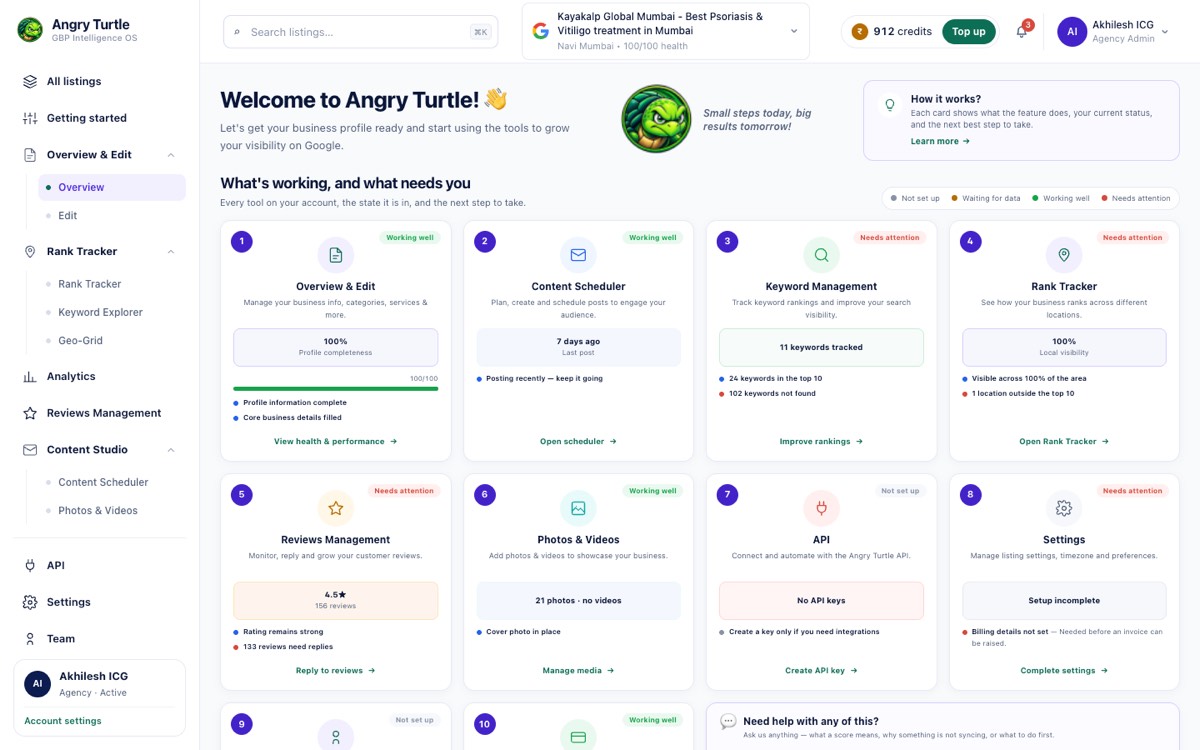

Related reading
Ready to have this run for you?
Book a free audit — we'll show you where you stand in 48 hours.