 Angryturtle
How AI Overviews Affect Local Search
What Google AI Overviews mean for Indian local businesses. How they affect click-through rates, which queries trigger them, and how to position your business to appear in them.
·
How Google AI Overviews Are Changing Local Search
AI Overviews sit above the local pack, above paid ads, above every organic result — the first thing a searcher sees on many queries now, before anything else on the page. For Indian local businesses, understanding what they are, how they affect search behaviour, and how citation actually gets decided is becoming table stakes, not a nice-to-have specialty.
What AI Overviews are
An AI Overview is a generated text summary appearing at the top of some Google results pages, synthesising information from multiple sources into a direct answer, with small citation chips linking back to the sources it drew on.
For local queries, they tend to appear on complex, comparative, or opinion-shaped searches rather than simple navigational ones. "Which IVF clinic in Mumbai has the best success rate," "best physiotherapist near me with experience in sports injuries," and "hotels in Gurgaon with good reviews for business travellers" are the kind of query that triggers one. "Dentist near me," "HDFC Bank branch Koramangala," and "restaurant open now Bandra" tend not to — the first is simple and navigational, the second is a direct lookup, and the third needs real-time information that AI Overviews aren't well suited to answer yet.
How AI Overviews affect click-through
The picture on click-through is genuinely mixed, and any source claiming a precise industry-wide number should be read sceptically — Google doesn't publish this data at the granularity local SEO would need.
What's reasonably clear directionally: when an AI Overview appears, clicks to the local pack and to organic results below it tend to decrease, because the answer partially satisfies the query before the user scrolls further. At the same time, a business named inside the AI Overview gets a form of brand exposure that behaves something like a top-of-page impression, even without a click. And queries that trigger an AI Overview tend to be more complex to begin with — a user who's satisfied by the AI answer may never click, but one who does click is arriving with higher intent than average.
The practical implication for a local business: not appearing in the AI Overview for your category's key queries is a growing cost, even if you rank #1 in the local pack for the same search. The AI answer can partially satisfy intent before the searcher ever reaches your listing.
The citation mechanism
AI Overviews don't cite businesses at random. They draw on a few distinct kinds of entity data.
GBP data — categories, services, attributes, review count and rating, hours, description — is structured data Google already has direct access to, which makes it the single most reliable extraction source available to the model.
Website content matters too, specifically the text Google has crawled and indexed. Content that's specific, factual, and clearly structured extracts more cleanly than vague marketing copy.
Third-party signals round it out: review content, data from authoritative directories like NABH, CREDAI, or IMA, and press mentions all supply external validation the model weighs alongside a business's own claims about itself.
On review volume specifically: there's no official published threshold, and any number quoted as exact should be treated as an estimate rather than a rule. What's defensible is the pattern — businesses with a thin, dated review history are cited far less often for competitive local queries than businesses with an established, actively growing review base. Review count functions less like a magic number and more like a legitimacy check a model applies before it's willing to state something confidently.
Positioning for AI Overview citation
Start with GBP completeness. Every incomplete field is a missed extraction opportunity, so prioritise the most specific applicable category, every service listed with a real description, every applicable attribute, and a specific, factual business description rather than generic marketing language.
Then build review count with real, ongoing velocity rather than a one-time push, and hold that pace month over month.
Structure the website for extraction: FAQ sections with question-format headings and direct answers, service pages that state what the service is in the opening sentence, an about/credentials page with specific, verifiable details — degree names, certification numbers, registration numbers — and LocalBusiness schema on every location page.
Build topical authority through ongoing content. A business with ten genuinely specific articles about one treatment area reads as more authoritative to an extraction model than a business with a single generic services page covering everything at once.
And earn external validation where it's genuinely available — accreditations like NABH or NABL, press coverage, industry association memberships — because these show up in web content the model weighs independently of anything the business says about itself.
The India timeline
AI Overviews have rolled out in India with some lag behind the US and UK, and coverage across English-language and Indian-language queries continues to expand as of 2026. That lag is itself the opportunity: businesses building AIO readiness now — review velocity, complete GBP, structured content — are laying the foundation before the feature reaches full prevalence in Indian search, rather than scrambling to catch up once it has.
Common mistakes to avoid
The most frequent mistake is treating AI Overview readiness as a one-time project rather than an ongoing discipline — a GBP completed once in January and never revisited drifts out of date within months. A second is chasing an exact review-count number as if crossing it guarantees citation; the number is directional, not a threshold that flips a switch. A third is writing website content for search engines in the old keyword-density sense rather than for direct extraction — stuffing a page with a keyword phrase does nothing for a model looking for a clean, factual answer.
Frequently asked questions
Do AI Overviews replace the local pack? No — they typically sit above it, and both can appear on the same results page. A business still needs to compete for local pack visibility even when it also targets AI Overview citation.
Can paid ads buy placement in an AI Overview? No. AI Overviews are generated from Google's synthesis of organic and structured data, not an ad placement, as of 2026.
How do I know if my business is currently being cited in AI Overviews? There's no built-in tracker inside Search Console for this yet. Manual monitoring of your key queries, alongside watching branded search impression trends, is currently the most reliable proxy.
Does having a Wikipedia page help with AI Overview citation? It can, where one genuinely exists and is accurate — Wikipedia is one of the higher-trust sources many models weight heavily. Most small and mid-sized local businesses won't qualify for a Wikipedia entry, so this matters more for larger or long-established brands than for a single-location clinic or restaurant.
Angryturtle builds AIO readiness into managed local SEO from day one, covering the GBP, schema, and content work this requires.
Stop guessing where you rank locally.
Rank OS scores your Google Business Profile the way Google's local algorithm does — relevance, review health, freshness, entity authority and AIO readiness — and shows you exactly what to fix.
Book a live demo →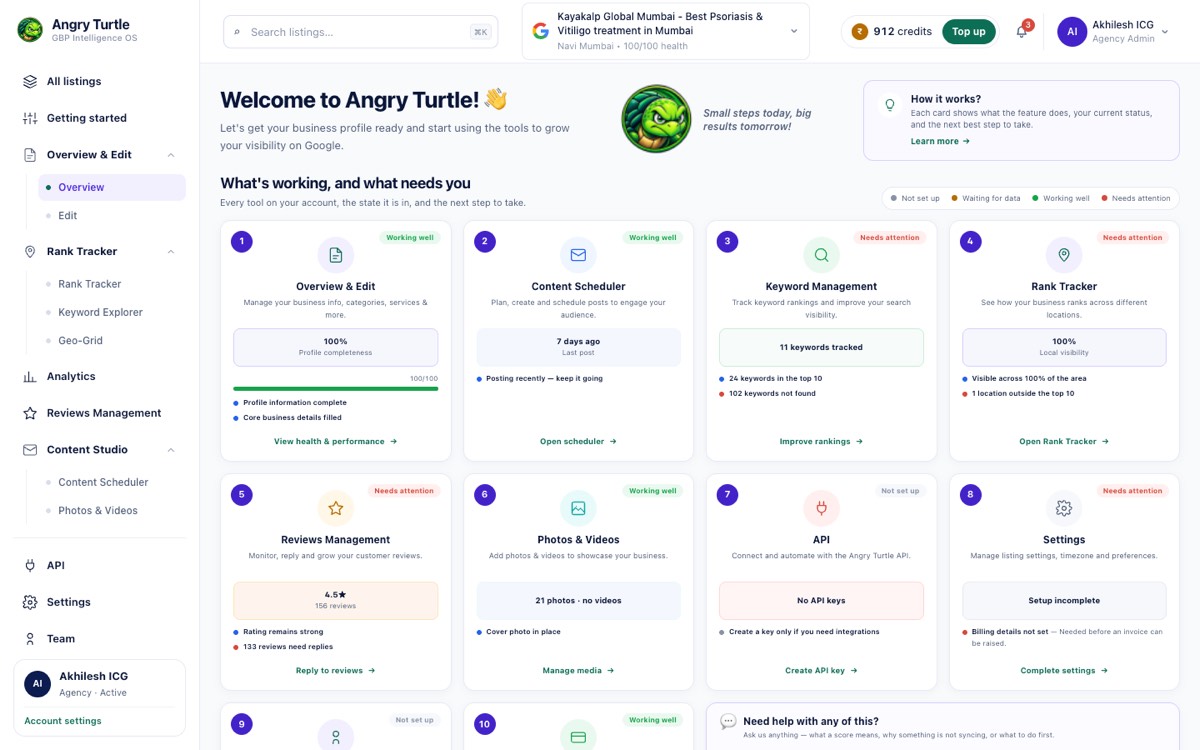

Related reading
Ready to have this run for you?
Book a free audit — we'll show you where you stand in 48 hours.