 Angryturtle
Tools Built on the Google Business Profile API
·
Google doesn't let just anyone edit a Business Profile programmatically. Every tool that claims to manage your GBP at scale is really just a client sitting on top of a handful of Google APIs — Business Information, Performance, Reviews, Media, Posts, and a fading Q&A endpoint — and what a tool can do for you is bounded almost entirely by which of those it has actually built against, and how deep.
That's worth knowing before you buy anything, because two tools can look identical in a sales demo and behave completely differently in production. One reads data and shows it to you nicely. The other reads and writes, pushing real changes back to Google. This piece walks through what the GBP API actually exposes, what "built on the API" tends to mean in practice, and where the real differences between tools show up.
What the Google Business Profile API actually covers
The GBP API isn't one endpoint, it's a family of them. Business Information handles name, description, phone, address, hours, categories and service areas — you can read the full field list at GBP API. Performance returns profile views, website clicks, calls and direction requests, with a reporting lag of roughly a month, surfaced in most tools through something like Insights & Performance. Reviews lets you read reviews and post replies. Media covers photo and video uploads. Posts handles the equivalent of Google Posts. Q&A exists but Google has been quietly deprecating it, so any tool leaning heavily on Q&A management is building on a feature with a shrinking future.
There's also no true product-catalogue endpoint — products publish as a form of post rather than through a dedicated catalogue API, which is why "product management" in most tools is really "post management with a product template." And there's no chat or messaging endpoint exposed by the Business Information API at all, so any tool promising to manage GBP messaging is either using a workaround or overstating what it does.
Rank position and citation data don't come from the GBP API at all — they come from separate sources like SearchApi.io for rank tracking and citation discovery, and Google Ads' Keyword Planner for search volume. A serious GBP tool is really stitching several APIs into one workflow, not calling a single "local SEO API."
Read-only vs read-write: the split that matters most
This is the single biggest fork in the market. Most tools built on the GBP API are read-only or partial: they pull your data, score it, and hand you a to-do list, but the actual edit — changing the phone number, fixing hours, updating categories — still happens by hand inside Google's own dashboard.
A smaller set of tools implement the write path: Edit to Google submits real updates through the Business Information API's update-mask mechanism, uploads media through resumable upload, publishes posts on a schedule that respects the listing's actual timezone, and posts review replies that appear live on the profile, not in a staging queue. Confirmed working, as of this writing, across name, description, phone, website, address, hours, holiday hours, categories, and service areas. Photos, posts, products and review replies publish live too.
The distinction sounds technical until you've lived the alternative: a dashboard that flags "your hours are wrong" every week for six months because nobody ever fixes it, because fixing it means leaving the tool, logging into Google separately, and doing it manually. Write access collapses that gap.
Rank, citations and the rest of the stack
Beyond the core API, a genuinely useful GBP tool usually bundles a rank tracker with geo-grid, a citation engine that checks NAP consistency and finds duplicate listings across directories, and some form of demand cluster analysis that groups the keywords actually driving discovery traffic to your category. None of these come from Google's own API — they're built by combining third-party data sources with what the GBP API returns, which is exactly the "integrated data graph" that separates a real platform from a single-purpose plugin.
Rank OS is Angryturtle's attempt to turn all of that into one number — a 0-100 score across five weighted dimensions (Relevance, Review Health, Freshness, Entity Authority, AIO Readiness) — rather than forty separate metrics nobody has time to read every week.
What GBP API tools genuinely can't do
Worth stating plainly, because every tool in this category has the same ceiling: none of them are website or on-page SEO tools. The GBP API has nothing to do with your website's crawlability, page speed or content structure. A GBP tool can check that your site's NAP matches your listing, but it can't optimise your homepage — see local ranking factors for how the two actually differ.
None of them are backlink tools either — citations are NAP listings on directories, not backlinks, and treating the two as interchangeable is a common but wrong assumption. And none of them are real-time. Google's own performance data lags by weeks, and even a successful write can take hours to reflect on the live listing. Any tool promising instant, live rank movement the moment you make a change is describing something Google's infrastructure doesn't support.
How to evaluate a GBP API tool before buying
Ask the vendor, specifically, which of the API endpoints they actually call versus which features are manual workarounds dressed up as automation. Ask whether edits genuinely push to Google or just populate an internal draft. Ask what happens to Q&A management given Google's own deprecation signal. And ask whether the tool covers agencies at all — Agency OS with its 22-endpoint API, role-based access and pooled credits is a different build target than a single-owner dashboard, and a tool optimised for one rarely serves the other well.
If you're weighing named alternatives, the honest comparison isn't feature-count, it's write depth. BrightLocal, Yext and Birdeye each cover a different slice of this stack; managed local SEO services exist precisely because most businesses would rather have someone who already knows this API landscape do the work than learn it themselves. For a fuller picture of where GBP data now intersects AI search, GBP optimization for AI search is the deeper read.
Frequently asked questions
Do all GBP tools use the same underlying API? Mostly yes, for the core profile data — there's only one official Business Information API. What differs is which endpoints a given tool actually implements, especially write endpoints, and how well it fuses that data with rank tracking, citations and keyword volume from other sources.
Can any tool guarantee instant rank changes after an edit? No. Google's own systems introduce a lag between an edit and its effect on ranking or performance data, typically hours for reflecting a change and closer to a month for full performance reporting. Treat "instant results" claims with suspicion.
Is GBP Q&A worth managing through a tool right now? Google has been signalling that Q&A is a legacy feature. It's fine to keep existing Q&A tidy, but building a strategy around it going forward is a weaker bet than investing in reviews, posts and category accuracy.
Does a GBP tool also fix my website's SEO? No. GBP API tools manage your Google Business Profile, not your website. They can check that your site's business information matches your GBP listing, but on-page and technical website SEO is a separate discipline entirely.
If you are weighing building on the API against buying, GBP API management sets out what the API permits, what access involves, and where a managed platform is the cheaper answer. The definition lives in the GBP API glossary entry.
Stop guessing where you rank locally.
Rank OS scores your Google Business Profile the way Google's local algorithm does — relevance, review health, freshness, entity authority and AIO readiness — and shows you exactly what to fix.
Book a live demo →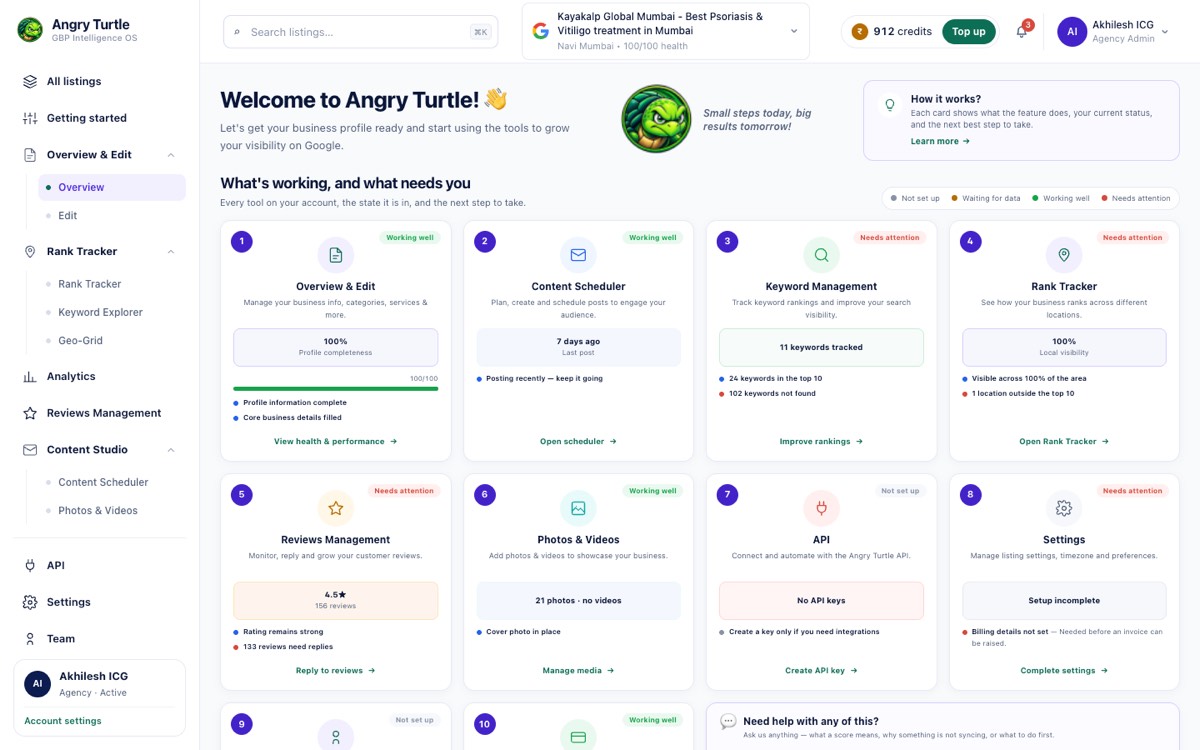

Related reading
Ready to have this run for you?
Book a free audit — we'll show you where you stand in 48 hours.