 Angryturtle
"GMB management agency" is what people still search for even though Google renamed Google My Business to Google Business Profile back in 2021. The search term stuck; the actual work behind it has changed more than the name did. A decade ago, managing a listing meant filling in a form once and checking back occasionally. Today it's an ongoing operating job with real technical depth, and most businesses hiring an agency for the first time don't know what they're actually paying for.
Here's the gap: a business owner searching "GMB management agency" is often picturing someone who logs in once a month and adds a photo. What a competent agency actually does looks a lot more like account management for a live system that Google keeps changing underneath everyone, with real consequences — a wrong category or a policy violation can get a profile suspended, not just under-optimised.
The actual task list, category by category
Profile accuracy work sits at the base of everything else: keeping the business name, address, phone number, hours, and category correct and matched across the web, which feeds what's called NAP consistency. Getting the primary category right in the first place, and revisiting it as Google's category list expands, decides which searches a listing is even eligible to appear for. Special hours during holidays, service-area boundaries for businesses that don't have walk-in storefronts, and attribute accuracy (wheelchair accessible, women-led, outdoor seating) all fall in here too, and they drift out of date faster than most owners expect.
Content operations is the second layer — regular GBP posts, keeping photos current rather than showing a five-year-old storefront, and managing the products or services list so it reflects what the business actually sells this month, not what it sold when the profile was first set up. Freshness decays after roughly three weeks of inactivity in most scoring models, which is a shorter window than most owners assume.
Review management is a full job on its own: monitoring new reviews across the day, drafting replies that sound like a real person rather than a templated apology, and flagging genuinely fake or policy-violating reviews for removal rather than letting them sit. Review velocity — how consistently new reviews come in, not just the total count — is itself a ranking signal, so an agency that only reacts to reviews rather than actively generating new ones is leaving a lever unused. Our guide to responding to reviews covers the tone and timing that actually work.
Citation and directory management rounds it out: making sure the business appears correctly across the roughly 20-plus platforms that Google and AI systems both draw entity confidence from, catching duplicate listings before they split a business's authority across two profiles, and keeping an eye on suspension risk before it becomes an actual suspension. Our GBP suspension reasons glossary entry covers what typically triggers Google's enforcement, and it's worth reading before it happens to you, not after. If a profile is brand new, claiming and verifying it correctly the first time avoids a whole category of problems agencies otherwise spend hours untangling later.
What a GMB management agency should NOT be doing
A competent agency will tell you plainly what a Google Business Profile can't fix. It's not a website SEO tool — optimising a listing doesn't touch your on-page content or backlinks, and a business with a broken website will still lose customers even with a perfect profile. It's not a backlink service; citations are directory listings, not links, and treating the two as interchangeable misunderstands both. And it's not real-time — Google's own performance data lags by roughly a month, and profile edits can take hours to reflect even after they're submitted correctly. Any agency promising instant, guaranteed ranking jumps is either overselling or doesn't understand the platform's actual constraints.
Self-serve platform, managed service, or both
There isn't a single right answer to whether a business should hire full management or run its own profile with better tools — it depends on time, not just budget. A solo owner with two hours a week and the discipline to use them can run their own optimisation with a platform built for it. A business with no internal bandwidth, or an agency managing dozens of client listings, needs the management layer on top.
Angryturtle works both ways rather than forcing a choice. As a self-serve platform, Rank OS gives an owner a transparent 0-100 score across five weighted dimensions — Relevance, Review Health, Freshness, Entity Authority, and AIO Readiness — with the top actions to move that score ranked by expected point lift, so the work is prioritised rather than a 40-item checklist nobody finishes. As a managed service, our GBP management services put that same scoring engine behind a team that actually does the work: posting, reply drafting, citation cleanup, and suspension monitoring, on a retainer basis.
The differentiator that actually matters in either case is direct write-back to Google — edits, posts, photos, and review replies publish live from inside the platform rather than sitting in a queue waiting for someone to manually push them through Google's own interface. Most tools in this category are read-only or partially write-capable; full write access changes how fast anything actually gets fixed.
For agencies specifically, Agency OS adds role-based access (Agency Admin, SEO, Project Manager, Client), white-label client portals, pooled credits across a book of business, and a documented 22-endpoint API for firms that want to build their own workflows on top rather than living entirely inside someone else's dashboard.
What to ask before hiring one
Ask what the agency actually pushes live versus what it recommends and leaves for you to implement — this single question separates a real management service from a reporting-only one. Ask how suspension risk is monitored, since a suspended profile during peak season is a worse outcome than a slow-growing one. Ask what happens to citation accuracy across the directory layer specifically, since that's the part most owners never think to check themselves. And ask whether the retainer scope is written down anywhere concrete — our what belongs in a local SEO retainer piece is a useful reference for what a fair scope actually looks like before you sign anything.
Frequently asked questions
Is "GMB" still the correct term to search for, or should I use "GBP"? Google renamed the product to Google Business Profile in 2021, so GBP is the current, correct term. GMB still gets searched heavily out of habit, and most agencies list both so the terminology gap doesn't cost them visibility either way.
How much does GMB/GBP management typically cost? It scales with the number of locations and how much active work is included — a single-location retainer looks very different from an enterprise account managing dozens of branches. Ask what specific tasks are covered at a given price point rather than comparing headline numbers alone, since scope varies enormously between providers.
Can an agency guarantee my listing will rank first? No agency can honestly guarantee a specific rank, because Google's algorithm and your competitors' behaviour are both outside anyone's direct control. A credible agency talks about the actions it will take and the score it expects to move, not a guaranteed position.
What happens if my profile gets suspended while under agency management? A competent agency should have a documented reinstatement process, not just prevention advice after the fact. See what a GMB suspension actually means for what the appeal process typically involves and how long it tends to take.
Stop guessing where you rank locally.
Rank OS scores your Google Business Profile the way Google's local algorithm does — relevance, review health, freshness, entity authority and AIO readiness — and shows you exactly what to fix.
Book a live demo →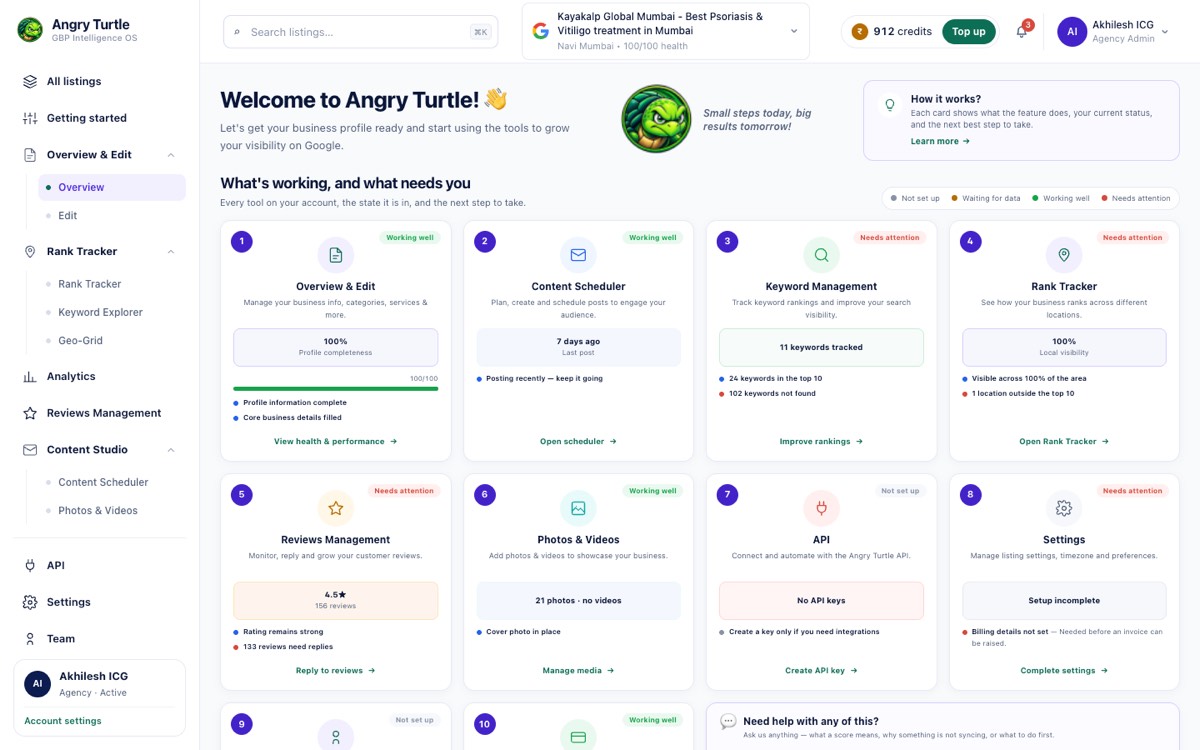

Related reading
Ready to have this run for you?
Book a free audit — we'll show you where you stand in 48 hours.