 Angryturtle
Hotel SEO in Mumbai
OTA listings versus the Google profile, category choice, and how travellers search differently from locals, for hotels and resorts in Mumbai.
·
A corporate traveller landing at CSMIA on a Tuesday night searches nothing like a family booking a Diwali weekend at the same hotel. The Tuesday search is "business hotel near BKC," decided inside minutes, often expensed and rebooked monthly. The Diwali search takes days, runs through three OTA tabs, and gets decided on photos and price. Hotel SEO in Mumbai has to hold both without one drowning the other, because Andheri and BKC alone carry enough corporate volume that a property built for leisure search loses real revenue if its Google Business Profile only speaks to holiday travellers.
Hotel SEO Mumbai has to solve for both demand types on one profile
The Mumbai market is unusual in how much of its hotel demand comes from business travel rather than tourism. Andheri East, the BKC corridor, and the airport belt run on corporate bookings, extended-stay executives, and same-day rebookings when a meeting shifts. A property here that only optimises for "hotel in Mumbai" is competing in the widest, most generic bucket of search when the actual money is in narrower, high-intent queries like "business hotel near BKC" or "hotel walking distance Andheri metro." Getting found for hotel seo in Mumbai means ranking for both the broad category term and the specific corporate-travel phrasing, and most properties here only do the first.
Category choice for a Mumbai business-corridor property
"Hotel" is the right primary category for most general-purpose Mumbai properties, but a property genuinely built around corporate stays, meeting rooms, a business centre, express check-in for late flights, should also carry "Business Hotel" as a category, not just a mention in the description. Google reads category as the strongest relevance signal it has, well ahead of anything written in posts or the business description. A hotel that only lists "Hotel" and hopes the word "business" in its description does the work is leaving the "business hotel Andheri" query on the table.
Secondary categories matter here specifically because Mumbai business hotels tend to carry more attached facilities than a leisure property does: "Conference Center" if meeting space is a genuine draw, "Restaurant" only if the food and beverage offering is strong enough to be searched on its own, "Airport Shuttle" style attributes filled in rather than assumed.
The hotel and its restaurant are two separate listings, and Mumbai's F&B scene makes that mistake common
A hotel restaurant that has any independent reputation, a rooftop bar that draws its own crowd, a standalone breakfast buffet locals book without staying overnight, needs its own Google Business Profile, distinct from the hotel's. This trips up more Mumbai properties than most cities because Mumbai's dining scene means hotel restaurants and bars often build a following that has nothing to do with the hotel's own guests. Running both under one listing means whichever one Google decided to rank buries the other; running them as two profiles, cross-linked in each description and connected as the same business entity where GBP allows it, lets both show up for their own separate search intent, "hotel in BKC" and "rooftop bar BKC" pull two different crowds and deserve two different listings.
OTA listings and the NAP conflicts a Mumbai property actually hits
MakeMyTrip, Booking.com, Goibibo, and Agoda all carry their own listing for a Mumbai hotel, and each one becomes a citation source Google reads alongside the GBP itself. The conflict that actually shows up in Mumbai more than most cities is building-name mismatch: an OTA listing that uses the commercial tower's name ("Solitaire Corporate Park") where the GBP uses the hotel's own branded address, or an older OTA entry still carrying a pre-renovation phone number nobody remembered to update after a brand change. Any one of those creates enough ambiguity that Google can't confidently treat all four listings as the same business, which weakens the local-pack signal all four should otherwise be reinforcing together. Fixing it means pulling up all four OTA dashboards and the GBP side by side, matching the name, building address, and primary phone number exactly, and re-checking after any renovation, rebrand, or phone-line change.
Building-name and landmark addressing in Andheri and BKC
Mumbai's commercial towers complicate hotel addressing in a way flatter, single-street cities don't. A hotel occupying floors of a mixed-use tower in BKC needs its GBP address to carry both the building name and the road name, because a traveller navigating by cab or ride-share is reading the building signage, not the survey number. Where the pin lands inside a dense tower cluster matters more than the address string itself; a pin that drops on the wrong side of the block in BKC's tight footprint can cost a guest ten confused minutes at exactly the moment, after a long-haul flight, when they're least patient for it.
Banquet and event space is its own search intent
A Mumbai hotel with banquet halls or event space is really running two search identities at once: "hotel in Andheri" for room bookings and "banquet hall Andheri" or "wedding venue BKC" for event bookings, and these are searched by completely different people with different urgency. The events searcher wants capacity, catering options, and photos of a set-up hall, not room photography. Wedding Venue and Conference Center as secondary categories, event-space photos separated clearly from room photos in the GBP gallery, and a GBP post calendar that covers upcoming availability windows all matter here specifically because a hotel that buries its banquet capability inside generic hotel photography loses a booking category with real margin attached to it.
Review response has to run daily in a corporate-heavy market
Business travellers write terse, specific reviews, wifi speed, meeting room AV, checkout speed on a Monday morning, and they write them fast, often from the airport on the way out. A Mumbai business hotel that lets reviews sit unanswered for a week looks slower than the corporate booker expects, and corporate travel desks do check recent review activity before greenlighting a property for repeat bookings. Every review deserves a reply inside 24 hours; a specific one, naming the thing the guest actually mentioned, does more for the next corporate booker than a templated "thank you for your feedback" ever will.
Corporate travellers and Mumbai residents search this differently
A Mumbai resident booking a staycation or a family event searches by neighbourhood and price, "hotel near Bandra for a weekend," and reads reviews for cleanliness and service. A corporate traveller searches by proximity to a specific office or the airport, checks wifi and meeting-room mentions in reviews before anything else, and often books same-day. A property's GBP posts, photo priorities, and even which reviews get highlighted in responses should reflect which of these two is actually driving the property's revenue, rather than defaulting to leisure-hotel best practice because that's what most generic advice covers.
Frequently asked questions
What should a Mumbai hotel look for in a hotel seo agency in Mumbai? Ask specifically whether they separate corporate and leisure search intent in their strategy, and whether they've handled OTA-to-GBP NAP reconciliation before, since that's the recurring technical problem in this market specifically.
Does a Mumbai hotel need a different Google category than a hotel in a leisure-first city? Only if the property genuinely serves corporate travellers; if it does, "Business Hotel" as a category, not just a description mention, is worth adding.
How fast should a business hotel in Andheri or BKC respond to reviews? Within 24 hours is the standard worth holding to, and it matters more here because corporate travel desks often check recent review responsiveness before rebooking a property.
Should a hotel's rooftop bar or restaurant have its own Google listing? Yes, if it has any following independent of hotel guests. Running both under one profile means one of the two rarely shows up for its own search.
What is the most common NAP problem for Mumbai hotels specifically? Building-name mismatches between OTA listings and the GBP, especially after a renovation or rebrand, and older OTA entries still carrying an outdated phone number.
Do hotel seo services in Mumbai need to cover banquet and event bookings separately from room bookings? Yes, if the property runs event space. Room-search and event-search are different intents searched by different people, and treating them as one blended strategy under-serves the higher-margin banquet business.
Angryturtle's hotel local SEO work covers the national mechanics this page builds on, and hospitality local SEO is the industry hub for hotels, restaurants, and event venues together. For Mumbai specifically, local SEO in Mumbai covers the city generally and hospitality in Mumbai narrows to this vertical; hiring guidance sits at choosing a local SEO agency in Mumbai. Hospitality reputation management goes deeper on review handling, GBP attributes that convert covers the amenity-field detail this page only summarised, and choosing the right GBP category covers category selection generally. NAP consistency explains the mechanism behind the OTA conflicts above.
See how Angryturtle runs hotel GBP management across Mumbai →
Stop guessing where you rank locally.
Rank OS scores your Google Business Profile the way Google's local algorithm does — relevance, review health, freshness, entity authority and AIO readiness — and shows you exactly what to fix.
Book a live demo →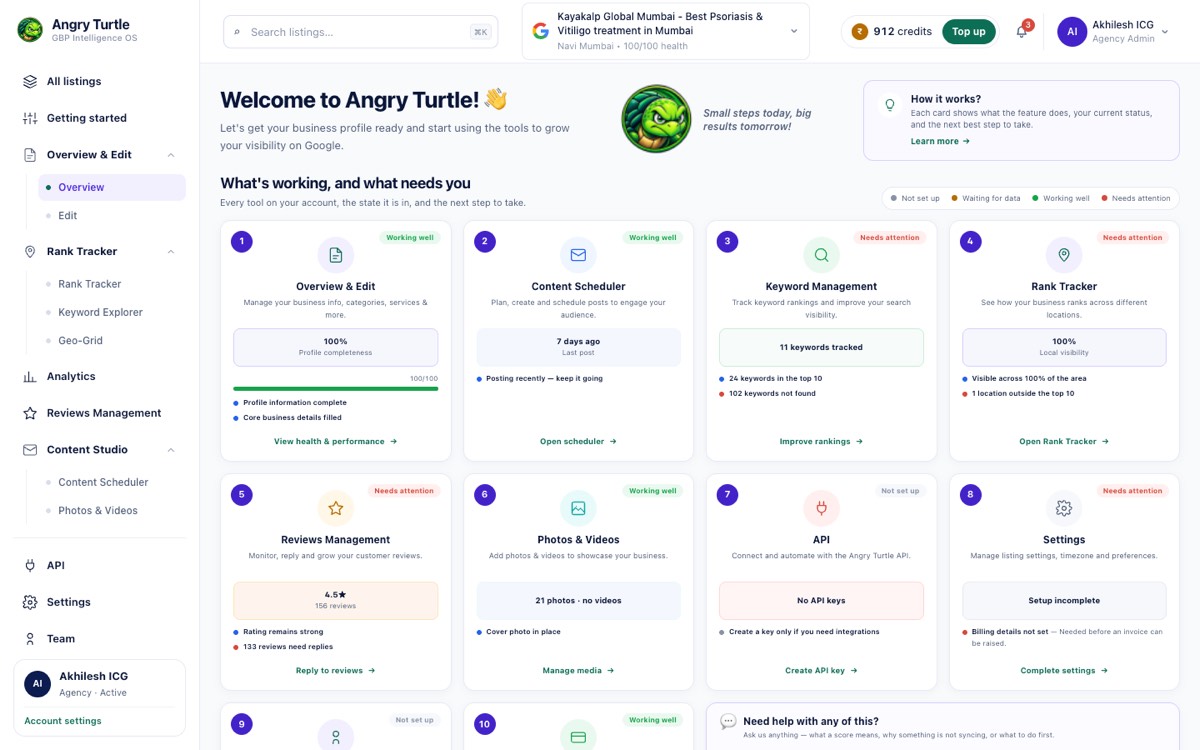

Related reading
Ready to have this run for you?
Book a free audit — we'll show you where you stand in 48 hours.