 Angryturtle
GBP Management in Mumbai: What the Market Demands
·
Managing a Google Business Profile in Mumbai means managing against a specific kind of noise: a search volume dense enough that a listing can rank fine citywide and still be effectively invisible three streets over, and a directory ecosystem — JustDial, Practo for healthcare, plus Google — that a profile-only strategy tends to miss half of. This is what GBP management actually needs to look like week to week for a Mumbai business, not the one-time setup checklist most guides stop at.
Proximity variance is bigger here than the theory suggests
Mumbai's suburbs — Andheri, Bandra, Powai, Malad, Mulund, Thane — each run their own commercial clusters, and a business ranking second for its category from an Andheri West address can fall off the map entirely searched from Andheri East, half a kilometre away. Single-point rank checks miss this completely; they report one number from one spot and call it done. Geo-grid rank tracking exists specifically to catch this — a grid of check points across a suburb shows exactly where a listing drops off, which is the only way to know whether a ranking problem is a profile problem or a proximity problem.
Weekly management should include watching that grid move, not just the star rating. Rank OS rolls proximity-adjusted performance into its Relevance score alongside Review Health, Freshness, Entity Authority and AIO Readiness, weighted differently depending on category — a restaurant's Freshness and Review Health carry more weight than its Entity Authority; a diagnostic chain runs the opposite way.
Category accuracy is the first thing worth auditing, every time
A dermatology clinic in Bandra listed only under "Doctor" competes against every GP in the western suburbs for a query it should be winning outright with the correct category and secondary categories filled in. This sounds basic and gets skipped constantly, partly because most businesses set their category once at signup and never revisit it as Google adds new, more specific options. Choosing the right GBP category walks through the audit logic, and it's worth rerunning it every few months, not just at onboarding.
Review cadence has to keep pace with a competitive market
A listing collecting one review a month looks stale next to a competitor posting weekly in the same Mumbai category, and Freshness in Rank OS starts decaying after roughly three weeks without new activity. Managing this actively — sending review requests after service completion, responding to what comes in within a day or two, flagging anything that looks fake for removal — is ongoing work, not a one-time setup task. How to get Google reviews and responding to reviews cover the mechanics; the harder part for a Mumbai business is simply keeping the cadence consistent across a busy operating calendar.
Practo matters alongside Google for healthcare specifically
Mumbai's clinic and diagnostic ecosystem runs a meaningful share of patient discovery through Practo rather than Google alone, and a GBP-only management approach that ignores this layer will optimise the profile perfectly while missing where actual bookings originate. Citation sites for healthcare in India covers the directory layer generally, and the healthcare local SEO in Mumbai page goes deeper on the city-specific version of this for clinics and hospital groups.
Multi-branch chains need branch-level management, not one dashboard glance
Pharmacy chains, gyms, tuition centres and diagnostic labs headquartered in Mumbai routinely run into branches competing against each other for the same search — a Bandra branch and a Khar branch fighting over "gym near me" instead of dividing the market between them. Location data management keeps NAP data and service-area scoping consistent per branch, and the underlying data-hygiene problem is covered generally in NAP consistency at scale. Managing ten branches from a single spreadsheet updated quarterly is roughly how this problem starts.
Posting cadence, not just posting existence
GBP posts decay fast in a market this competitive — a post from six weeks ago reads as inactivity next to a competitor posting twice a week. GBP posting content cadence and GBP post ideas cover what to actually post; the management discipline is keeping a calendar rather than posting in bursts around launches and going quiet in between.
What managed GBP management should actually cover
A Mumbai business evaluating managed GBP services should expect, at minimum: category audits repeated periodically, citation cleanup across the 20+ directories that matter for the category, active review request and response workflows, a real posting calendar, and — for multi-branch operations — geo-grid tracking per branch rather than one number for the whole chain. GBP management services and managed local SEO break down what's typically included at each tier, and a quote that skips proximity tracking for a multi-branch business is usually underscoping the actual work.
Frequently asked questions
How often should a Mumbai business update its GBP profile? Categories and core information should be reviewed every few months; posts and review responses need weekly attention. A profile set up once and never revisited will drift stale regardless of how well it was configured at launch.
Does a Mumbai business need geo-grid tracking, or is a single rank check enough? A single check from one address tells you almost nothing about how a business looks across its own suburb, let alone the wider city. Geo-grid tracking is worth the setup cost for any Mumbai business competing across more than a few blocks.
What's different about managing multiple branches in Mumbai versus a single location? Multiple branches introduce a cannibalisation risk that single-location businesses never face — branches quietly competing for the same search instead of each owning its own catchment. That needs deliberate service-area scoping and per-branch data hygiene, covered in managing multiple locations.
Stop guessing where you rank locally.
Rank OS scores your Google Business Profile the way Google's local algorithm does — relevance, review health, freshness, entity authority and AIO readiness — and shows you exactly what to fix.
Book a live demo →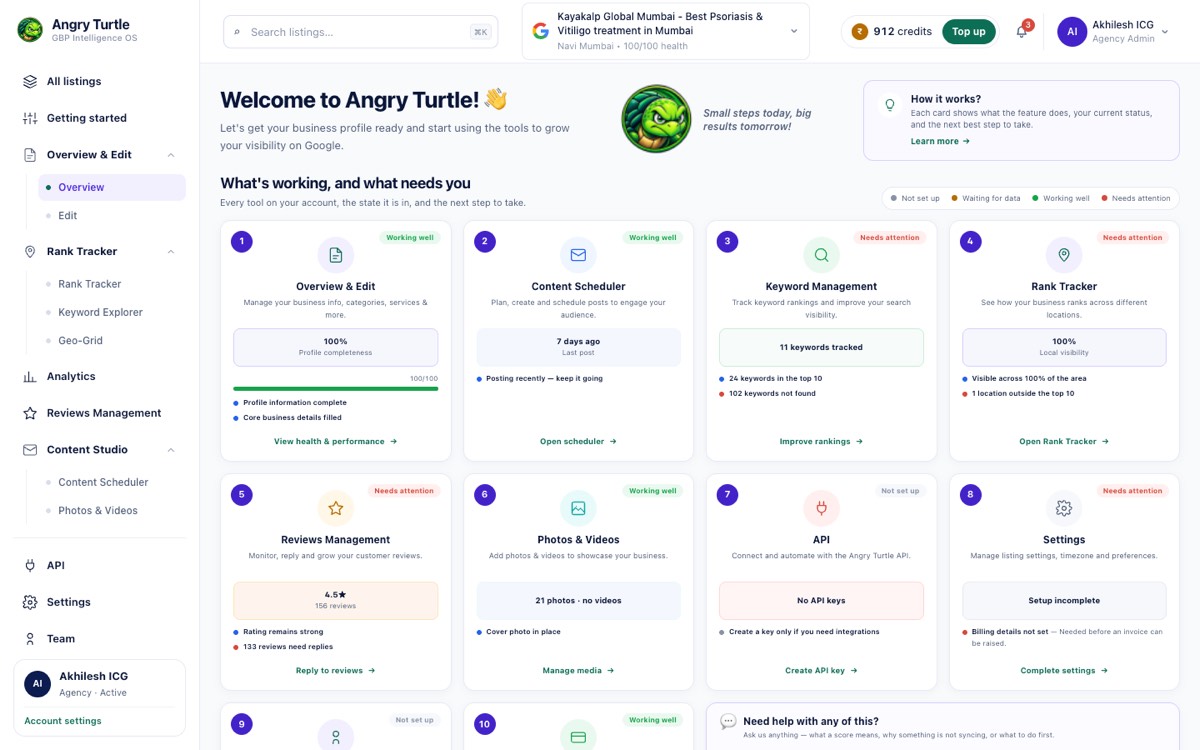

Related reading
Ready to have this run for you?
Book a free audit — we'll show you where you stand in 48 hours.