 Angryturtle
A restaurant chain with six branches asked us once whether they should hire a marketing coordinator to handle their Google Business Profiles or just pay an agency. The honest answer was neither option alone — they needed someone with two hours a week and a system that told that person exactly what to do, which is a different question from "in-house or agency" entirely. Most businesses frame this as a binary when it's really a question about time, skill, and how many locations are involved.
What in-house actually requires
Running local SEO in-house means someone on staff, usually a marketing generalist or the owner themselves, learns the mechanics: category selection, NAP consistency across directories, posting cadence, and review response. None of this is technically hard, but it is time-consuming in a way that competes directly with whatever else that person's job actually is, and it's the first thing that slips when the business gets busy — which is exactly the wrong moment for a profile to go stale.
The advantage of in-house management is speed and knowledge. Nobody understands your business's actual services, seasonal quirks, and customer voice better than someone who works there, and that shows up in review replies and post copy that sound like a real person rather than a generic template. The disadvantage is that most staff learn local SEO through trial and error rather than structured training, and a single person managing it has no backup when they're on leave or move to a different role — the knowledge often walks out the door with them.
Our complete profile optimisation guide and first local SEO plan are written specifically for the in-house case: someone doing this themselves for the first time, with no agency shorthand assumed.
What an agency actually adds
An agency brings pattern recognition across many accounts — they've seen what a suspension looks like before it fully happens, they know which category mismatches actually trigger enforcement versus which ones are cosmetic, and they've built the muscle memory that a single in-house person managing one profile never gets the reps to build. Reading our GBP performance data guide is something an agency does across dozens of accounts a week; an in-house owner does it once a month if they remember to.
The tradeoff is cost and distance. An agency doesn't know your business the way staff do, and the quality of an agency's output depends heavily on how much actual context you give them versus how much they're guessing. A retainer without a clearly written scope is where this goes wrong most often — the agency delivers what they think "management" means, which may not match what you actually needed.
Where the number of locations changes the answer
For one or two locations, the calculation usually favours whichever option the business has genuine bandwidth for. A busy owner with zero spare hours needs an agency or a very lightweight self-serve tool, full stop — the math on hiring dedicated in-house staff for one location rarely works out. A business with someone who has two structured hours a week and a real interest in learning the mechanics can absolutely do this in-house with the right platform doing the heavy lifting.
For ten or more locations, agency or dedicated in-house infrastructure becomes close to mandatory, because manual, unsystematic management simply doesn't scale past a handful of profiles without something breaking — a missed review here, a stale category there, multiplied across dozens of listings. This is where enterprise multi-location governance and our multi-location local SEO services content becomes relevant, because the operational question shifts from "who does the work" to "what system prevents inconsistency across branches."
Franchise and multi-brand operations face a specific version of this problem: each branch may have a local manager who wants some autonomy over their own profile, while the parent brand needs consistency and oversight across all of them. Bulk operations via the GBP API exist precisely for this middle ground, letting a central team push consistent changes while individual locations still get local flexibility where it matters.
The third option most businesses don't consider
The framing "in-house or agency" skips the option that fits most real businesses best: in-house ownership backed by a platform that does the diagnostic and execution work, so the person managing it doesn't need years of accumulated agency-side pattern recognition to be effective. Angryturtle's Rank OS turns "what should I do this week" into a ranked list — the top actions by expected point lift across Relevance, Review Health, Freshness, Entity Authority, and AIO Readiness — so an in-house person with two hours doesn't need to reinvent an agency's institutional knowledge from scratch.
For businesses that do choose an agency, the same platform underneath removes a lot of the trust gap: Agency OS gives the client a white-label portal showing the actual Rank OS score and what moved it, rather than a monthly PDF summarising work that's hard to verify happened. And because edits write directly to Google rather than sitting in a queue, both an in-house manager and an agency account manager are working from the same live system, not a disconnected reporting layer bolted on top of the real platform.
Making the actual decision
Count the hours you actually have available, not the hours you wish you had. Be honest about whether anyone on staff has the discipline to do this consistently rather than in bursts around slow weeks. And if you do go with an agency, insist on a written retainer scope before signing, since an unscoped agency relationship has most of the disadvantages of in-house management (inconsistency, unclear accountability) with none of the cost savings.
Frequently asked questions
Is it cheaper to manage local SEO in-house than to hire an agency? Usually, in raw dollar terms, if the person doing it already has capacity and doesn't need to be hired specifically for the role. It stops being cheaper the moment you have to hire someone new just to handle it, since that person's full salary should count against the comparison, not just the hours they spend on GBP work.
Can a franchise let each location manage its own profile while keeping brand consistency? Yes, with the right infrastructure. Bulk operations tools let a central team enforce brand-level consistency on things like name format and category, while individual locations retain control over local posts, photos, and review responses that reflect their own community.
How do I know if my in-house person is actually doing local SEO well? Look at whether the profile posts regularly, whether reviews get replied to within a few days rather than weeks, and whether the category and services list have been revisited in the last six months. A Rank OS-style score removes the guesswork by giving a specific number and specific actions tied to it, rather than relying on a gut feeling.
Should I switch from agency to in-house once I feel confident in the mechanics? It's a reasonable path for a single-location business that's learned the fundamentals and has the ongoing time to sustain it. For multi-location or franchise operations, the coordination overhead across branches usually still favours dedicated infrastructure or agency support even once the mechanics are well understood.
Stop guessing where you rank locally.
Rank OS scores your Google Business Profile the way Google's local algorithm does — relevance, review health, freshness, entity authority and AIO readiness — and shows you exactly what to fix.
Book a live demo →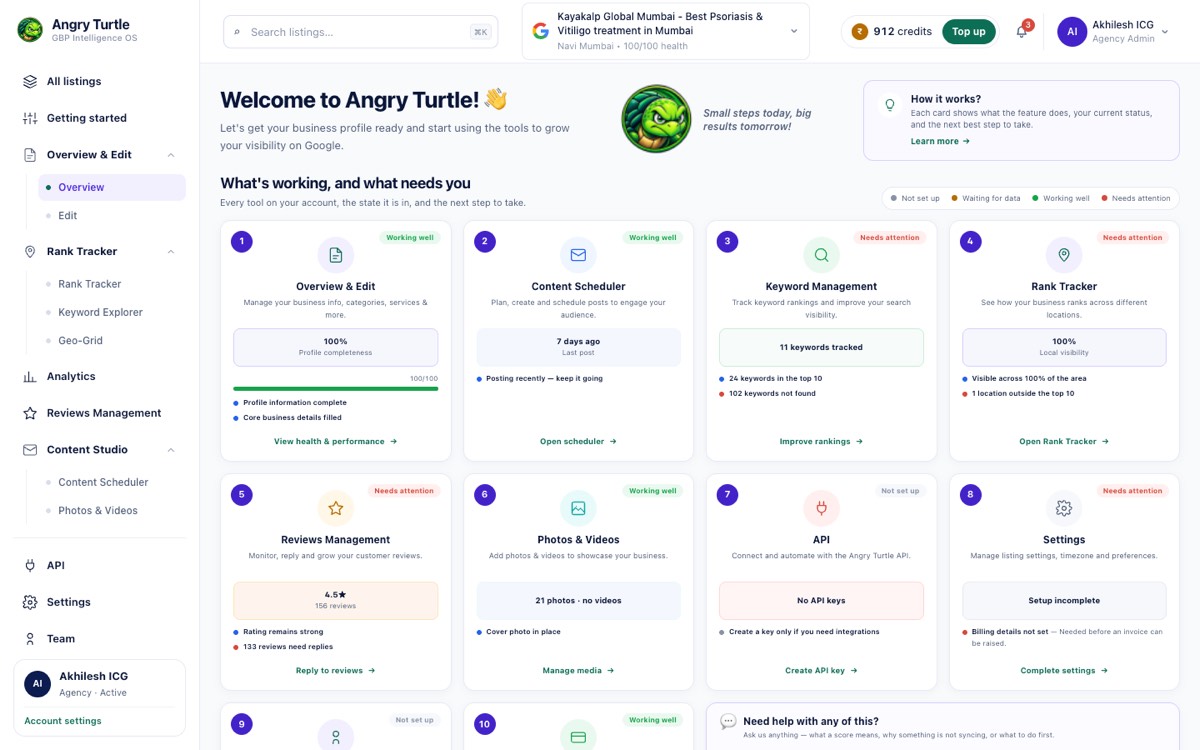

Related reading
Ready to have this run for you?
Book a free audit — we'll show you where you stand in 48 hours.