 Angryturtle
Reporting a Competitor Who Keyword-Stuffed Their GBP
·
Google lets you report a Google Business Profile for keyword-stuffing directly through Maps, using the "Suggest an edit" or "Report a problem" flow on the listing itself. Whether Google acts on the report, and how fast, is entirely up to their moderation team — filing it correctly just gets your case in front of the right process.
Keyword-stuffing on GBP usually looks like a business name padded with services and location terms it doesn't legitimately need: "Sharma Electricians — Best 24/7 Emergency Electrician Delhi NCR Cheap Rates" instead of just "Sharma Electricians." It's against Google's guidelines, it's a genuinely common tactic among competitors chasing quick relevance wins, and it's more fixable through reporting than most business owners realize.
What actually counts as a violation
Google's business name policy is specific: the name field should reflect your real-world name, not a marketing tagline. A business appending "Best," a service list, or a city name to their actual trading name is violating that policy directly, and it's distinct from a legitimately long business name that happens to include a location as part of its real, registered name.
The same abuse shows up in categories too — a business claiming a dozen loosely related secondary categories purely to widen its search footprint, several of which don't genuinely describe what it does. GBP categories exist as a fixed, defined list precisely so that relevance stays meaningful; padding them dilutes that for everyone, including honest competitors in the same space. Choosing a GBP category explains what legitimate category selection looks like, which is the contrast worth having in mind when you're assessing whether a competitor crossed the line. A business this aggressive on names and categories has also often edited other fields in ways that read as a pattern rather than an isolated slip, which is one of several signs covered in GBP suspension reasons.
Building the report that actually gets attention
A vague report ("this business is spamming") rarely moves. A specific one — the exact violating text, a screenshot, and which guideline it breaks — gives Google's moderation team something concrete to act on. Screenshot the listing name and the category list as they currently appear, since businesses sometimes revert a stuffed name temporarily if they suspect a report is coming, then re-add it once reviewed.
File the report through the "Suggest an edit" flow on the listing in Google Maps, choosing the option closest to "Business information is incorrect" or the equivalent name-violation category available at the time you file. Multiple independent reports on the same listing tend to carry more weight than a single one, though Google doesn't publish exact thresholds for how many reports trigger a review.
What happens after you report it
This is the part worth being honest about: the outcome is Google's decision alone. Some name violations get corrected within days once flagged. Others sit for weeks, particularly if the business has otherwise clean signals and the violation is borderline rather than blatant. A small number never get actioned even when they're clearly against guidelines, which is a real limitation of the reporting system, not a sign you did anything wrong in filing it. In more severe or repeated cases, Google occasionally suspends the listing outright rather than just correcting the name — fixing a suspended Google Business Profile is the process on the other side of that outcome, though obviously not one you'd be running for your own listing here.
While you wait, the more productive use of your time is usually your own listing, not repeatedly re-reporting the same violation. GBP ranking factors and the underlying local ranking factors Google weighs cover what actually moves your own relevance score regardless of what a competitor is doing, and closing your own gaps tends to compound faster than waiting on someone else's correction.
Competing against a stuffed listing while it's still live
A keyword-stuffed name can produce a real short-term relevance bump, which is exactly why competitors do it despite the guideline risk. Your response isn't to copy the tactic — that risks your own listing — it's to close the gap through the levers that are actually within your control: a fully filled-out secondary category list, a specific and accurate business description, and consistent review generation. Competitor ranking higher on Google Maps covers the broader version of this if keyword stuffing is only part of what's driving the gap between you.
Running a structured competitor comparison — reviews, categories, citation presence — makes it easier to tell how much of the gap is the keyword stuffing specifically versus other factors you should be addressing regardless. Competitor analysis automates that comparison across your top local rivals rather than checking each one manually.
How Angryturtle helps here
Beyond identifying where a competitor is genuinely outperforming you through legitimate signals, Rank OS scores your own listing across five weighted dimensions so you know exactly which lever to pull rather than guessing. For the reporting side specifically, local competitor analysis walks through documenting a violation properly, though filing and following up with Google is something every business does directly with Google itself — there's no way for a third-party tool to file or expedite that report on your behalf.
GBP management services covers ongoing competitive monitoring if you'd rather have violations and gaps flagged automatically instead of noticing them only when you happen to check.
Frequently asked questions
Will reporting a competitor's keyword-stuffed name actually get it removed? Sometimes, but not always, and not on a predictable timeline. A well-documented report improves the odds; it doesn't guarantee action.
Can I get in trouble for reporting a competitor? No, as long as the report is accurate and made in good faith. Filing false or exaggerated reports repeatedly can affect your own account's standing with Google's moderation systems, so only report genuine violations.
Is a long business name always a violation? No. Some businesses genuinely have long registered names, and that's not the issue. The violation is padding the name with marketing language, service lists, or location keywords that aren't actually part of the real business name.
Should I match the competitor's tactic while I wait for a resolution? No. It risks your own listing under the same guidelines, and a temporary bump from a stuffed name isn't worth the suspension risk if your own report or someone else's eventually gets Google's attention on the practice generally.
What if the same competitor keeps re-adding the keyword after each correction? Repeated violations on the same listing are worth re-reporting each time, ideally noting the pattern in the report itself. Persistent abuse is more likely to eventually trigger a stricter review than a single isolated incident.
Stop guessing where you rank locally.
Rank OS scores your Google Business Profile the way Google's local algorithm does — relevance, review health, freshness, entity authority and AIO readiness — and shows you exactly what to fix.
Book a live demo →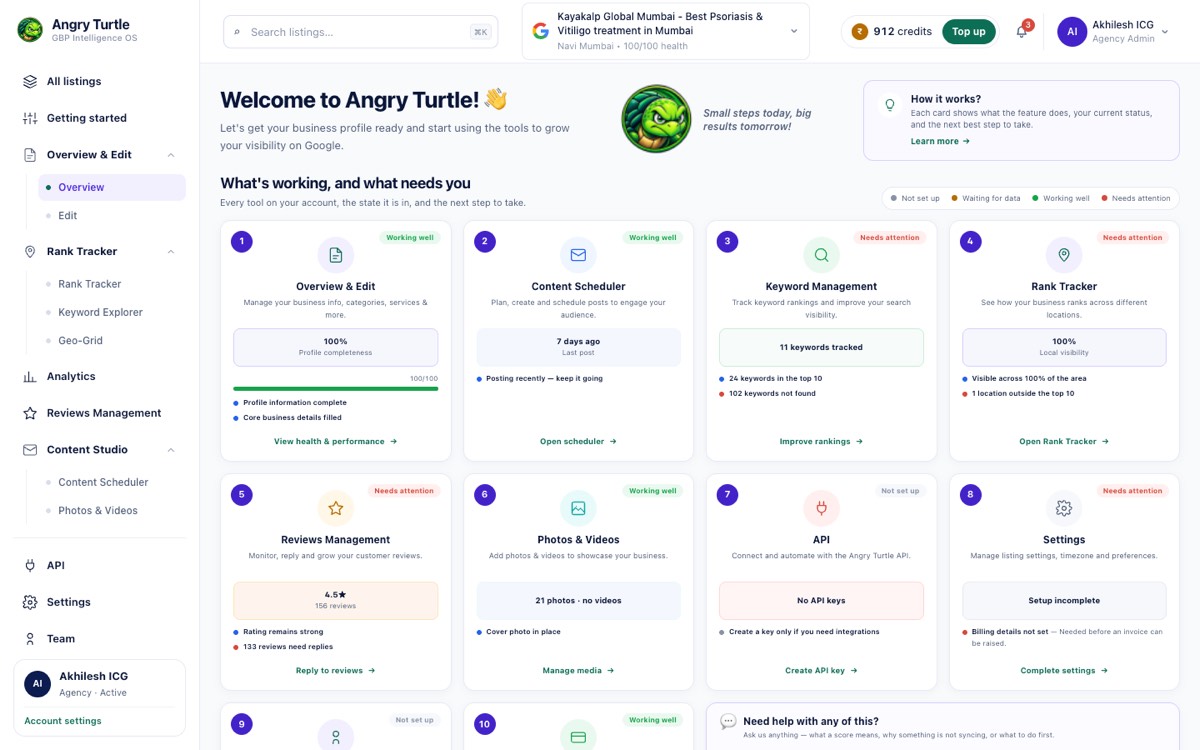

Related reading
Ready to have this run for you?
Book a free audit — we'll show you where you stand in 48 hours.