 Angryturtle
Best Local SEO for Coaching Institutes in India
How coaching institutes rank higher on Google Maps in India. GBP management, admission-season campaigns, review generation from students, and city-page strategy.
·
Local SEO for Indian coaching institutes: the admission-season playbook
Coaching institute demand in India moves in sharp seasonal waves rather than a flat baseline. JEE and NEET admissions run November through January for advance courses and February through April for foundation batches. The post-board-result surge hits May and June for most students. Outside those windows, search volume drops off noticeably. Institutes that dominate local search during the actual peaks capture most of the season's enrolments — the rest of the year is largely about maintaining position, not winning it. Local SEO for coaching institutions runs on this same seasonal calendar, whether the institute calls itself a coaching centre, an academy, or a test-prep institution in its own marketing.
Getting category and services right
Category choice depends on what the institute actually teaches. General coaching fits "Tutoring Service" or "Education Centre." A dedicated JEE or NEET specialist should use "Test Preparation Center" where that category is available in the local geography. A language institute pairs "Language School" as primary with "Tutoring Service" as secondary. Computer training uses "Computer Training School." Management coaching pairs "Business School" with "Tutoring Service."
The services list matters more here than in most categories, because it's where specificity does real work. Each course needs its own service entry rather than a single generic line — JEE Advanced preparation, NEET UG coaching, Class 11 Science foundation, IELTS preparation, and CAT coaching each listed separately, with a description that naturally works in the exam name, course duration, and whatever actually differentiates it, whether that's batch size or a strong result record.
Attributes worth completing include online-plus-offline availability, hostel facilities for institutes running residential programmes, weekend batch availability, and demo classes — the last one carries real conversion weight since a demo is often the deciding factor for a hesitant parent.
Running the calendar: what changes by month
Late in the calendar year, as the early JEE batch cycle opens, posts should push early-bird registration with a concrete number attached — "save ₹12,000" reads more credibly than a vague "limited time offer" — alongside a clear deadline on any seat announcement and dates for upcoming free demo classes.
Once the broader admission peak hits in February through April, the emphasis shifts toward proof: weekly posts built around testimonials, past results, and faculty highlights, offer posts announcing scholarships, and a Q&A section seeded with the questions parents actually ask before enrolling — fee structure, batch start date, students per batch.
May and June, right after board results land, is the moment to publish the actual numbers: "Our students in board results 2025 — [X]% scored above 90%," paired with new batch announcements and a review-request push aimed specifically at students who just sat their exams, while the result is still the first thing on their mind.
September and October bring the CAT and MBA season, calling for its own batch-launch posts and workshop or demo-class announcements distinct from the JEE/NEET calendar running the rest of the year.
Why students are the best reviewers, and the hardest to time right
A student who hits their target score is often genuinely eager to credit the coaching that got them there — which makes timing the entire game. For JEE and NEET, the window is within 48 hours of the result being declared, while the emotional peak and the instinct to attribute the outcome to the institute are both still fresh. For CAT, the natural window sits post-admission season, once calls from IIMs or other management institutes start coming in. For IELTS or GMAT, within a week of receiving the official score works well.
The ask itself should come from whoever the student actually worked with, not a generic institute number: "[Student name], congratulations on [specific achievement]! Your hard work made this possible. If you have a moment, a quick Google review would really mean a lot — many future aspirants will read it before deciding." And whenever topper results get announced publicly — on social media, on a notice board — that's the exact moment to run a coordinated review-request drive for the whole batch at once, while attention on the achievement is already high.
Running multiple centres without losing the local edge
Different centres in the same brand often carry genuinely different result records, and GBP content should reflect that honestly rather than defaulting to the brand's aggregate numbers everywhere — a centre with a strong local track record loses credibility if its posts only ever cite the national average.
Geography matters at the competitive level too. A Mumbai centre competes inside a Mumbai cluster; a Pune centre competes inside a Pune cluster. Treating both with the same rank strategy ignores that the competitive set, and often the search volume itself, differs meaningfully between the two cities.
Some coaching brands, particularly in IIT-JEE coaching, have individual faculty members who've built their own student following strong enough to justify a dedicated faculty-level GBP profile alongside the centre's. A student searching "Sharma sir coaching" finds both, and losing either half of that search halves the discovery opportunity.
Location pages for multi-city institutes
Institutes with centres in several cities need dedicated location pages — /coaching/jee-coaching-in-delhi/, /coaching/neet-preparation-chennai/ — and each one has to reference that specific centre's batch size, result record, faculty, and facilities. A page that's just the national template with the city name swapped in reads as thin to both users and Google, and risks the same cannibalization problem multi-location businesses run into generally.
Common mistakes in coaching institute local SEO
Publishing results-season posts with the brand's national average when the local centre's actual number would land better and read as more specific. Missing the 48-hour review-request window after NEET or JEE results, when the emotional motivation to leave a review fades within days. Listing "coaching services" as a single generic entry instead of breaking out each course individually. And running identical location pages across five cities with only the city name changed, undermining exactly the local specificity that's supposed to make each page rank.
When should a coaching institute start its admission-season GBP campaign? Roughly a month before the season's early-bird window opens — enough runway to build post frequency before the peak search volume actually hits.
Do faculty-level GBP profiles cause cannibalization with the centre profile? Not usually, provided the two target genuinely different search intent — a named-faculty search versus a general centre search — rather than competing for the same generic keyword.
How many photos should a coaching institute GBP maintain? There's no fixed number, but classroom activity, faculty, results announcements, and facility shots refreshed regularly outperform a static set uploaded once at setup.
Is WhatsApp review generation compliant for a coaching institute? Yes, provided the request asks for honest feedback rather than a specific rating and isn't tied to any incentive.
Is local SEO for coaching institutions any different from local SEO for a single tutoring centre? Not structurally — the same category, services, and review mechanics apply either way. What changes is scale: an institution running multiple branches or faculty-level profiles has to manage cannibalization and calendar coordination across all of them at once, which a single centre never has to think about.
Related reading: local SEO for coaching institute setup covers the operational how-to in more detail, and how to get more Google reviews covers the generation mechanics generally. For the industry hub, see education local SEO. Multi-centre operators should also read multi-location local SEO strategies and keyword cannibalization in local SEO for the location-page risk mentioned above.
Angryturtle manages coaching institute GBPs with admission-season campaign calendars →
Stop guessing where you rank locally.
Rank OS scores your Google Business Profile the way Google's local algorithm does — relevance, review health, freshness, entity authority and AIO readiness — and shows you exactly what to fix.
Book a live demo →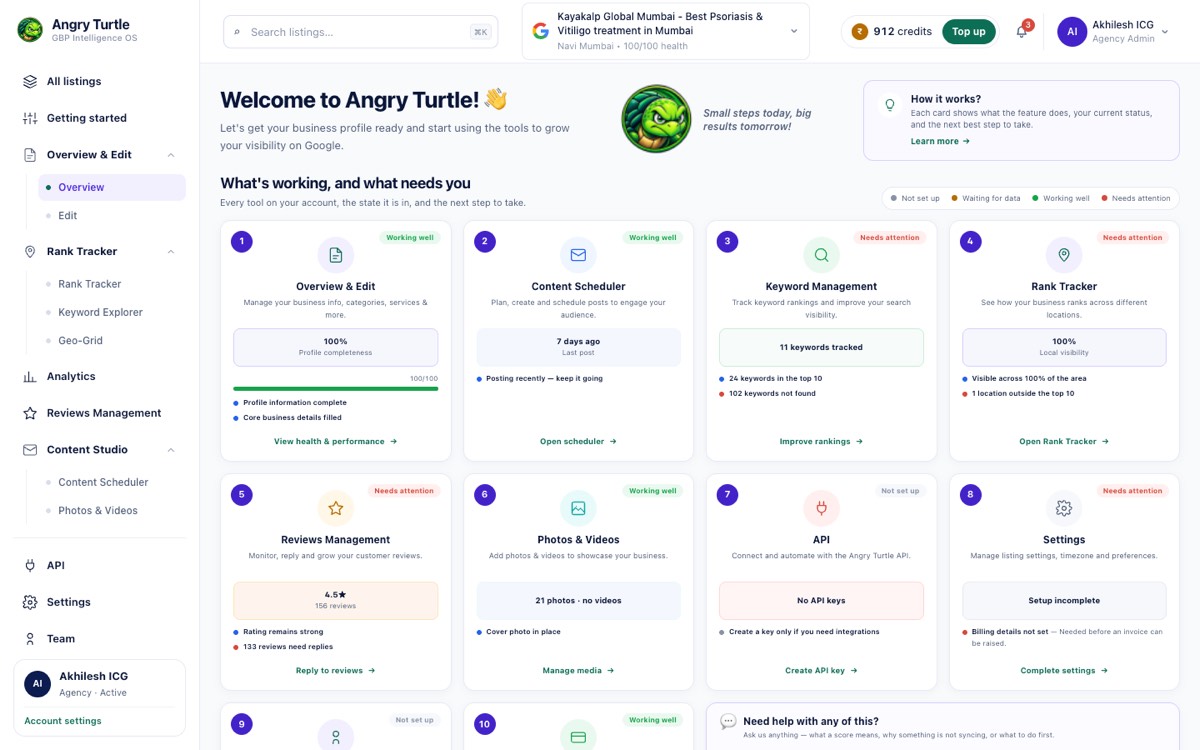

Related reading
Ready to have this run for you?
Book a free audit — we'll show you where you stand in 48 hours.