 Angryturtle
How to Get More Google Reviews (Ethically)
Ethical tactics for generating more Google reviews for Indian businesses. WhatsApp strategies, QR codes, timing guidance, and what Google's policy actually allows.
·
How to get more Google reviews: what Google allows and what actually works in India
Most Indian businesses do one of two things about reviews: nothing, hoping customers review spontaneously, or something that violates Google's policy, like offering a discount for a five-star review. Both underperform, one from inaction and the other from a violation that can eventually get flagged.
This guide covers what Google actually permits, and more specifically, what works given how Indian customers actually behave online.
What Google's policy actually says
Permitted: asking customers to leave a review, reminding customers who haven't yet, following up with people who haven't reviewed, making it easy with QR codes or direct links, and training staff to mention it verbally.
Prohibited: offering any incentive in exchange for a review, asking for only positive reviews, asking customers to review from a business-owned device or IP address, buying reviews from a third party, and creating fake reviews yourself or through associates.
The policy is simpler than most businesses assume: you can ask, you cannot pay. You can make it easy, you cannot manufacture it.
Why generic review tactics underperform in India
Standard playbooks built for Western markets translate poorly here. Email review requests see open rates of just 5 to 15% in India, and most of the people who do open still don't click through to leave a review — the email channel is largely a dead end for this specific ask.
SMS is adequate but not great: open rates are high, but the click-through from an SMS link to an actual Google review page is inconsistent, and a lot of that traffic gets lost at the tap.
WhatsApp beats both by a wide margin. Adoption is near-universal in urban India, and a message from a number a customer already has saved gets a 60 to 80% open rate. Personalised WhatsApp review requests routinely land 20 to 35% completion — three to five times what the same audience returns on email.
The WhatsApp review request playbook
Use WhatsApp Business, free for most volumes, or the WhatsApp Business API for high-volume automation across many locations. Generate a direct review link first: in the GBP dashboard, under "Share your Business Profile," copy the "Ask for reviews" link — it opens straight to the five-star prompt, skipping the search step entirely.
The message itself should be personalised, not a broadcast blast with no name attached: "Hi [Name], thank you for visiting us today! If you have 2 minutes, we'd really appreciate a quick Google review — it helps other patients/customers find us. Here's the direct link: [link]. Thank you!"
Timing depends on the category. Healthcare works best 2 to 4 hours after the appointment, when the experience is still fresh but the patient isn't mid-commute. A restaurant does well at 1 to 2 hours after the meal. Retail can wait 24 to 48 hours after purchase. Coaching institutes should send immediately after a notable milestone — a result, a course completion. Hotels work best 24 to 48 hours after checkout.
If there's no review after 5 days, one gentle follow-up is fine: "Hi [Name], just a quick reminder — if you have a moment, we'd love your feedback on Google. [link]." One follow-up only — a second nudge starts to read as pressure rather than a reminder.
QR codes: generation and placement
Point any QR generator at your direct review link and test it on a few different phones before printing — a QR that resolves fine on one Android model can occasionally misbehave on an older device. Good placement spots include the reception desk (a small laminated stand), restaurant tables (alongside the menu QR), the bottom of a receipt or invoice, an insert in every shopping bag, a waiting-room poster, and a clinic's exit area, where patients on their way out are a captive, relaxed audience.
Staff-led review generation
A frontline staff member's verbal request, delivered naturally, is one of the most effective tactics available, and it's free. What works sounds like: "If you enjoyed your experience today, a quick Google review would really help us. I can send you the link on WhatsApp if you'd like." Casual, offered rather than pushed.
What doesn't work sounds like: "We need reviews, please go on Google and leave us 5 stars before you leave." Pressured, awkward for the customer, and a pattern Google's systems are increasingly good at flagging when it produces a burst of suspiciously similar five-star text.
Build the request into customer service training as a single sentence at the natural end of a positive interaction — after the customer has already expressed satisfaction, never as a cold opener.
Review generation in regulated industries
For healthcare, BFSI, and other regulated categories, the request has to ask for honest feedback, not specifically positive feedback. A healthcare-safe version reads: "Hi [Patient name], we hope your appointment went well. If you'd like to share your experience at our clinic on Google, here's the direct link: [link]. Your honest feedback helps other patients." What's never acceptable in a regulated category: "Please give us 5 stars so other patients can find us," which crosses from a neutral ask into a prescriptive one.
Making review generation actually run without being manual
Most of what breaks review generation isn't the messaging, it's follow-through — nobody sends the WhatsApp message on day one, or the QR code at reception is three months out of date and points to a defunct link. Angryturtle's platform automates the timing and dispatch side of this (and, separately, can publish the review responses themselves straight to a business's live GBP — write-back to Google is confirmed working), which is what turns a playbook like this from a document nobody follows into something that actually runs every day across a location or a whole network of them.
Common mistakes in review generation
Sending the request too late, once the specific experience has faded from a customer's mind. Using the generic "search us on Google" link instead of the direct review link, which adds friction and loses people at the search step. Sending more than one follow-up, which tips into pressure. And running the exact same request wording across a healthcare, retail, and hospitality client alike, when the regulated categories specifically need the honest-feedback framing rather than the more casual retail version.
Can I ask customers by phone instead of WhatsApp? Yes, and it works, but it depends entirely on the person making the call remembering to ask — WhatsApp scales better because it doesn't rely on a live conversation happening at the right moment.
Is it against policy to remind a customer more than once? A single, gentle follow-up is within Google's guidelines. Repeated reminders start to look like pressure, which risks the spirit if not the letter of the policy.
Do QR codes actually convert better than a printed link? Generally yes, purely on friction — typing a URL by hand loses people that a scan doesn't.
How many reviews should a new business aim for before it starts seeing local pack benefit? There's no official Google number, and treating any fixed figure as a real threshold is a guess. The more reliable approach is checking the review counts of whoever's actually ranking well in the local pack for your category and city, and using that as the working target — what counts as "enough" in a crowded metro category is a very different number from what counts as enough in a thinner Tier 2 market.
Related reading: respond to negative reviews covers the other half of review management, and review generation strategy goes deeper on the systems side. For regulated categories specifically, see healthcare reputation management. For a channel-specific deep dive, review request via WhatsApp covers the mechanics in more detail. Businesses setting up review generation as part of a new profile should also read how to set up a Google Business Profile in India and review velocity and local SEO.
Angryturtle manages review generation for all managed clients →
Stop guessing where you rank locally.
Rank OS scores your Google Business Profile the way Google's local algorithm does — relevance, review health, freshness, entity authority and AIO readiness — and shows you exactly what to fix.
Book a live demo →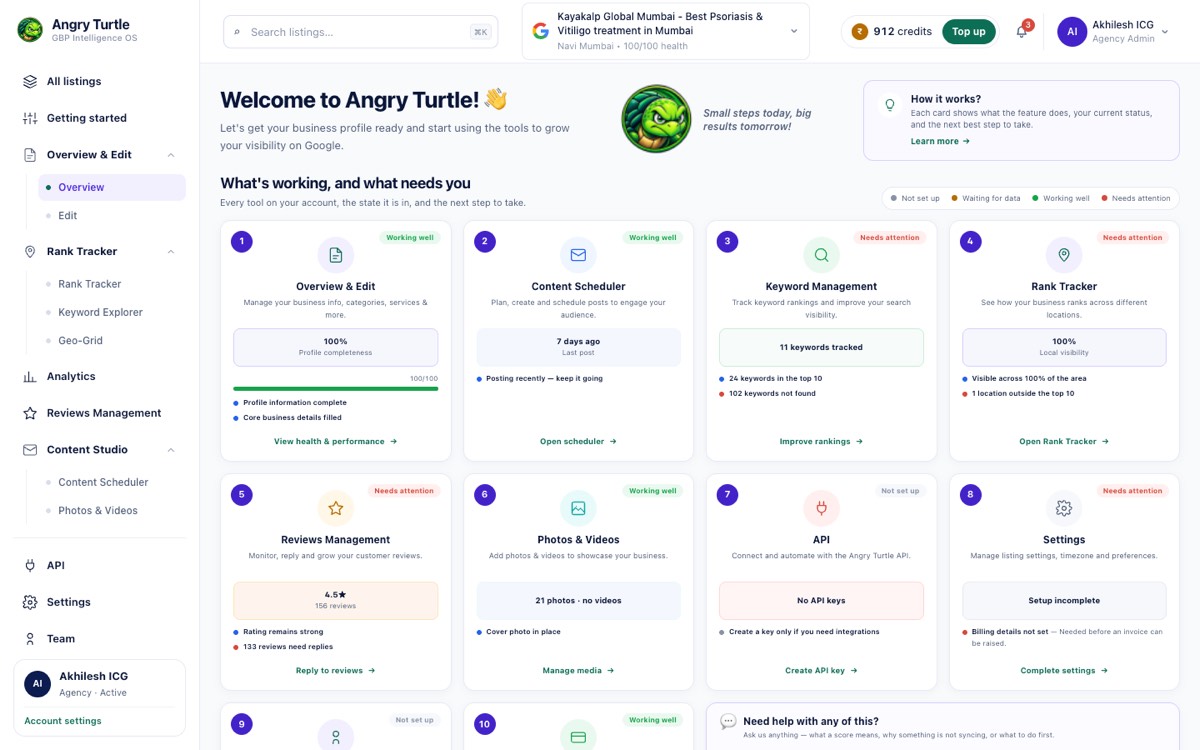

Related reading
Ready to have this run for you?
Book a free audit — we'll show you where you stand in 48 hours.